

What Furniture Repair in Richardson, TX Actually Looks Like
A dining chair that rocks on three legs. A dresser drawer that gave out when a teenager yanked it too hard. An heirloom side table with a gouge the size of a quarter, left from the last move. These are the calls we get from Richardson homeowners every week at Andrew’s Refinishing, and they share something in common: every one of those pieces is worth saving.
Our furniture repair services for the Dallas-Fort Worth area have been handling structural fixes, joint rebuilds, finish blending, and cane replacements since John founded the shop in 1980. We work out of our Carrollton workshop at 2425 Parker Rd. Bldg. 5, and we pick up and deliver across Richardson and the surrounding North Dallas corridor. This post covers the specific repair services we offer, what each one involves, what you can expect to pay in 2026, and how our photo-based quoting process makes getting an honest number quick and painless.
A companion post covers the broader restore-versus-replace question in depth. Here, we stay focused on the practical repair menu and the quoting process, so you know exactly what you’re getting into before you call.
The Repair Menu: What We Fix for Richardson Customers
Re-Gluing Loose Joints and Wobbly Frames
A wobbly chair is almost never a “throw it out” situation. The frame itself is usually fine. What has failed is the glue in the mortise-and-tenon or dowel joints, which dries out and loses grip over years of use, humidity swings, and the simple physics of sitting down hard after a long day.
Re-gluing a loose joint properly requires fully disassembling the affected section, cleaning the old adhesive from both mating surfaces, and reassembling with fresh glue under controlled clamping pressure. Skipping any of those steps produces a repair that lasts six months. We don’t skip them. According to WoodnBits’ guide on reinforcing loose furniture joints, combining mechanical reinforcement with fresh adhesive consistently outperforms glue-only fixes for joints that bear regular load. That’s why, on chairs and frame sections that take real weight, we often add a dowel alongside the fresh glue bond.
A single dining chair with one or two loose joints typically runs $275-$375 all-in for repair, depending on how many joints need attention and whether finish blending is required where we’ve opened the frame. A full set of six chairs with widespread loosening lands closer to the $1,500-$2,000 range.

Dowel Replacement and Structural Re-Pinning
When a joint has failed completely, or when the original wooden peg has sheared off inside the socket, re-gluing alone won’t restore the structural integrity. We drill out the old dowel, bore fresh matched holes in both pieces, and drive new hardwood dowels, sized to the joint, with adhesive on all contact surfaces.
This is especially common on older dining chairs (pre-1980s construction often relied on dowels exclusively rather than mortise-and-tenon) and on beds where the side rail brackets have pulled free. The result is a joint that frequently tests stronger than the original factory connection, because we’re using fresh dowels cut to exact diameter rather than relying on an aged fit.
Richardson homes from the 1970s and 1980s often contain exactly this type of furniture: well-built pieces from American manufacturers that used dowel joinery throughout. Forty years of use takes its toll on any adhesive, but the frames themselves are sound. That’s the definition of a repairable piece.
Broken Legs and Apron Repairs
A broken leg is a more serious structural problem, but it’s rarely hopeless. If the break is clean and the wood on both sides is undamaged, we can re-glue and reinforce with an internal pin or dowel that runs across the break line, making the repaired section effectively monolithic. The repair site gets finish-blended to match the surrounding wood.
If the leg is shattered or the wood has compressed at the break point, replacement is sometimes the honest call. We source replacement stock from suppliers who carry period-appropriate hardwoods, including oak, walnut, cherry, and mahogany, and turn or shape the new leg to match the original profile before staining and finishing to blend. Family Handyman’s guide on using epoxy for wood repairs explains why two-part epoxy consolidants are often used as a prep step when wood has compressed or degraded at a stress point before any mechanical reinforcement goes in. We follow the same approach for compromised wood before pinning.
Two-Part Epoxy Gouge and Chip Fills
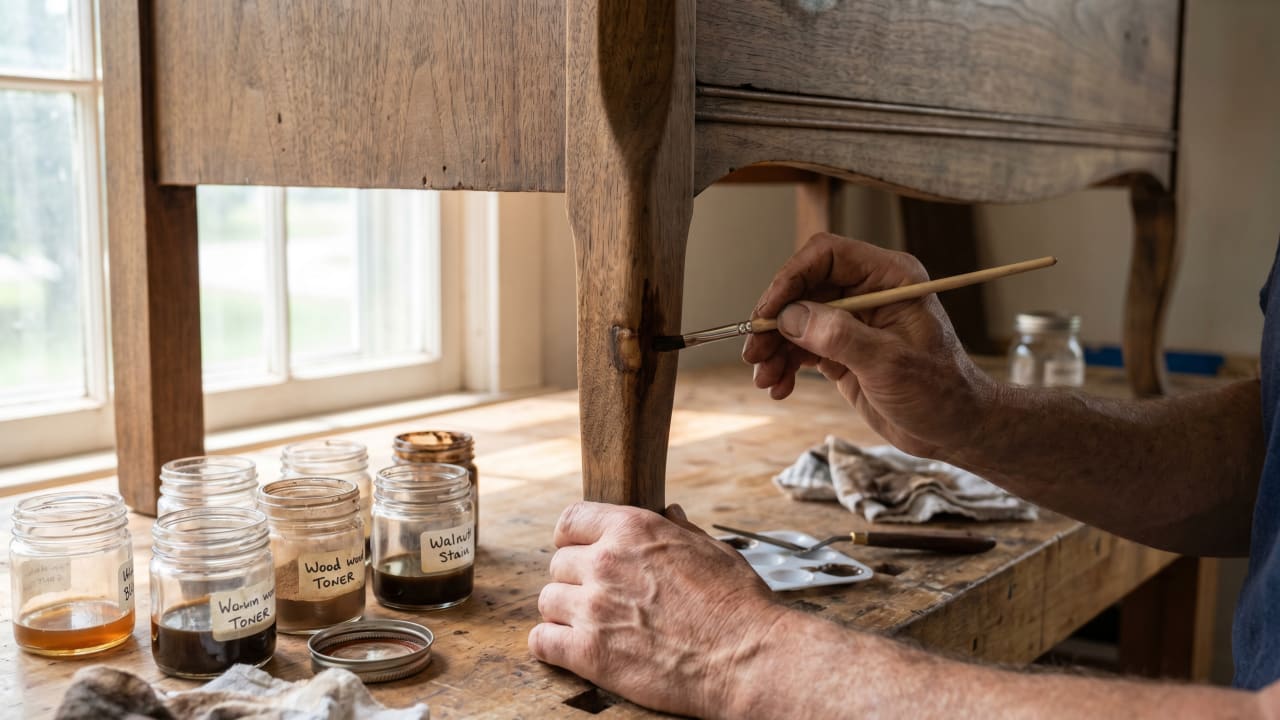
Gouges, deep chips, and missing corners on furniture parts, including legs, rails, case sides, and drawer fronts, are repaired with professional-grade two-part epoxy filler. The process: clean the damaged area, apply the mixed epoxy slightly proud of flush, let it cure fully, then sand back and carve to match the surrounding profile. Once the shape is right, the patch gets color-matched by hand with toners and glazes applied directly to the piece.
The key here is that color matching happens on your actual furniture, not against a sample card. Wood varies, and the stain or finish on a 20-year-old piece has aged and patinated. We match to what’s in front of us, not to what the manufacturer’s spec sheet said in 2004. For case pieces and chair parts, this approach produces a repair that reads as invisible at normal viewing distance. One exception: we don’t touch up tabletops or dresser tops in isolation. Tops always get a full strip and refinish, because spot repairs on horizontal surfaces that take daily use never hold up the way a full-surface finish does.
Veneer Patching and Re-Gluing
Lifting or chipped veneer is one of the most common calls we get, and one of the most satisfying repairs to complete. The process involves carefully re-adhering lifted sections with fresh adhesive and clamping, or, where veneer has chipped or torn away, cutting a matched patch from veneer stock and scarfing it into the void.
One clarification that surprises some customers: real-wood veneer over a particleboard or MDF substrate is very much something we work with. A large share of furniture made since the 1980s uses this construction method, and veneer on a stable substrate is entirely repairable. What we don’t do is structural repair on a particleboard core that has swollen, delaminated, or crumbled from moisture damage, because the substrate itself is compromised beyond what adhesives and mechanical fasteners can correct. If the substrate is sound and only the face veneer is damaged, we can fix it.
Cane and Rush Seat Replacement
Traditional woven seats have a lifespan. Natural cane lasts roughly 15-20 years before it becomes brittle, and rush lasts somewhat longer under gentle use. When cane or rush breaks down, the replacement process starts with removing all the old material down to the bare frame, inspecting the frame joints while the seat is open (a good opportunity to catch loose glue that would have been the next problem), and weaving the new material.
We replace hand-cane, sheet cane, and natural rush. Hand caning is the most labor-intensive: each individual strand is woven through holes drilled around the seat perimeter, a process that takes 8-20 hours depending on seat size. Sheet cane, the pre-woven mat held by a spline, is faster but requires careful spline-fitting to hold properly. According to Mumford Restoration’s guide on woven chair seats, rush seats woven correctly can last 30-60 years. The longevity is worth the investment, especially on antique or heirloom chairs where the woven seat is part of the piece’s visual identity.
One note on scope: we do cane and rush, not wicker or vinyl webbing. If your chair has woven reed or paper rush over a wicker frame, that’s a different trade with different materials, and not something we take on.
Finish Blending and Color Matching on Parts
After any structural repair, there’s usually a finish question: the area we worked on looks different from the surrounding surface because we’ve sanded, stripped, or opened wood that hasn’t seen air in decades. Finish blending brings the repaired area back to a visual match with the rest of the piece.
We use dye-based and pigment stains to build color, then apply a lacquer topcoat, our standard residential finish, over the blended area. The lacquer is built up to match the surrounding sheen level. Color matching on wood is an art, not a formula. We cannot stain lighter than the natural color of the wood, so if the existing finish is very dark and the new wood or repaired area is lighter, we work within the chemistry of what’s possible and communicate that clearly before we start.
How the Quoting Process Works in Richardson: Honest Numbers Before You Commit
One of the things Richardson customers consistently mention in our reviews is that the estimate they received was the number on the final invoice. That’s not an accident. We built our quoting process around giving you a binding number from photos before anything gets loaded into a truck.
Here’s how it works: you send photos of the damage through our free online estimate form. We look at what you’ve got, ask any follow-up questions we need, and come back with a firm price for the repair. No in-home visit required, no vague “starting at” language, no surprise add-ons when we open the piece at the shop. If something unexpected turns up once we’re working, we call you before we proceed.
Good photos make a difference. Shoot in daylight, include the damage from straight on and at a 45-degree angle to show depth, and photograph the whole piece so we understand the scale and construction. A clear picture of a broken joint tells us almost everything we need to quote it accurately.
For pickup and delivery in Richardson, the starting rate is $250 round trip from our Carrollton workshop. We handle the logistics from your front door to the shop and back. For straightforward cushion-only jobs, we’d prefer you drop the cushions off at the shop, since there’s no frame to protect in transit, and drop-off keeps costs down for you.
What to Expect: Lead Times and the Shop Process
Once a piece arrives at the Carrollton workshop, it goes through intake: we document the existing condition with photos, confirm the approved scope of work, and slot it into the queue. Single-piece structural repairs typically complete in 4-6 weeks. More involved work that combines structural repair with a full strip and refinish runs 5-6 weeks. Cane replacement adds time based on the seat count and pattern complexity.
We’ll give you a realistic completion window when we take in the piece, and we contact you when it’s ready. No chasing, no mystery. The shop has been running this way since John opened it in 1980, and the process is the same today.
When the piece comes back, the finish will have had time to fully cure in a controlled environment. Lacquer hardens progressively for several weeks after application. We time the return to your home so the piece is handling-ready, and we give you care guidelines so you’re not putting it back into full use before the finish has reached its full durability.
When Repair Makes More Sense Than Replacement
The furniture repair and restoration industry has seen consistent growth over the past several years, driven in part by homeowners who have done the math on replacement. Angi’s 2026 furniture repair cost data puts professional furniture refinishing in the $150-$1,550 range depending on complexity, which frequently undercuts the cost of a comparable new piece by a wide margin, especially for solid-wood or heirloom furniture that would cost $2,000-$5,000 to replace with something of equivalent quality.
The calculation gets even clearer for pieces with sentimental value. A grandmother’s dining set isn’t replaceable at any price point. A mid-century credenza in genuine walnut veneer over a solid-wood frame is a different object from the particleboard-and-foil-print versions selling at big-box stores today. Repairing what you have almost always produces a better piece than buying new at a comparable budget.
The honest answer on when to replace: if the primary structural members are made from MDF or particleboard without a real-wood face, and that core material has absorbed moisture and swollen or crumbled, repair is not economical. We’ll tell you that plainly. We’re not interested in taking money for a repair that’s going to fail. But that scenario is less common than people think, because most furniture that’s worth saving is worth saving for a reason.
Serving Richardson and the Surrounding North Dallas Area
Our pickup and delivery route covers Richardson, TX and the communities around it. We regularly serve North Dallas, Plano, Garland, Addison, and University Park, in addition to our home base in Carrollton. If you’re unsure whether we come to your neighborhood, call 214-731-3060 or drop us a note through the estimate form and we’ll confirm.
Richardson’s housing stock includes a significant share of established ranch-style and traditional-construction homes from the 1960s through the 1990s, and with that housing comes the furniture those decades produced: solid-wood dining sets, mid-century bedroom suites, and traditionally framed upholstered pieces. That’s exactly the kind of work our Carrollton workshop has been built around for 45 years. We understand how those pieces were made, how they fail, and how to bring them back.
For a broader look at our furniture refinishing services across the Dallas area, including full strip-and-refinish work on case pieces and dining sets, that page covers the scope in detail. And if you want to see the kind of work we do before you call, our customer reviews include descriptions of real jobs from real customers across the DFW metro.
Frequently Asked Questions: Furniture Repair in Richardson, TX
How much does furniture repair cost in Richardson, TX?
For single-piece structural work, most repairs run $275-$650 depending on the scope. A single dining chair with loose joints is typically $275-$375. More involved repairs, like a broken leg replacement or combined joint and finish work, land toward the upper end of that range or above. We provide a firm, binding quote from photos before any work begins, so there are no surprises at pickup.
Do you offer pickup and delivery in Richardson?
Yes. We pick up and deliver across Richardson and the surrounding North Dallas area. Pickup and delivery starts at $250 round trip from our Carrollton workshop. For cushion-only jobs, we prefer you drop them at the shop, since there’s no frame in transit and it keeps the cost down for you.
How long does furniture repair take?
Most single-piece structural repairs complete in 4-6 weeks from intake at our Carrollton workshop. If the repair includes a full strip and refinish, allow 5-6 weeks. Cane and rush replacement timing depends on the seat count and pattern. We give you a realistic completion window when we take in the piece.
Can you repair furniture made with particleboard or MDF?
It depends on the construction. If the piece has real-wood veneer over a particleboard or MDF substrate and the substrate is structurally sound, we can repair the veneer, fix the joints, and refinish the piece. Where we draw the line is structural repair on a core that has swollen or crumbled from moisture, because no adhesive restores a compromised substrate. We’ll assess from photos and tell you honestly what’s repairable before you commit.
Do you replace cane seats for Richardson customers?
Yes. We replace hand-cane, sheet cane, and natural rush seats at our Carrollton workshop and serve Richardson customers via pickup and delivery. We don’t do wicker or vinyl webbing replacements. If your chair has traditional cane or rush seating that has broken down over time, send us photos through the estimate form and we’ll give you a firm price.
Get a Binding Quote for Your Furniture Repair in Richardson
If a piece in your home needs structural repair, a cane replacement, or finish work after an old repair went wrong, start with photos. Our free online estimate is fast, specific, and binding. You’ll know the number before anything moves.
Richardson homeowners can request a free online estimate here, or call the shop directly at 214-731-3060. We pick up across Richardson, North Dallas, Plano, Garland, Addison, and University Park. You can also find directions and hours at our location and contact page.
Forty-five years of furniture repair in the DFW area, under the same family, at the same Carrollton workshop. That’s the credential behind every quote we give.