
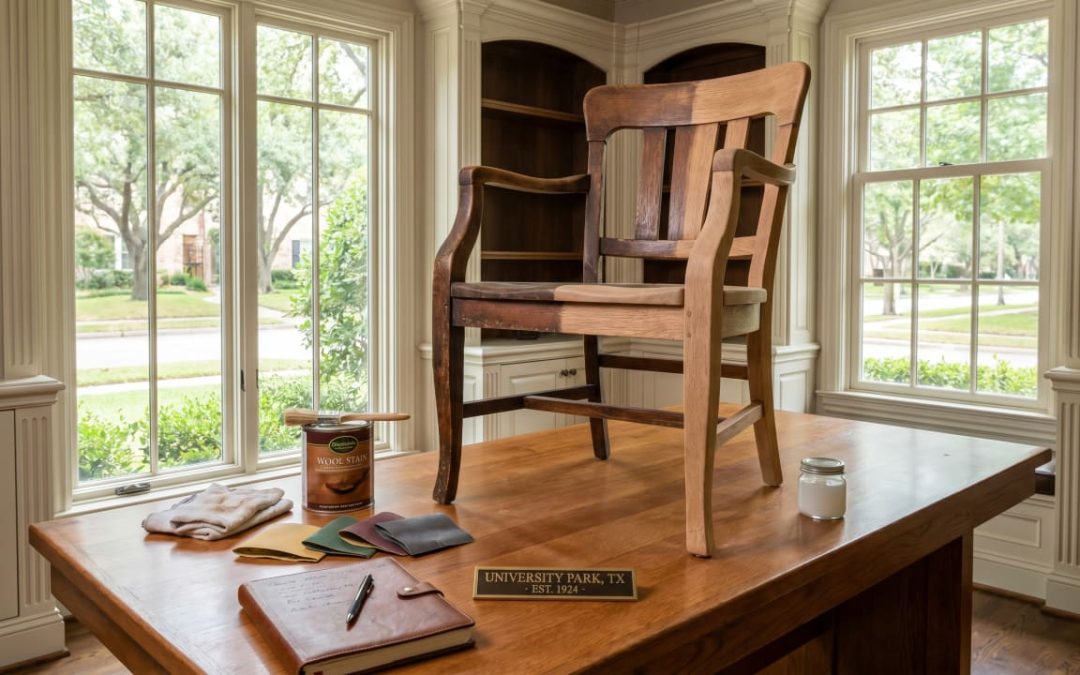
What Furniture Refinishing Actually Costs in University Park, TX
University Park homeowners know their furniture. The homes along Lovers Lane, Beverly Drive, and the streets surrounding SMU hold dining tables that have hosted generations, dressers handed down from grandparents, and side chairs that cost more new than most sofas do today. When a finish starts to cloud, a top gets water-ringed, or decades of use dull what was once a beautiful lacquer, the question isn’t whether to restore the piece. The question is what it’s going to cost.
We’ve been refinishing furniture in this region since 1980, and University Park is one of the neighborhoods we know well. The pieces that come through our workshop from this area tend to be quality: solid walnut, cherry, and mahogany dining sets; well-built dressers from the mid-century era; upholstered chairs in fabrics that were expensive when they were bought and haven’t been made easier to source since. The furniture is worth restoring. The question our customers always ask first is what it costs. This guide answers that directly, using our actual 2026 pricing.
Our Dallas furniture refinishing service covers University Park and the surrounding Park Cities area. We pick up and deliver throughout the metroplex, and every quote we give is based on a photo estimate that’s binding before we ever load the truck.
For a full overview of our repair capabilities beyond refinishing, see our furniture repair services. For questions about reupholstery pricing, our upholstery service page walks through the cost breakdown on sofas and chairs.
2026 Refinishing Price Ranges by Piece Type
These are real prices from our shop, not national averages from aggregator sites. Furniture refinishing costs vary by piece size, condition, wood species, and the finish work involved. The figures below reflect where jobs typically land in our shop in 2026. According to Angi’s 2026 refinishing cost data, national averages run lower than what custom shops in higher-cost metro areas charge, which is worth knowing when you compare quotes.
- Shop minimums: Basic repairs start at our $125 shop minimum. Refinishing jobs start at $600, regardless of piece size, and that figure covers materials, equipment time, and the craftsmanship involved in proper stripping, prep, and finishing.
- Single dining chair: $275–$375. This covers a standard side chair with a wood frame. Carved details, turned legs, or structural repairs push the price toward the upper end.
- Small pieces (end tables, accent tables, side chairs): $275–$650. Pricing scales with size and complexity.
- Nightstand: Starts at $650. A true solid-wood nightstand with drawer faces and a finished top requires more surface work than its size suggests.
- Dining table top only (standard finish): $120 per running foot. A six-foot table top runs approximately $720 for the surface alone. This covers stripping the top, correcting the wood, and applying a new lacquer finish.
- Dresser or hutch (full refinish): $1,200–$2,200. Large case pieces with multiple drawer faces and a significant surface area sit in this range. Ornate carved detail or extensive color matching adds to the estimate.
- Full dining set (table plus six chairs): $2,500–$4,000. This is our most common job type in the area. A solid-wood dining set that has been in a family for twenty years often justifies a full refinish because the bones are still excellent and replacement cost for comparable quality runs well above this range.
- Pickup and delivery: Starts at $250 round trip. We handle all logistics; you don’t need to disassemble or transport anything.

One important note: we cannot stain a piece lighter than its natural wood color. If the wood is naturally a medium walnut tone, we can match that, go darker, or add warmth or gray. But lightening beyond what the stripped wood reveals isn’t achievable with stain alone. We’ll be direct about this when you send photos.
What Drives the Cost: Five Variables That Move the Number
Two pieces that look identical can quote differently. Here’s why.
1. Size and Surface Area
The single biggest driver of cost is how much surface we’re finishing. A large dining table has six to eight square feet of top alone, plus aprons, legs, and stretchers. A small side table might have a fraction of that. Labor tracks surface area closely because stripping, sanding, and finishing all scale with how much wood we’re working with. The per-running-foot pricing on table tops is our way of giving customers a transparent number for that exact relationship.
2. Current Condition
A piece with a single worn finish coat that strips cleanly takes less time than one with four layers of old varnish, oil, and wax built up over fifty years. Deep scratches that have gone through to bare wood, heat damage from dishes, or finish crazing all add prep time. The more we have to correct before we can start finishing, the more the job costs. This is one reason photo estimates work so well: we can see the actual condition before we quote.
Repairs compound this. If a piece needs structural work before refinishing (loose joints, a broken apron, drawer runners that have failed), those are quoted separately from the refinishing itself. Our furniture repair service handles those issues before the piece goes to the finishing room.
3. Carved or Turned Detail
A plain, flat surface strips and sands quickly. A cabriole leg with a carved knee, a turned spindle, or a piece with raised panel details takes considerably longer because each profile requires hand work. Strippers flow into crevices; sanding has to be done by hand with folded paper or shaped blocks; finish application requires getting into every recess without leaving runs. That time shows up in the quote.
4. Finish Type and Color Match
We use lacquer for residential furniture finishing. It produces a durable, cleanable surface appropriate for dining tables, dressers, and case pieces, and it lets us control sheen level precisely. Specialty color matching, particularly when you’re trying to match a new piece to existing furniture in your home or blend a repair into an existing finish, takes more setup and more test panels before we commit to the final coat. That’s quoted accordingly.
According to HomeAdvisor’s refinishing cost guide, finish type and wood species are consistently among the top cost variables cited by professional refinishing shops nationwide, a pattern that holds in our own quoting experience.
5. Solid Wood Versus Veneer
We refinish both solid wood and pieces built on particleboard or MDF cores with a real wood veneer face. The veneer work requires more care because the layer is thin: aggressive sanding goes through it, and heat from stripping can lift the edges. That caution adds time. We do not refinish laminate surfaces (printed paper or plastic film over a substrate) because there’s no real wood layer to work with. If you’re not sure which your piece is, the photo estimate usually makes it clear.
Restore or Replace: The Economics for Park Cities Homeowners
This is the most honest conversation we have with customers, and it’s worth having before you spend anything. The calculus is different for quality heirloom furniture than it is for mass-market pieces.
Solid hardwood furniture built in the 1960s through the 1990s, the era that produced most of the dining sets and case pieces we see from Park Cities homes, was made to last. The joinery is mortise-and-tenon or dowel construction. The wood is often kiln-dried domestic hardwood: walnut, cherry, mahogany, or oak. Replacing a six-person walnut dining set of that quality today means either buying new at $8,000–$15,000 for comparable material and construction, or buying something that isn’t comparable at all.
Against that context, a $2,500–$3,500 full refinish on a structurally sound set is a clear financial winner. You get a piece that will serve your family for another thirty years, finished to your specification, with a known history behind it.
The calculation changes for lower-quality pieces. If a piece is constructed of particleboard with a laminate surface (not veneer), or if the structure has failed in ways that cost more to repair than the piece’s replacement value, we’ll tell you. Sentimental value is real and can justify a restoration that pencil math alone wouldn’t, but we’re not in the business of talking customers into jobs that don’t make sense. The photo estimate is free, and honest assessments are part of what we offer.
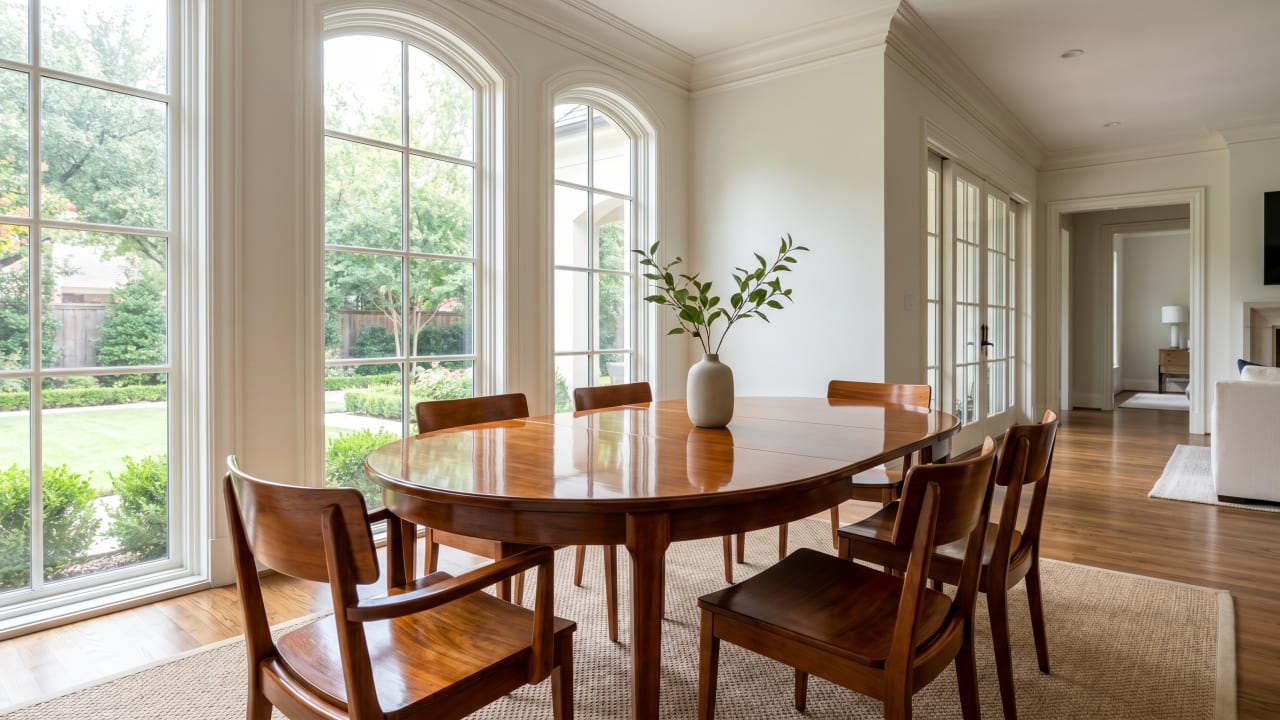
Research from Fibrenew’s furniture restoration guide suggests the general threshold is restoration making financial sense when repair costs stay below roughly 50% of the replacement value. For solid-wood dining sets and case pieces of the type common in this area, that test is usually easy to pass.
Antique and Heirloom Pieces: A Different Kind of Value
Homes in this neighborhood hold a lot of genuinely old furniture. A chest of drawers from a grandparent’s estate. A secretary desk that came from the family house in East Texas. A set of dining chairs that haven’t left the family since the 1940s. These pieces carry value that market price alone doesn’t capture.
For antiques in original or near-original finish, we give honest guidance on the restoration-versus-preservation question. Some antique pieces are more valuable with their original patina intact, even if it’s worn. Others have been repainted or poorly refinished over the years and benefit enormously from returning to the wood underneath. We assess the piece in photos, and if there’s any question about how original the current finish is, we can discuss it further before committing to full strip-and-refinish.
One note on antique shellac pieces: we do not do French polish. It’s a very delicate finish with virtually no resistance to heat, water, or scratches, which is why we strip those pieces and refinish them in modern lacquer instead. The new finish keeps the depth and warmth of the original look while standing up to daily use. If you have a shellac-finished antique from the nineteenth or early twentieth century, mention it when you send photos so we can plan the job accordingly.
According to Ackerman and Sons Furniture Workshop’s guide on heirloom restoration, the key distinction is between restoration (preserving as much of the original as possible) and refinishing (a full strip-and-restart). Both are valid approaches depending on the piece, its history, and what the owner wants to accomplish. We walk customers through which makes sense for their specific furniture during the photo estimate process.
How the Quote and Process Work
The free photo estimate is the starting point for every job. You send photos of the piece, describe what you’re hoping to achieve (new color, same color, specific sheen level, any repairs needed), and we send back a binding written estimate. Binding means the price we quote is the price you pay, barring something we discover after stripping that wasn’t visible in photos, which we always flag before proceeding.
Once you approve the estimate, we schedule pickup from your home. Our team handles all logistics: we bring the right equipment, wrap the pieces properly, and transport them to the shop. Lead times for standard refinishing jobs currently run 5–6 weeks for most pieces, and 4–6 weeks for single smaller items. We keep you updated through the process.
In our shop, stripping is done using our laser stripping equipment or a chemical overflow method, where stripper flows continuously over the piece as we brush. For top-only refinishes, we use a gel stripper applied to the surface. We do not use heat guns, we do not sandblast, and we do not submerge pieces. These distinctions matter because the wrong stripping method damages veneer, raises grain unpredictably, or warps solid wood.
For a step-by-step look at what happens from drop-off to delivery, the workshop process walkthrough covers each stage in detail.
Color Matching and What’s Achievable
Color matching is done on the actual piece, not from a swatch book or a sample chip. Every piece of wood takes stain differently based on species, grain pattern, and age, so we test on the piece itself before committing to the final color. This is particularly important when you’re trying to match a piece to existing furniture in your home.
The one hard limit: we cannot stain wood lighter than its natural color. If the wood is naturally a medium walnut tone, we can match that, go darker, or add warmth or gray, but we cannot achieve a bleached or whitewashed look through stain alone. Customers who want a significantly lighter result than what stripping reveals sometimes opt for paint instead of stain, which opens different options. We’ll walk you through those choices honestly when it’s relevant to your piece.
For more on how wood species affect the refinishing result, including why some species like oak require extra steps to avoid blotching, the oak furniture refinishing guide covers that territory well.
Serving University Park, TX and the Surrounding Area
We serve University Park, TX and the surrounding corridor. Our pickup and delivery network covers Highland Park, Preston Hollow, North Dallas, Devonshire, and the neighborhoods around our Carrollton workshop. Whether your home is near the SMU campus or along one of the streets closer to the Dallas city limits, we can schedule pickup from your address.
Pickup and delivery starts at $250 round trip. For customers with cushion-only reupholstery jobs (no wood frame), we prefer customer drop-off at our Carrollton shop, which avoids the delivery fee entirely. For full refinishing and repair work, we handle all transport.
Our workshop is located at 2425 Parker Rd. Bldg. 5, Carrollton, TX 75010. Reach us at 214-731-3060 or through our location and contact page.
Frequently Asked Questions
How much does furniture refinishing cost in University Park, TX?
Refinishing jobs at our shop start at $600, and basic repair jobs start at our $125 shop minimum. From there, refinishing pricing scales by piece: single dining chairs run $275–$375, dressers and hutches $1,200–$2,200, and a full dining set (table plus six chairs) typically falls in the $2,500–$4,000 range. Table tops are quoted at $120 per running foot. Pickup and delivery in University Park starts at $250 round trip. Every quote is based on a free photo estimate that’s binding before we begin work.
Is refinishing worth it compared to buying new furniture?
For solid hardwood furniture, the answer is almost always yes. Replacing a quality walnut or mahogany dining set today costs $8,000–$15,000 for comparable construction. A full refinish of the same set runs $2,500–$4,000, leaves you with a piece that will last decades more, and preserves any family or sentimental history the furniture carries. We’ll give you an honest assessment on the photo estimate if a piece doesn’t meet that bar.
Do you pick up and deliver furniture in the Park Cities area?
Yes. We offer pickup and delivery throughout University Park, Highland Park, Preston Hollow, and the surrounding area. Pricing starts at $250 round trip. You don’t need to disassemble or move the furniture yourself. We handle all transport.
How long does furniture refinishing take?
Standard refinishing jobs currently run 5–6 weeks from pickup to delivery. Single pieces sometimes complete in 4–6 weeks. Reupholstery runs 6–12 weeks depending on workload at the time. Lead times can shift based on shop volume, so we give you a current estimate when you book.
Can you refinish veneer furniture, or only solid wood?
Yes. We refinish pieces built on particleboard or MDF cores with a real wood veneer face, which covers a large share of furniture made from the 1960s through today. Veneer work requires more careful stripping and sanding than solid wood, which affects the quote, but the results are excellent when the veneer is in good condition. We do not refinish laminate (paper or plastic film) surfaces, because there’s no real wood layer to work with. Send photos and we’ll tell you which category your piece falls into.
Get a Free Photo Estimate
If you have a dining set that needs a new finish, a dresser with a clouded top, or a set of chairs ready for a refresh, the first step is a free photo estimate. Send us photos of your piece, tell us what you’re hoping to achieve, and we’ll come back with a binding written quote, typically within a business day.
University Park homeowners can request a free online estimate or call us directly at 214-731-3060. We’ve been doing this work since 1980, and we’re confident enough in the quality to quote on it before you commit to anything.
For more on what goes into a full refinishing job, see our complete Dallas furniture refinishing service page. We serve the full DFW metroplex from our Carrollton workshop, with University Park and surrounding areas a regular part of our schedule.