
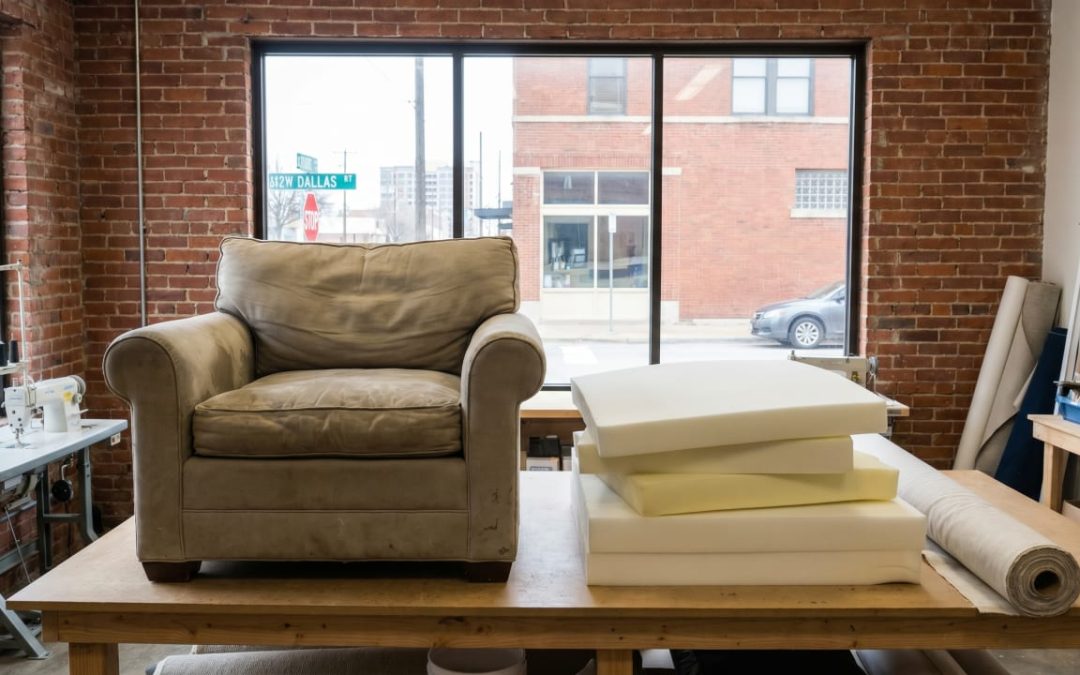
Dallas Sofas That Look Fine But Feel Like Sitting on a Plank
You sink into your sofa and land somewhere between the armrest and the floor. The fabric’s still clean, the legs are solid, the frame doesn’t creak, but the foam is completely shot. If you’ve lived with a sagging sofa seat for longer than you’d like to admit, you already know this feeling. The good news is that the frame is the expensive part. The foam is just chemistry, and chemistry can be replaced.
At Andrew’s Refinishing, we’ve been doing cushion and foam replacement in Dallas, TX and across the DFW metroplex from our Carrollton workshop for 45 years. Foam replacement is one of the most underused restoration services we offer, underused because most people don’t realize it’s an option separate from full reupholstery. When the fabric is fine and the frame is sound, swapping out degraded foam cores can resurrect a sofa at a fraction of the cost of anything else. This guide explains the whole picture: what actually happens to foam over time, what the density numbers mean, when foam-only replacement makes sense versus a fuller job, and what the process looks like from our workshop to your living room.
If you already know your cushions are shot and want a free quote, you can send us photos for a free online estimate no hauling anything across town. But if you want to understand what you’re actually paying for and why the foam spec matters, read on.
Why Foam Fails, and Why Dallas Heat Speeds It Up
Polyurethane foam is the core of virtually every sofa cushion made in the last 60 years. It starts as a block of open-cell foam, millions of tiny air pockets that compress under weight and spring back when the load is removed. That spring-back is what makes a cushion feel supportive rather than flat. Over time, the cell walls of the foam break down through a combination of mechanical stress (every time you sit), oxidation (the foam literally reacts with air), and heat cycles.
In North Texas, the heat cycle problem is amplified. Summer temperatures consistently top 100°F, and rooms that face south or west heat up significantly even with air conditioning. Foam degradation accelerates in sustained heat. A cushion that might last 10 years in a temperate climate can show meaningful breakdown in 6–8 years here. That’s not a manufacturing flaw, it’s chemistry in a Texas summer. The foam doesn’t fail dramatically; it creeps. The first sign is usually a slight “pancake” feeling in the seat, then a bottomed-out sensation when you sit firmly, then the frame-contact experience that drove you to look this up.
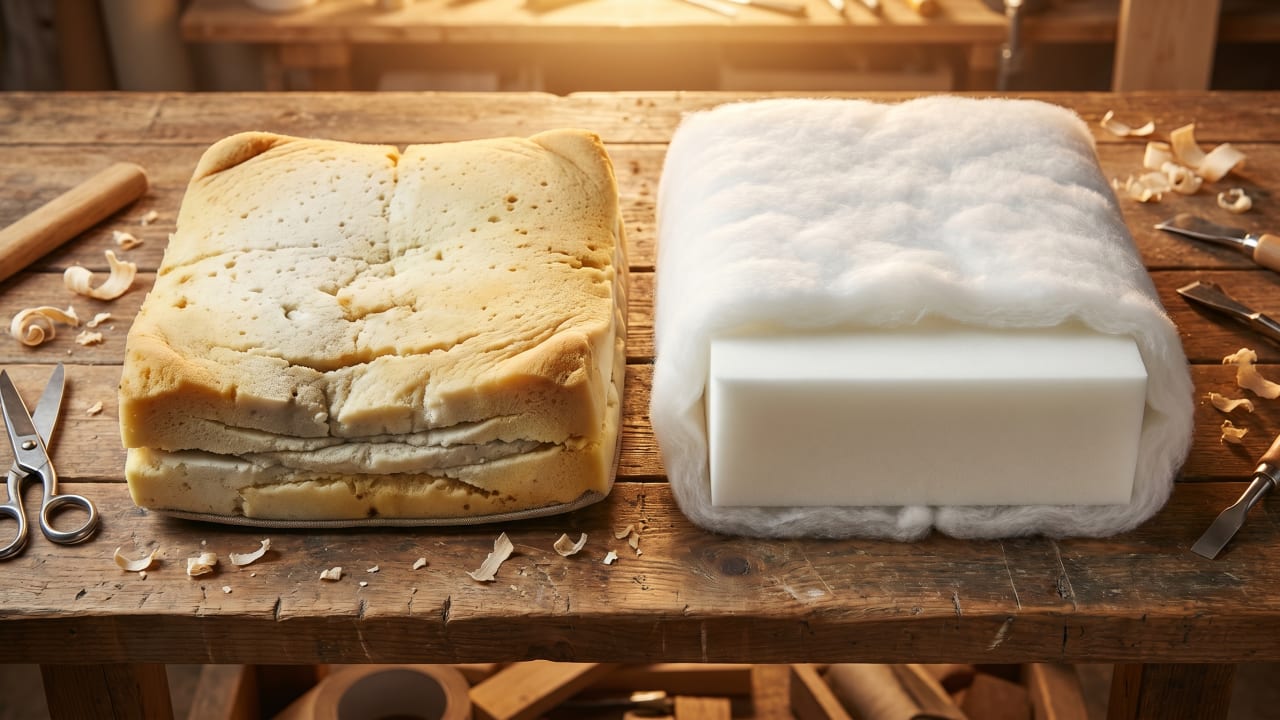
According to foam density research from US Cushion residential seat cushions with lower density foam (1.5–1.8 lbs per cubic foot) typically show noticeable breakdown in 3–5 years of daily use, while cushions built with 2.4–3.0 lb/ft³ high-resilience foam hold their integrity for 10–15 years. The original cushions in most mid-market sofas sold through national retailers are built to a price point, not a longevity point. What we replace them with at our workshop is built to last.
HR Foam, Density, and What Those Numbers Actually Mean
Foam specs feel technical until you understand what you’re actually measuring. Density (lbs/ft³) tells you how much material is packed into a cubic foot of foam, it’s a proxy for durability and material quality, not for how firm the cushion feels. Firmness is a separate spec called ILD (Indentation Load Deflection). You can have a high-density foam that feels soft, or a low-density foam that feels hard but breaks down quickly. Both density and firmness matter; they just measure different things.
Here’s the practical breakdown for choosing replacement foam:
- 1.5–1.8 lbs/ft³ (entry-level): What most furniture store sofas ship with. Acceptable for occasional-use pieces, a guest room chair, a decorative bench. Not appropriate for a primary sofa that sees daily use. Will soften noticeably within 3–5 years, even faster in rooms with significant sun exposure.
- 1.8–2.2 lbs/ft³ (standard residential): A reliable everyday-use density. Good for main seating in a typical household. Expect 7–10 years of performance with normal use.
- 2.5-3.0 lbs/ft³ HR (high-resilience): A higher-tier foam available on request. HR foam must meet a support factor of 2.4 or higher in addition to the density requirement. It springs back faster, holds its shape longer, and handles heat cycles without the cell-wall degradation that collapses cheaper foam. We’ll quote HR foam when the customer asks for it or when the piece sees heavy daily use that justifies the upgrade. According to Sailrite’s upholstery foam guide, HR foam at proper density routinely delivers 12+ years of daily-use performance.
When we cut replacement foam, we spec the density based on the piece: how many people use it, how often, and what the client’s comfort preference is. A petite person who reads in a chair once an evening needs a different spec than a family of four whose kids treat the sectional as a trampoline. That conversation is part of what the estimate covers.
The Layer Nobody Talks About: Dacron Wrap and Down Alternatives
Foam is the structural core, but the outer wrap determines the surface feel, that plush, rounded, hotel-sofa sensation that good upholstery has. In quality cushion construction, the foam core gets wrapped in a layer of Dacron (bonded polyester batting) or, in higher-end applications, a down-feather wrap.
Dacron wrap serves two purposes: it softens the visual transition from the hard foam edge to the fabric surface (eliminating that boxy, institutional look), and it fills the casing evenly so the fabric doesn’t bunch or pull at the corners. According to The Foam Factory’s construction guidelines a half-inch to one-inch Dacron wrap is standard for most residential cushions, thick enough to round the profile, thin enough to avoid uneven compression over time.
Down-feather wraps are the premium option for clients who want that deep, sink-in feel, common in high-end sofas from brands like RH or Mitchell Gold. The tradeoff is maintenance: down cushions need regular fluffing and reshaping, and they’re not ideal for households with heavy daily use or pets. For most families, a quality HR foam core with a generous Dacron wrap hits the right balance between longevity and comfort.
When Foam-Only Replacement Makes Sense
This is the key question, and we get it constantly. Not every cushion problem requires full reupholstery. Our rule at the workshop is straightforward: if the fabric is in good condition and the frame is sound, foam replacement is almost always the right move. Here’s how to think through it:
- Fabric is clean and undamaged: If the upholstery has no tears, stains, pet damage, or significant wear, there’s no reason to remove it. We can often replace foam cores without disturbing the fabric at all, depending on the cushion construction. If the cushion has a zipper, it’s even simpler, the old foam core slides out, the new one slides in, and the only indication anything changed is that the sofa suddenly feels supportive again.
- Frame is structurally sound: A solid hardwood or kiln-dried frame can last 25–50 years. Most quality American sofas from the 1980s through early 2000s, the era that produced most of the heirloom and hand-me-down pieces we see from homes in Lakewood and Preston Hollow, were built on real frames. Replacing them makes no sense when the foam can be refreshed.
- You still like the piece: Style is subjective, but if you want to keep the sofa, the cost math almost always favors foam replacement over full reupholstery or buying new. Foam replacement at our shop is a fraction of what a comparable quality-frame sofa costs new from a retailer.
- Loose cushion construction: Cushions with removable covers and zipper access are the cleanest case for foam-only replacement. The old core slides out, the new one slides in, and the sofa suddenly feels supportive again. If your cushions are attached (the fabric is sewn directly into the sofa body), the labor to access the foam roughly matches what a full reupholstery takes. In those cases, we’ll usually recommend reupholstery instead of a foam-only swap. We’ll tell you which case you’re in when you send photos.
According to upholstery guidance from Foamite if your comfort issues are primarily in the cushions and the frame is structurally sound, replacing the foam cores will dramatically improve comfort without the cost of a full replacement or complete reupholstery. Where foam-only doesn’t make sense: the frame is wobbly or made from particleboard; the fabric has significant damage; or the piece has both structural and comfort issues that add up to a fuller scope anyway. In those cases, our Dallas upholstery service handles everything, foam, fabric, spring work, and frame repair, as a unified project.
What Types of Pieces Come Through Our Shop
DFW homes present a particular set of cushion-replacement candidates, and we see consistent patterns:
- Primary sofas and sectionals: The most common case. A 10-to-15-year-old sofa from a quality brand, Ethan Allen, Thomasville, Henredon, Bradington-Young, with a solid frame and intact fabric but collapsed seat cushions. Quality pieces bought to last, and they will last, with new foam.
- Club chairs and accent chairs: The seat cushion compresses faster on a chair than a sofa because the weight concentrates on a smaller surface. A club chair that’s become uncomfortable is usually a foam problem, not a fabric or frame problem. We see a lot of these on mid-century or vintage pieces clients want to preserve.
- Dining chair seat pads: Dining chair foam is thin to begin with, typically 2–3 inches, and the concentrated daily pressure of mealtimes collapses it faster than almost any other household furniture. Replacing dining chair cushion foam is a half-day shop job that completely transforms how the chairs feel at the table.
- Banquettes and window seat cushions: Built-in seating is extremely common in the ranch-style and mid-century homes throughout the metro. The cushions on these are usually simple foam-in-a-cover construction with no frame complexity. New foam, new cover if needed, and the built-in feels brand new.
If you’re not sure whether your piece is a foam-only case or needs a fuller scope, the photo estimate is exactly the right starting point. We’ll tell you honestly which way it goes, and if it falls somewhere in between, we’ll price both options so you can decide.
Zipper Repair and Cushion Casing: The Details That Make the Difference
Foam is only part of the cushion equation. The casing, the fabric envelope that holds the foam, determines whether the new foam looks and performs the way it should. Two common issues we address alongside foam replacement:
Zipper repair and replacement: The zipper on a removable cushion cover is a failure point that often precedes or accompanies foam failure. A stuck or broken zipper makes foam access impossible and can tear the casing fabric if forced. We replace zippers as part of the foam replacement job when needed, typically a #5 or #8 coil or continuous zipper depending on the cushion construction and weight of the outer fabric.
Cushion casing replacement: If the outer fabric is still in good shape but the interior lining (the casing that wraps the foam directly, inside the outer cover) has deteriorated, common in older sofas where the inner ticking has shredded or become brittle, we replace the casing while we have the cushion open. This keeps the foam in position, prevents the Dacron wrap from shifting or bunching, and gives the cushion a clean interior structure that supports the outer fabric properly.
How the Foam Replacement Process Works
Here’s what a typical cushion foam replacement job looks like from our Carrollton workshop’s perspective. We’ve kept this as streamlined as possible because we know you have better things to do than coordinate a complicated logistics operation for a sofa cushion:
- Step 1, Photo estimate: Photograph the piece and the cushions, close-ups of the sag, the tags with original specs if visible, and the overall piece. Email or text the photos to us. We assess the scope and send a written quote, usually within one business day.
- Step 2, Drop off (preferred): For cushion jobs, we prefer customers drop off at the workshop, since cushions fit easily in a car and it keeps the job moving quickly. If drop-off isn’t practical for your situation, we can talk through pickup options when you respond to the estimate.
- Step 3, Workshop assessment: Once the piece is on our bench, we open the cushions and assess the existing foam spec, the casing condition, the zipper, and the Dacron layer. If anything changes the scope or price from the original estimate, we call you before proceeding.
- Step 4, Foam fabrication: We cut replacement foam to the original dimensions and agreed spec (or upgraded density if you’re going HR). Custom-shaped cushions, tapered banquette foam, T-shaped sofa cushions, irregular window seat profiles, are no problem. We have a full foam fabrication setup at the workshop.
- Step 5, Assembly and wrap: New foam gets its Dacron wrap layer, goes into the casing, and everything gets buttoned up. Zipper repairs or casing replacements happen at this stage. The finished cushion should look cleanly rounded and feel firm without being hard.
- Step 6, Pickup from the shop (or delivery): When the cushions are ready, we’ll call you to schedule pickup at the workshop. Delivery is available if it was part of the original arrangement. Typical turnaround for a foam-only job is 1-2 weeks depending on shop queue.

If you also want to change the fabric while we have the piece open, that’s the natural time to do it. We keep swatch books at the workshop, performance fabrics, wovens, velvets, and Sunbrella for pieces that live near a window or see heavy use. You’re welcome to come in and look through the books in person; once you pick a fabric, we order it in (typically about a week to arrive at the shop).
Commercial and Restaurant Cushion Replacement
Restaurants and hospitality venues deal with a specific version of the foam replacement problem: booth and banquette seating that sees 4–6 hours of continuous use per day, seven days a week. The foam spec for commercial seating is different from residential, it typically needs to be higher density (2.5–3.0 lbs/ft³ minimum) with a firmer ILD so it doesn’t bottom out during a full service shift. Standard residential foam won’t hold up in a busy restaurant for more than a year or two.
We handle commercial foam replacement for restaurants, hotels, and bars through our commercial furniture services program. Volume pricing applies for 10 or more seat cushions, and we can schedule off-hours pickup and delivery to avoid disrupting your service. If you’re a restaurant owner in Uptown, Deep Ellum, or the Design District planning a refresh, call us at 214-731-3060 to discuss timing and commercial foam specs.
We Serve Dallas and the Surrounding DFW Metro
Our Carrollton workshop at 2425 Parker Rd. Bldg. 5 serves all of Dallas, including Highland Park, Design District, Bishop Arts, Downtown Dallas, Preston Hollow, and East Dallas, plus the surrounding DFW metroplex. We regularly do pickup and delivery to Richardson, Irving, Garland, Lewisville, and Plano. Our service area covers the full DFW metro, so if you’re in Allen, McKinney, Frisco, or anywhere else across the area, we have you covered. Flat-rate pickup and delivery fees are based on distance from the Carrollton shop, ask us when you request your estimate.
Dallas Cushion Replacement FAQ
What foam density should I request for Dallas sofa cushion replacement?
For a primary sofa with daily use, we don’t lead with HR foam. HR is a mid-tier upgrade we quote on request, usually the right call for very heavy daily use or when the customer wants the longest-lasting option available. For most everyday households, a standard polyurethane density holds up very well. We’ll spec the foam based on the piece, the household, and what you want out of it, and walk through the trade-offs in the estimate.
How long will new cushion foam last in a Dallas living room?
With quality HR foam at 2.5 lbs/ft³ or higher, expect 10–15 years of performance in a typical household that uses the sofa daily. Lower-density foam will break down faster, especially in south- or west-facing rooms that get significant Texas sun exposure. Foam density and construction quality matter far more than the brand name on the sofa.
How much does cushion foam replacement cost in Dallas?
Pricing depends on the number of cushions, the size and shape of each cushion, whether the casing or zipper needs attention, and the foam density spec. A single sofa seat cushion replacement typically starts in the $75–$150 range depending on size and complexity. A full three-seat sofa with HR foam and Dacron wrap on both seat and back cushions runs more, send us photos and we’ll provide a written quote at no charge. Our free online estimate is the binding quote; no surprise add-ons when you pick up.
Do you offer pickup and delivery in Dallas for cushion replacement?
Yes, we offer DFW-wide pickup and delivery from the Carrollton workshop at 2425 Parker Rd. Bldg. 5. Most addresses across the metro are within 25–35 minutes of the shop. Pickup is scheduled by appointment, delivery follows after the job is complete, and flat-rate fees apply based on distance from Carrollton.
When does foam-only replacement make sense versus full reupholstery?
Foam-only replacement is the right call when the fabric is undamaged and clean and the frame is structurally sound with no wobble or breakage. If the fabric also needs replacement, we’ll price both options, foam only versus foam plus new fabric, so you can decide what makes sense for your home and budget. Full reupholstery is often worth it when the frame quality is high and you’ve been wanting a fabric change anyway.
Ready to Bring Your Sofa Back to Life?
Foam replacement is one of those jobs that seems minor until you sit down on the finished piece. The difference between a collapsed 1.5 lb foam core and a fresh HR foam cushion wrapped in Dacron is not subtle, it’s the difference between tolerating a sofa and actually enjoying it again. For homeowners with quality frames and intact fabric, it’s often the smartest restoration dollar you can spend.
Andrew’s Refinishing has been doing this work from the Carrollton workshop since 1980, 45 years of knowing exactly how foam performs in DFW homes, how to spec a replacement that outlasts the original, and how to handle the job without making your week complicated. If you want to explore what our full range of furniture services can do for a piece, from foam replacement to full reupholstery to wood refinishing, we’re happy to walk through it with you.
You can request a free online estimate by sending photos of your piece, no appointment needed, no hauling furniture across town. Or call us directly at 214-731-3060. We’ll tell you honestly whether foam replacement is the right move, what density spec to use, and what it’ll cost. That’s the kind of straight answer you get from a shop that has been at it since 1980.