
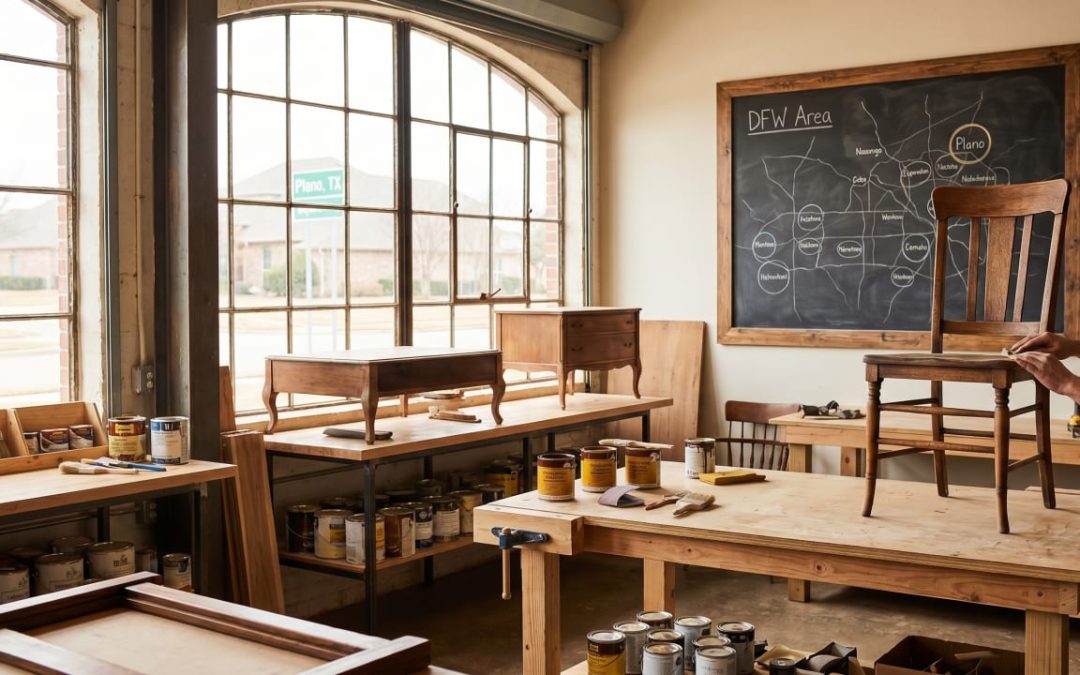
Why Plano Homeowners Are Refinishing Instead of Replacing
If you have a solid-wood dining set at home, the kind with thick turned legs and a deep walnut or oak grain typical of pieces made in the 1980s and 1990s, you already own something that today’s furniture market cannot easily replace. A comparable solid-wood set built to that standard costs two to four times what refinishing your existing piece would run. And refinishing gives you exactly what you paid for originally: real wood, real joinery, and a finish that can be refreshed again in another twenty years.
At Andrew’s Refinishing, DFW’s furniture refinishing specialists since 1980 we work with Plano homeowners regularly. The drive from our Carrollton workshop at 2425 Parker Rd. Bldg. 5 runs about 15 to 20 minutes up the Dallas North Tollway. We pick up, we complete all work in our fully equipped shop, and we deliver back to your door. For neighborhoods like Willow Bend, Bent Tree, and the Stonebriar corridor, that’s a straightforward route we cover every week.
This guide covers what furniture refinishing actually involves, which wood pieces respond best to it, what the full stripping-and-finishing process looks like in our workshop, how to choose between finish types, and what a realistic timeline and cost range looks like. If you’ve been looking at a piece that needs help, read this first, then request a free online estimate with a few photos and we’ll tell you exactly what the job would involve.
What Furniture Refinishing Actually Means
Refinishing is not painting over a piece. It is not wiping it down with furniture polish. Refinishing means removing the existing finish down to bare wood, through chemical stripping, mechanical stripping, or both, and then rebuilding the surface from scratch: sanding, staining (if a color change is desired), sealing, and applying a professional topcoat in a controlled spray environment.
The distinction matters because it separates cosmetic touch-up work from the deeper service that restores a piece to like-new condition. A genuine refinishing job by a professional shop addresses UV fade, finish crackle, white watermarks, darkened rings, and scratched topcoat, all at once, not one at a time. According to Mumford Restoration’s step-by-step refinishing guide the process moves through structural repairs first, then stripping, then progressive sanding, then sealing and finish application, every stage matters equally to the final result.
This is also why refinishing is a distinct service from furniture repair. Furniture repair in DFW covers structural fixes, loose joints, broken legs, cane replacement, gouge fills. Refinishing is about the finish itself: the color, the topcoat, the sheen level. Sometimes a piece needs both; often it needs only one. When you send us photos, we’ll tell you which applies to your specific piece before any commitment is made.
Which Pieces Are Worth Refinishing
Not every piece of wood furniture is a strong refinishing candidate. The guiding principle is construction quality: if the bones are solid wood with real joinery, the refinishing math almost always works in your favor. Here is how we assess pieces when homeowners send in photos:
- Dining sets, tables and chairs: The most common refinishing job we see. Rosewood, walnut, and oak dining sets from the 1980s and 1990s are exceptionally well-built. A full dining set refinish, table plus six chairs, typically costs a fraction of what a comparable solid-wood replacement would run, and the result is a set that looks new and will outlast the house.
- Dressers and bedroom sets: High-drawer pieces with dovetail construction are worth refinishing almost without question. Water rings on the top surface, UV fade on the drawer fronts, and scratched topcoat are all routine refinishing problems.
- Hutches and china cabinets: Large display pieces often have significant glass and veneer detail. We refinish the wood components and match the stain across all surfaces. Color matching on adjacent pieces is something we do every week, it is not a special request.
- Headboards and bed frames: Solid-wood headboards respond well to refinishing, especially when the finish has cracked or the stain has faded unevenly from Texas sun coming through bedroom windows.
- Desks and home office pieces: Executive desks and library pieces with heavy-use surfaces, scratches, heat marks, ink stains, are strong refinishing candidates. A good lacquer topcoat on a desktop will outperform the original factory finish.
- Antiques and heirlooms: This is where experience matters most. Antique restoration requires knowing when to preserve original patina versus when a full strip is the right call. We have been making those judgment calls since 1980.
Almost any wood piece we see can refinish beautifully. Solid wood is the obvious yes, but particleboard and MDF with a real wood veneer on top refinish just as well, and they’re a huge share of our work. The narrow exceptions: we cannot work on laminate (plastic) coatings, since laminate won’t accept a new finish, and we don’t structurally repair MDF or particleboard cores. Beyond those exceptions, the real question is whether the work is worth it for you. Sometimes the monetary math doesn’t pencil out but sentimental value does. A piece passed down from family is often worth restoring even when a comparable replacement would cost less. We’ll give you an honest read when you send photos.
The Refinishing Process at Our Carrollton Workshop
When a piece comes in, here is the actual sequence of work in our shop:
Step 1: Assessment and Disassembly
We inspect the piece for structural issues before touching the finish. Loose joints, failed dowels, or damaged veneer sections get addressed before refinishing begins, because applying a new finish over a structurally compromised piece is a short-term solution at best. Hardware comes off, glass comes out of any cabinet doors, and the piece is catalogued so it goes back together exactly as it arrived.
Step 2: Stripping
We strip the old finish using one of two methods. For most pieces we use a chemical overflow method where the stripper flows over the piece as the craftsman brushes it. The chemistry stays active on the surface and we never submerge anything in a tank. For pieces with carved details, complex profiles, or applications where chemical access is restricted, we use our laser stripper, which removes finish without altering the wood profile. According to Mumford Restoration’s wood furniture restoration best practices guide, commercially available strippers often leave old finish residue in the wood grain, which causes adhesion problems with the new topcoat. We strip to bare wood, every time.
Step 3: Sanding
Progressive grit sanding, typically 80 grit for rough areas, 120 for general smoothing, and 180 to 220 for the final surface, prepares the wood to accept stain evenly. This step is where much of the skill lives. Uneven sanding produces uneven stain absorption, and uneven stain absorption is immediately visible in the finished piece.
Step 4: Staining (When Applicable)
If you want to change the color, stain goes on after sanding. Worth knowing the constraint up front: we can darken a piece or shift its tone, but we cannot stain a piece lighter than the natural wood underneath. You can only go as light as the bare wood allows. If the goal is to match an existing finish on an adjacent piece, our team color-matches by eye and test on the actual piece. Stain is given adequate dry time (typically 12 to 24 hours) before the sealer coat, because rushing to topcoat over wet or partially cured stain produces exactly the kind of muddy, uneven result that sends pieces back to the shop.
Step 5: Sealing and Topcoat
The sealer locks the stain and builds a foundation for the topcoat. The topcoat is applied in our spray booth, a controlled environment where dust contamination is managed, humidity is regulated, and overspray is collected properly. We apply multiple thin coats rather than one heavy coat, sanding lightly between coats for adhesion and a smooth final surface. The topcoat choice depends on the piece’s use and your preferences, more on that in the next section.

Step 6: Final Inspection and Delivery
Before any piece leaves the shop, we inspect it under direct light for surface defects, orange peel, fisheye, missed spots, sheen inconsistency. Hardware goes back on. If there are matching pieces remaining at your home that we need to match, we reference photographs taken at pickup. Then we schedule delivery back to your door.
Choosing the Right Finish for Your Piece
One question homeowners ask most often: what finish should I choose? The right finish depends on the piece’s use, the look you want, and what the wood will be exposed to. Here is a plain-language breakdown of the finishes we use:
Lacquer
Lacquer, specifically catalyzed nitrocellulose lacquer, produces a smooth, crystal-clear surface with a fast dry time. Its biggest advantage is repairability: future coats bond chemically with previous coats, meaning scratches and scuffs can be recoated without full stripping. According to Pittsburgh Spray Equipment’s finish comparison guide lacquer’s fast dry time (around 30 minutes per coat) and recoatability make it a professional shop standard for decorative indoor furniture. That repairability is why lacquer is our standard residential topcoat across the board, dining tables, desks, dressers, chairs, and display pieces, applied in a satin, semi-gloss, or gloss sheen depending on the piece.
Polyurethane (Commercial Only)
For commercial pieces, restaurant tables, hotel case goods, hospitality refinishes, we spec polyurethane. It offers excellent hardness and wear resistance, which matches the heavier day-to-day abuse those settings see. According to Family Handyman’s finish comparison, polyurethane is the right call for indoor surfaces that take heavy day-to-day use. We don’t use it as a residential topcoat.
When you submit photos for a free estimate, let us know how the piece is used and what sheen level you prefer, satin, semi-gloss, or gloss. For residential pieces, we’ll spec lacquer, our standard topcoat across the board. Polyurethane is reserved for commercial work where the durability requirements call for it. We’ll explain the choice and the trade-offs before any work starts.
Refinishing Cost vs. Replacement: The Honest Math
The numbers on furniture refinishing are clear once you look at them side by side. According to Angi’s 2026 furniture refinishing cost data, national averages run from $150 to $1,550 per piece. Our shop’s pricing reflects DFW market rates and our spray-booth standard of work: refinishing jobs start at $600, dining table top-only standard refinishes are priced at $120 per running foot, and a full dining set, table plus six chairs, typically falls in the $2,500 to $4,000 range.
Compare that to replacement. A new solid-wood dining set comparable in quality to a 1980s or 1990s set runs $1,500 to $5,000 or more. Budget sets from big-box stores are cheaper ($300 to $800 for a dining table), but those are generally particleboard or veneer over MDF, not refinishable, and unlikely to outlast a decade of normal use. The solid-wood set in your dining room, refinished properly, should easily last another 20 to 40 years.
The math changes if a piece has severe structural damage, legs that have split, joints that have failed repeatedly, or veneers that are delaminating across major surfaces. In those cases we’ll tell you upfront. We are not in the business of refinishing pieces that will need to come back in two years because the underlying structure was not sound.
General rule: if the shop quote is less than 50 percent of what a comparable new solid-wood piece costs, refinishing almost always wins on value, longevity, and the material quality of what you end up with.

Timeline: What to Expect
Our standard refinishing lead time is five to six weeks from pickup. That timeframe covers assessment, any minor structural repairs, stripping, sanding, staining (if applicable), sealing, topcoat application, and final inspection. Complex restorations, large sets, antiques with significant structural work, or pieces requiring extensive color matching, can take longer.
The workshop runs a queue, and it fills up fastest in the fall months (September through November) when homeowners are preparing dining rooms for the holiday season. If you have a Thanksgiving deadline in mind, contacting us in August or early September is not too early. We schedule by appointment and will give you a realistic return-date estimate before any piece leaves your home.
Pickup and delivery are included in our standard process. We schedule both the pickup and the delivery return at booking, so you know the target return date upfront.
Why Plano Homeowners Choose Refinishing Over Replacement
Plano has a housing stock that skews heavily toward mid-1980s through late-1990s construction in many of its most established neighborhoods. Those homes were originally furnished with a generation of solid-wood pieces, rosewood from the Philippines, American walnut, red oak, and pecan, that are genuinely superior in construction to what the same price point buys new today. Homeowners who choose refinishing are not being sentimental. They are being practical about material quality and long-term value.
There is also the sustainability dimension, which younger homeowners increasingly factor into restoration decisions. Refinishing a solid-wood piece uses a fraction of the raw material and energy that manufacturing a new piece requires. The piece does not go to a landfill. The craft involved in a proper refinishing job, the kind Andrew’s Refinishing has been delivering since 1980, is the kind of skilled trade work that makes furniture last for generations rather than years.
And honestly, the character of older solid-wood furniture is difficult to replicate. A 1988 walnut dining table has a grain figure, a weight, and a joinery quality that modern production furniture rarely matches at a comparable price. Refinished properly, it looks like what it is: a quality piece restored to its best condition. That is what our workshop is built to deliver.
You can read more about the full refinishing process and the steps involved on our refinishing process page which walks through each stage in detail.
Serving Plano and Surrounding DFW Cities
Andrew’s Refinishing serves Plano homeowners from our Carrollton workshop, with DFW-wide pickup and delivery at a flat fee. In addition to Plano, we regularly serve Richardson, Frisco, Allen, McKinney, and Carrollton, all within easy range of our Parker Rd. shop. We also cover the broader Dallas-Fort Worth metroplex including Dallas, Fort Worth, Addison, Lewisville, Coppell, and Flower Mound. If you’re anywhere in the DFW area and have a piece worth refinishing, distance is not a reason to leave the job undone. Our location and contact page has the full address, phone number, and map.
Start With a Free Online Estimate
You do not need to haul your dining table or dresser to the shop to get a quote. Take a few photos, top surface, overall piece, any problem areas, and submit them through our free online estimate form. We’ll review them and come back to you with a realistic assessment: what the work involves, which finish makes sense, and what the turnaround looks like. No obligation, no vague ballparks, just a straight answer from people who have been doing this work since 1980.
You can request a free online estimate here or call us directly at 214-731-3060. If you want to see what finished work looks like before committing, check our customer reviews from clients who have been through the process. Forty-five years of craft speaks for itself.
Frequently Asked Questions, Furniture Refinishing in Plano, TX
How much does furniture refinishing cost in Plano, TX?
Cost depends on the piece size, finish complexity, and current condition. Refinishing jobs start at $600. A single dining chair runs $275 to $375; a dining table top-only standard refinish is priced at $120 per running foot; a full dining set with six chairs typically falls in the $2,500 to $4,000 range. All jobs begin with a free photo-based estimate, call 214-731-3060 or submit photos online at andrewsrefinishing.com.
How long does furniture refinishing take for Plano homeowners?
Most pieces are returned within four to six weeks. Complex restorations or large sets can take longer. Andrew’s Refinishing picks up and delivers area-wide, and we give you a specific return-date estimate when you book.
Can you match the stain on my other dining room pieces?
Yes. Color matching is one of our most routine requests. We work from reference photos and finish samples from adjacent pieces to match stain tone and sheen level across your entire set. If you have two chairs that are fine and one that got damaged, we can refinish the damaged piece to match the originals.
Do you pick up and deliver in Plano, or do I bring the piece to Carrollton?
We offer pickup and delivery for a flat fee. We come to your address, load the piece, take it to our workshop, complete all work there, and return it to your door. You never need to transport the piece yourself.
Is it worth refinishing an inherited dining set?
If the piece is solid wood with sound structural bones, refinishing almost always costs significantly less than a comparable new solid-wood set. A refinished heirloom piece will also outlast budget-tier replacement furniture by decades. Send us photos and we’ll give you an honest assessment, if refinishing does not make financial sense for your specific piece, we’ll tell you that too.