
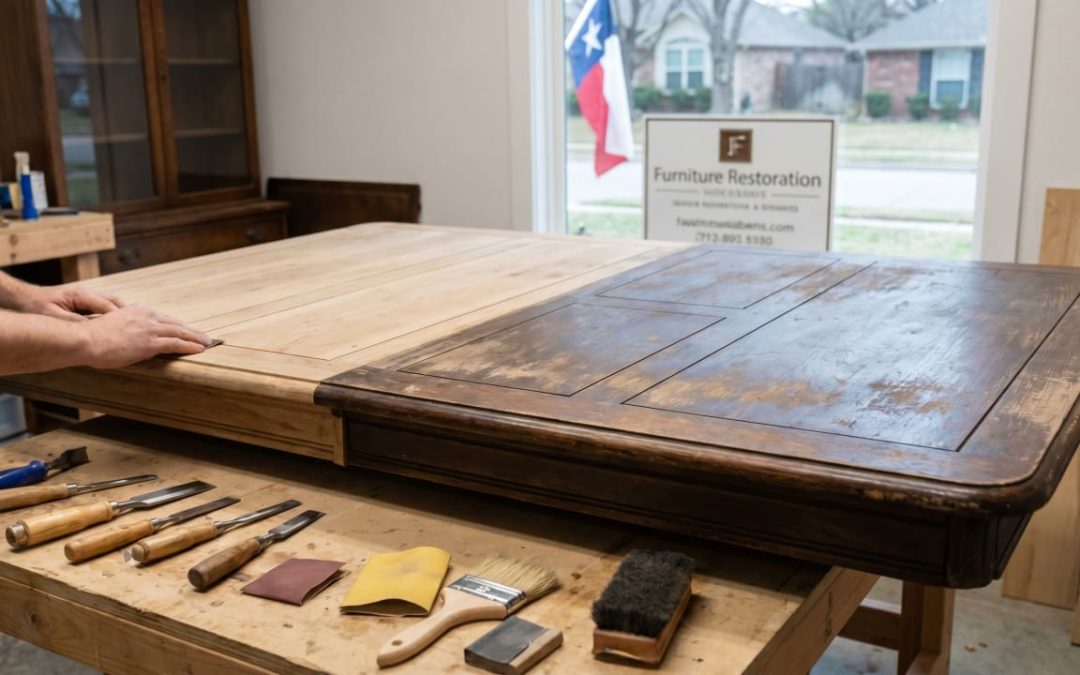
What Furniture Restoration Really Means for North Dallas Homes
You have a piece of furniture that matters. Maybe it’s a walnut dining table that anchored every holiday dinner for thirty years, a mahogany dresser that crossed state lines with your grandmother, or a solid oak bedroom set from a Preston Hollow estate sale that has more character than anything you’ve seen in a showroom. Something happened to it: a deep gouge, a cloudy water ring, a drawer that won’t close, joints that wobble when you sit down. And now you’re weighing the question that every homeowner eventually faces. Restore it, or replace it.
That question has a real answer, and it’s not always obvious from the outside. At Andrew’s Refinishing, we’ve been working through that decision with DFW families since 1980, when Andrew’s father John started the business in Carrollton. In 45 years of furniture restoration, repair, and refinishing, we’ve seen what holds up, what’s worth the investment, and when a piece isn’t the right candidate. If you’re looking for furniture repair and restoration in the Dallas area, understanding the full scope of what restoration means will help you make the right call before you spend a dollar.
This guide is written for homeowners in North Dallas specifically. The homes here, from the estates near Preston Hollow to the established neighborhoods along the tollway corridor, tend to have quality furniture worth saving. Solid wood construction, genuine veneer over hardwood cores, period joinery. These pieces respond beautifully to professional restoration. Let’s talk about what that process actually involves, and how to know whether your piece belongs in the shop.
Repair, Refinishing, and Restoration: How the Terms Fit Together

People use these words interchangeably, but in the shop they mean different things. The distinction matters when you’re figuring out what your piece actually needs.
Furniture repair addresses structural and mechanical problems: loose or broken joints, cracked rails, missing tenons, wobbly chair legs, stuck or broken drawers, damaged cane seats. The goal is function. A dining chair that rocks on its feet is a repair job. A drawer that won’t track is a repair job. Re-gluing loose joints and wobbly chairs is some of the most common work we do, and when it’s done right, a good joint outlasts the original.
Furniture refinishing is surface work: stripping the old finish down to bare wood, correcting any color issues, and applying a new topcoat. It addresses scratches, water stains, fading, cloudiness, peeling lacquer, or a finish that simply looks dated. The surface becomes new. The underlying wood is untouched.
Furniture restoration is the full package: structural repair plus refinishing, plus whatever else the piece needs to function and look the way it was meant to. For a dining set with loose chairs, a scratched tabletop, and veneer lifting at a corner, restoration covers all of it in one project.
Most pieces that come into the workshop need some combination of the three. A walnut hutch that came through recently needed two broken mortise joints reglued, a gouge on the side panel filled with epoxy and color-matched, and a full refinish on the top and doors. That’s restoration. Our Dallas furniture refinishing page covers the surface-work side of that equation in more detail if you want to dig into the specifics.
According to professional restoration guidance from Mumford Restoration, evaluating structural condition and material quality is the essential first step before committing to any restoration project. That’s exactly how we approach it: the scope of work follows from what the piece actually needs, not a standard menu.
What’s Actually Worth Saving: A Practical Framework
Not every piece is a candidate, and part of our job is telling you honestly when one isn’t. Here’s how we think through it.
The Construction Test
Solid wood and hardwood veneer over a solid or plywood core are the best candidates for restoration. These materials respond well to stripping, sanding, staining, and finishing. They can be re-glued, repinned, and refinished multiple times over decades.
Laminate over particleboard, the material used in most mass-market flat-pack furniture, is not a restoration candidate for surface work. The laminate can’t be stripped and restained. If the particleboard core is damaged structurally, that’s also outside our scope. But here’s something that surprises many homeowners: a lot of mid-century and quality furniture made from the 1960s onward uses real wood veneer over a particleboard or MDF core, not laminate. Real veneer on MDF refinishes just like solid wood. We work on these pieces regularly. If you’re not sure which you have, send us a photo and we can tell you quickly.
The Sentimental Test
There’s a reason people hold onto quality furniture across generations. Research on heirloom furniture care consistently finds that sentimental value often outweighs monetary value in the decision to restore. When you invest in restoring a piece, you’re not just fixing wood. You’re keeping something that belongs to your family’s history.
We hear this regularly. Someone brings in a cherry bedroom set from the 1950s that belonged to a parent. It’s scratched, the finish is dull and crazed, and one drawer front is cracked. On the open market it might appraise at $400. But to the family, it’s irreplaceable. Restoration runs $1,400-$1,800 for a piece like that. Almost every time, when people see it back in their home looking the way it did forty years ago, they know it was right.
The Economics Test
For pieces without strong sentimental pull, the rule of thumb is straightforward: if restoration costs less than 50-60% of what you’d spend on a comparable new piece of the same quality, restoration wins. New solid wood furniture of genuine quality costs considerably more than people expect. According to HomeAdvisor’s 2025 cost data, professional furniture refinishing typically costs significantly less than replacing with comparable quality materials. Refinishing a solid walnut dining table that would cost $3,000-$5,000 to replace, for $900-$1,200, is an easy call.
The furniture repair and restoration market has grown steadily as homeowners recognize that quality restoration is both economically sound and environmentally responsible compared to replacement. The shift toward keeping and restoring quality pieces reflects what craftsmen have always known: a well-made piece of furniture, properly cared for, will outlast several generations of mass-produced replacements.
The Pieces We See Most Often from Homes Across North Dallas
Working with clients across this area for decades gives you a clear picture of the furniture in these homes. Here’s what comes through the shop regularly, and what restoration looks like for each type of piece.
Dining Room Sets
The dining room is where furniture takes the most abuse and carries the most meaning. Chairs get scratched beneath the aprons, table tops accumulate water rings and heat marks, and finishes dull from years of cleaners and placemats. A full dining set restoration (table, six chairs, buffet) typically runs $2,500-$4,000 depending on condition and size. Individual dining chairs run $275-$375 each. The table top, depending on length and finish choice, starts around $120 per running foot for a standard lacquer finish.
One thing to know about table tops: we never do touch-ups on a top. The whole surface gets refinished. Color-matching a spot repair on a top is nearly impossible to make invisible, and the result looks worse than the original damage. When the top comes back, it’s uniform and correct.
Bedroom Furniture
Dressers and hutches are among the most common restoration projects we handle. These pieces often have complex profiles, multiple drawer fronts, and hardware that needs careful attention. Refinishing a dresser or hutch runs $1,200-$2,200 depending on size and complexity. A nightstand starts at $650. These are pieces that people tend to move from house to house across decades. In the established homes of this area, we often see bedroom sets that have been through two or three families.
Occasional Tables, Cabinets, and Accent Pieces
Coffee tables, side tables, console tables, china cabinets. These pieces take surface damage from daily use and often have structural wear at the joints from being moved repeatedly. Small pieces start at $275-$650 for refinishing depending on complexity. Structural work is quoted separately after we see the piece.
Structural Repair Work
Loose joints, cracked rails, and broken structural elements are handled with traditional methods: re-gluing with appropriate adhesives, re-doweling where a joint has degraded beyond glue, and epoxy fills for gouges and missing material. We also do cane and rush seat replacement. Not wicker, but traditional cane weave and rush wrapping on chair seats and backs. These are skills that are harder to find than they used to be.
What we don’t do: we don’t repair pieces where the structural member itself is raw particleboard or MDF with no wood facing. If a drawer bottom cracked because it’s unfinished particleboard, that’s not a repair we can make last. Solid wood structural members, including hardwood veneer over solid cores, are a different story entirely.
How We Approach Refinishing at the Workshop

The finishing is where the visible result comes from, and the process behind it matters more than most people realize. Here’s what happens when a piece comes into the shop for refinishing.
Stripping the Old Finish
We use a laser stripper for most work, or a chemical overflow method where the stripper flows continuously over the piece as we brush it in. For top-only refinishes, where we’re redoing a flat surface, we may use gel stripper. We never use submersion, heat guns, or sandblasting. Those methods damage wood fibers and raise grain in ways that require much more aggressive sanding to correct, which takes off material you don’t want to lose. The goal is to get back to clean bare wood without damaging the underlying material.
The choice of finish type is determined by the piece’s end use. For residential furniture, dining tables, bedroom sets, living room pieces, we use lacquer. It builds well, cures hard, and holds up to the real-world demands of a home. For commercial pieces, we use poly or pre-catalyzed lacquer for added durability. Outdoor furniture gets either a water-based polyurethane or a hybrid wood oil, matched to the piece and how much weather it will see. On interior work, we don’t use oil finishes, wax, gel stain, or conversion varnish. Those are finishes we’ve moved away from for specific technical reasons having to do with durability and consistency of results.
Color-Matching and Staining
Color-matching is done on the actual piece, not on sample boards. Wood varies in its absorption and undertone even within a single species, so the only way to get the color right is to mix and test on the real surface. We can match an existing color from another piece in the same set, or work from a photo of how the original looked when new.
One hard limit: we cannot stain wood lighter than its natural color. Stain adds color; it doesn’t remove it. If you want a lighter finish on a dark walnut piece, that requires bleaching the wood first, which is a more complex process we evaluate case by case. In most situations with dark walnut or mahogany, we work within the natural range of the wood rather than pushing it lighter.
The Finish Coats
Lacquer is sprayed in multiple coats with light sanding between each to create a smooth, even surface. The result is a finish that protects the wood from moisture and normal wear while letting the wood’s natural figure and color read clearly. The lacquer we use for residential furniture is clear and remains that way over time.
You can see more about our process on our furniture refinishing process page, which walks through each step. The piece is returned to you finished, clean, and ready to go back into use.
When Restoration Includes Upholstery
Furniture restoration often involves both the wood frame and the fabric. A bedroom bench with cracked veneer, a dining chair with frame damage and a worn seat pad, a sofa frame that’s structurally sound but cosmetically tired. These pieces need both disciplines handled in the same project.
We handle upholstery and reupholstery in Dallas at the same workshop. For a three-seat sofa, reupholstery labor starts at $1,500, and fabric typically adds roughly another $1,200, so complete jobs start at about $2,500 including material. We work from swatch books. We don’t keep fabric in inventory, but lead time on ordering is typically about a week. COM fabric (customer’s own material) is $35 per yard for the labor portion. For cushion-only work, we prefer customer drop-off at the shop rather than pickup and delivery, since the transport cost doesn’t make sense for that size of job.
What we don’t do in the upholstery category: leather of any kind, wicker and rattan, vinyl webbing, and auto or boat upholstery. Our focus is residential and commercial fabric work on furniture frames, along with cane and rush seat replacement on chairs.
Serving North Dallas and Surrounding Communities
Our Carrollton workshop at 2425 Parker Rd. Bldg. 5 is just northwest of North Dallas, a short drive from Preston Hollow, Far North Dallas, Highland Park, University Park, and Addison. We offer pickup and delivery throughout the area and across the DFW metroplex, starting at $250 round trip. For pieces that require careful handling, large dining sets, fragile antiques, heavy bedroom furniture, our team handles the logistics so you don’t have to move it yourself.
If you’re not sure whether we cover your location, reach out and we’ll confirm. The shop is close enough to most of the area that dropping off in person is also a good option.
What to Expect: Lead Times and the Estimate Process
Standard refinishing projects run 5-6 weeks from the time the piece arrives at the shop. Single pieces, one chair, one side table, one small cabinet, can sometimes be completed in 4-6 weeks depending on current volume. Reupholstery projects typically run 6-12 weeks depending on workload at the time, with fabric selected and ordered at deposit so the material is already at the shop when the work begins.
The estimate starts with photos. You send us clear photos of the piece from every angle, with close-ups of any damage, and we give you a binding quote. Photo estimates let you know exactly what you’re looking at before anything leaves your home. For complex pieces or damage that’s hard to assess from photos, we can look at the piece in person as well.
We’ve been doing this for 45 years from the same location, and that continuity means something. The estimate you get is based on decades of knowing how long the work takes and what it costs to do it right. You can read what past clients have said on our reviews page. The consistency of the work and the communication are two things people mention regularly.
Frequently Asked Questions
How much does furniture restoration cost in North Dallas?
Restoration pricing depends on the piece and what it needs. Refinishing starts around $600 for smaller pieces. Single dining chairs run $275-$375 each. A full dining set is typically $2,500-$4,000. Dressers and hutches run $1,200-$2,200. Structural repair work is quoted after we see the piece, and basic repairs start at the $125 shop minimum. We provide binding photo estimates, so you know the cost before anything leaves your home. Pickup and delivery starts at $250 round trip.
Is it worth restoring furniture rather than buying new?
For solid wood and genuine veneer pieces, restoration almost always makes financial sense when the cost stays below 50-60% of what comparable new furniture would cost. Quality solid wood furniture costs considerably more to replace than to restore. Add sentimental value for family heirlooms and the case for restoration becomes even clearer. We’ll tell you honestly if a piece isn’t a good candidate, and we won’t take on work that isn’t going to give you a result worth the investment.
How long does furniture restoration take from pickup to delivery?
Standard refinishing runs 5-6 weeks from arrival at the shop. Single pieces may be completed in 4-6 weeks. Reupholstery projects run 6-12 weeks depending on workload at the time; fabric is selected and ordered at deposit, so material is on hand when the work starts. We’ll give you a realistic timeline with your estimate so you can plan accordingly.
Do you pick up furniture from the North Dallas area?
Yes. We offer pickup and delivery throughout North Dallas, Preston Hollow, Highland Park, University Park, Addison, and across DFW. Pickup and delivery starts at $250 round trip. For large or fragile pieces, having us handle transport is the practical choice. Call 214-731-3060 to arrange pickup or get a quote.
What finishes do you use on restored furniture?
For residential furniture, we use lacquer. It builds beautifully, cures hard, and holds up to real daily use in a home. For commercial pieces, we use poly or pre-catalyzed lacquer for extra durability. Outdoor furniture gets either a water-based polyurethane or a hybrid wood oil, depending on the piece and its exposure. On interior work, we don’t use oil finishes, wax, gel stain, or conversion varnish. Every finish decision is matched to how the piece will actually be used and what the wood needs.
Ready to Find Out What Your Piece Is Worth Saving?
The first step is a photo estimate: free, binding, and usually completed within a business day or two. Send clear photos of your piece from every angle, with close-ups of any damage, and we’ll tell you exactly what restoration involves, what it costs, and whether the piece is a good candidate. No obligation until you decide to move forward.
North Dallas homeowners can request a free online estimate through our website, or call the shop directly at 214-731-3060. We’re at 2425 Parker Rd. Bldg. 5 in Carrollton, just northwest of North Dallas, and we’ve been at this location since 1980. If you’d like to stop by, our location and contact page has directions and hours.
The furniture in your home that has history, character, and quality construction is worth a second look before you decide to replace it. Forty-five years of doing this work has taught us that most pieces people aren’t sure about turn out to be very much worth saving. Let’s find out together.