

What Plano Homeowners Actually Ask Before They Call
There’s a particular kind of furniture question that comes up regularly, and it usually sounds something like this: “My grandmother’s oak dining set has been sitting in the garage for two years. The finish is shot, one leg is wobbly, and I can’t find anything new that’s built as well. Is it worth restoring?”
The honest answer, and the one we’ve been giving DFW homeowners since 1980, is that solid-wood furniture from the 1970s, 1980s, and 1990s is almost always worth restoring. The joinery is typically better than what you’ll find at mid-tier price points today, the wood is denser, and the piece already has the proportions that fit a room. What it needs is a workshop that knows what it’s doing, not a replacement run to a furniture store.
This guide walks through exactly what furniture restoration in Plano, TX involves, assessment, repair, refinishing, timelines, and cost, so you can make the call with clear information in hand. If you want to see the full scope of what our Carrollton workshop handles, the Dallas furniture repair and restoration service page covers every repair category we work on.
According to IBISWorld’s furniture repair and reupholstery industry analysis the U.S. furniture repair and reupholstery sector generates over $2.1 billion in annual revenue, a figure that reflects just how many homeowners across the country are choosing restoration over replacement. The local housing stock, with its concentration of high-quality homes built during the 1980s and 1990s boom, is a particularly strong driver of that trend locally.
Why Plano Homeowners Have So Much Worth Restoring
Plano’s residential growth peaked during two waves: the late 1970s through mid-1980s, and again in the 1990s. Subdivisions like Willow Bend, Stonebriar-adjacent neighborhoods along the Dallas North Tollway corridor, and the established areas near Bent Tree were built for families who were buying quality, and that extended to their furniture. A lot of the dining sets, bedroom suites, hutches, and sideboards from those decades are solid cherry, oak, walnut, or mahogany. They were expensive when purchased and they’re still structurally sound today.
What happens over 30 to 40 years of Texas living is predictable: the finish oxidizes and dulls, especially on pieces near south- or west-facing windows where UV exposure is constant. Joints loosen as the wood cycles through summer humidity and winter dry spells. The occasional ring, scratch, or gouge accumulates. None of that means the piece is gone, it means it needs professional attention, not a dumpster.
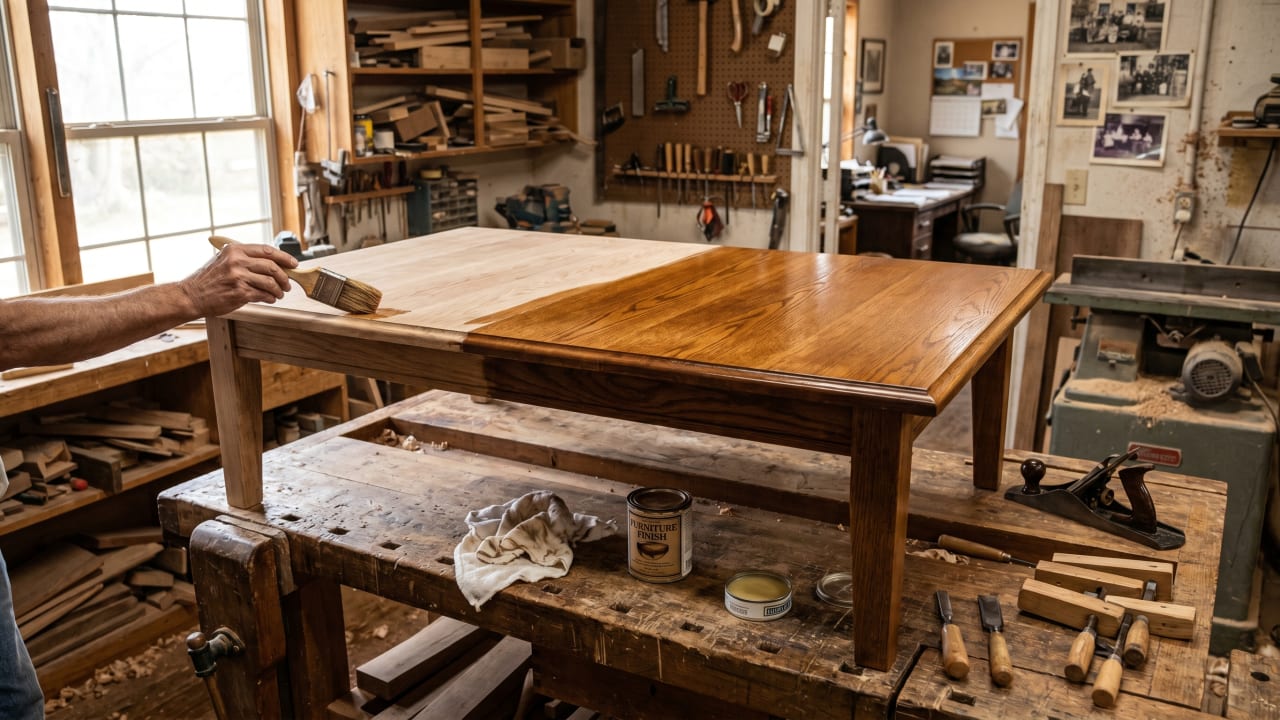
We see these pieces regularly. The drive from Plano to our Carrollton workshop is roughly 15 to 20 minutes via the Dallas North Tollway, and we also offer flat-fee pickup and delivery for clients who don’t want to load a dining table into a truck bed.
According to Angi’s 2026 furniture refinishing cost data the average professionally refinished piece runs between $341 and $931 depending on size and complexity. For a solid-wood dining set that would cost $3,000 to $6,000 new, or more, for comparable quality, that math is straightforward.
What “Furniture Restoration” Actually Means (It’s Usually Two Services)
People use the word “restoration” to mean different things. In our shop, it typically breaks into two distinct types of work, sometimes they overlap, sometimes only one is needed.
Structural Repair: Fixing What’s Broken
This covers everything that affects how the piece functions and holds together:
- Loose joints and re-gluing: The most common repair we see. Decades of seasonal wood movement breaks the original glue bonds, and joints that once fit snugly develop play. We disassemble the affected sections, clean out the old adhesive, and re-glue with modern structural adhesives under clamping pressure. A properly re-glued joint is often stronger than the original.
- Dowel replacement: When a joint has failed repeatedly or a dowel has sheared, replacement is the right call. We match the dowel diameter and wood species to the original.
- Leg repairs and cracks: Cracks along the grain on chair legs or table legs are usually repairable with epoxy consolidants and careful clamping. A clean break, particularly on a tapered leg, can often be pinned and glued invisibly.
- Cane and rush replacement: Chair backs and seats with woven cane or rush eventually sag or crack. We source matching machine-cane, hand-woven cane, and rush in appropriate weaves for the piece, then reweave to the original pattern.
- Veneer repair: Lifted, bubbled, or missing veneer sections on case goods, dressers, hutches, sideboards, can be re-adhered or replaced with matched material. This is one of the more technically demanding repairs, and the goal is a seam you can’t find.
For clients with estate-quality pieces, structural repair alone is sometimes all that’s needed, the finish is worn but acceptable, the proportions are right, and the piece just needs to stop wobbling. We’re happy to do repair only and leave the refinishing for another time or another budget cycle.
Refinishing: Restoring the Surface
Refinishing is the process of removing the old finish down to bare wood and applying a new one. It’s more involved than touching up a scratch, and it produces a more complete result. Here’s what the process actually looks like in our workshop:
- Stripping: The old finish, lacquer, polyurethane, shellac, or whatever was applied originally, comes off via chemical strippers and hand tools. We avoid aggressive power sanding on fine furniture because it removes too much surface material and can alter the profile of molded edges.
- Sanding and preparation: Once stripped, the wood is hand-sanded through progressively finer grits to remove mill marks, scratches, and grain raising. The wood needs to be dead-smooth before stain goes on, or every imperfection telegraphs through the final finish.
- Staining: If a color change is requested, or if we’re matching an adjacent piece, stain is applied and wiped, with dwell time adjusted for the wood species. Oak absorbs very differently than cherry; walnut needs different handling than mahogany. We test color on a hidden surface or scrap piece before committing to the full piece.
- Finish application: Final topcoats are lacquer, applied in our shop spray booth in multiple thin passes with light sanding between coats. Sheen is matched to what the piece calls for, satin, semi-gloss, or gloss.
For clients interested in a step-by-step walkthrough, our furniture refinishing process page explains each stage in detail.
When Restoration Makes Sense vs. When It Doesn’t
We’ll be direct here because we think it’s more useful than a sales pitch: not every piece is worth restoring, and a professional shop should tell you that if it’s true.
Almost always worth restoring:
- Solid wood, or particleboard and MDF with a real wood veneer over it (we refinish those constantly). We cannot work on laminate over particleboard, and we do not repair the MDF or particleboard core itself.
- Pieces with genuine sentimental or provenance value, where the financial math doesn’t have to win on its own
- Antiques and estate pieces where replacement cost for comparable quality is very high
- Commercial-quality frames, dining chairs, case goods, from the 1960s-1990s built to contract standards
- Pieces where only minor structural repair or surface refinishing is needed, the bar is low when the scope is limited
Less often worth the investment:
- Low-cost particleboard or MDF-core furniture, the substrate doesn’t accept stripping and refinishing the way solid wood does
- Pieces with catastrophic structural failure where more than half the joinery has failed, sometimes the repair cost exceeds what similar quality costs on the secondary market
The fastest way to get an honest read is to send us photos through our free online estimate process, we look at the photos, give you a range, and tell you whether the piece is a good candidate. No obligation, no haul-in required for the assessment.
The Dallas furniture refinishing service page has a useful overview of what refinishing covers and when it’s the right call versus a targeted repair or touch-up approach.
Cost and Timeline: What to Actually Expect for Plano Furniture Restoration
We don’t publish a price sheet because the range is genuinely wide, a single side chair refinish and a ten-piece dining set with structural repairs are both “furniture restoration” but they’re not the same job. What we can give you is honest framing:
Typical Cost Ranges
- Small pieces (end tables, side chairs, single drawers): Refinishing typically runs $275-$650 per piece depending on profile complexity and finish type. Structural repair on a single chair joint adds $75-$150.
- Medium pieces (coffee tables, four-drawer dressers, individual dining chairs with full refinish): Generally $400-$800 per piece. Sets of dining chairs are quoted as a group with a per-chair rate that declines slightly with quantity.
- Large pieces (dining tables, hutches, armoires, full bedroom suites): $800-$2,500+ depending on piece size, finish complexity, and scope of repair needed. A full dining set (table plus six chairs) typically runs $2,500-$4,000 for complete refinishing and structural repair, compared to $4,000-$8,000 or more for equivalent new solid-wood replacements.
All estimates are based on photos submitted through our online estimate form. Final pricing is confirmed once we assess the piece in the workshop, but photo estimates are accurate within 10-15% in the majority of cases. HomeAdvisor’s 2025 furniture refinishing cost data corroborates the range: professionally refinished pieces average $630, with straightforward work running lower and complex antique restorations running higher.
Typical Timeline
Most single pieces are completed in 4 to 6 weeks from drop-off or pickup, sometimes longer depending on the current workshop queue. Full dining sets or pieces with complex structural repairs typically run 6 weeks or more. Rush scheduling is sometimes possible, call to ask about current availability at 214-731-3060.
We schedule by appointment for drop-off and pickup. Clients using the Carrollton workshop directly will find it at 2425 Parker Rd. Bldg. 5. For homeowners who’d rather not transport a large piece, ask about our flat-fee pickup service.
What the Workshop Process Looks Like, Start to Finish
Here’s a realistic walk-through of what happens when a client sends us a piece:
- Free online estimate: You submit photos through our website. We review, ask follow-up questions if needed, and give you a written range with scope description. This usually happens within one business day.
- Intake and assessment: Once you approve the estimate range and schedule intake, we do a hands-on assessment of the piece in the workshop. We’ll confirm the scope, identify anything that wasn’t visible in photos, and finalize the price.
- Repair phase: Structural work comes first, re-gluing, clamping, dowel replacement, veneer repair. The piece needs to be structurally complete before stripping begins, because sanding and stripping stress the joints.
- Strip and prep: Old finish is removed, the wood is hand-sanded, and any color decisions are finalized. We’ll sample the stain color with you or against a reference photo if matching is needed.
- Finishing: Stain (if applicable), sealer coats, and topcoat in the spray booth. The number of passes depends on the finish specification.
- Delivery or pickup: Finished pieces are wrapped carefully for transport. Delivery is scheduled by appointment.
Professional restoration isn’t a one-day job, the drying and curing time between coats is what builds a durable, even finish. Rushing that process is how you get a finish that checks or peels within a few years. We don’t do that.

The Case for Restoration Over Replacement: A Practical and Environmental Argument
Beyond the cost argument, there’s a straightforward sustainability case for restoring rather than replacing. A comprehensive life cycle assessment published in Scientific Reports found that furniture production is among the more resource-intensive manufacturing processes, harvesting, milling, transportation, and finishing all carry environmental costs that are avoided entirely when an existing piece is restored rather than replaced.
The U.S. disposes of an estimated 12 million tons of furniture annually, much of it solid wood that could be refinished and used for another generation. For homeowners weighing a purchase against a restoration, the environmental math consistently favors restoration, especially for solid-wood pieces where the raw material has already been produced and the finish is the only thing that’s failed.
From a purely practical standpoint, solid wood furniture from the 1960s through the 1980s was built with old-growth and slow-growth timber that is significantly denser than the plantation-grown material in most new furniture. That density matters for finish adhesion, structural integrity, and longevity. A properly refinished piece from 1985 will outlast most new furniture at comparable price points, that’s not nostalgia, it’s material science.
When Plano Furniture Restoration Also Means Reupholstery
Many of the pieces homeowners bring to us for refinishing also need upholstery work, dining chairs with worn seat pads, club chairs with cracked leather, sofas where the frame is excellent but the fabric is finished. We handle both services under one roof, which matters more than it might seem: having a single shop manage the wood refinishing and the fabric work means the two processes are coordinated on the same timeline, and you’re not shuttling a piece between two vendors.
Our Plano upholstery service covers sofas, chairs, dining seats, and ottomans. We also keep swatch books at the workshop. Clients can come in and look through the books to pick a fabric in person, and we order it in (typically about a week to arrive at the shop) rather than picking blind from a single sample.
For clients with dining sets that need both chair refinishing and seat reupholstery, coordinating both through a single shop also means a unified aesthetic outcome, the stain color and the fabric choice get reviewed together, not in isolation.
Types of Pieces We Regularly Restore for Plano and DFW Clients
To give you a concrete sense of what we handle, here are the most common restoration projects we see:
- Dining sets: Tables and chairs from the 1970s-1990s in oak, cherry, or walnut. Often structural repair plus full refinish. These are the most common large restoration projects we handle.
- Bedroom furniture: Dressers, headboards, nightstands, armoires. The 1980s-era bedroom suites from makers like Thomasville, Bassett, and Drexel Heritage were well-built and are worth restoring. Finish renewal and hardware updates can transform these completely.
- Antiques and heirlooms: Pre-1950s pieces, Victorian, American Colonial, Mid-Century Modern, where patina preservation is a consideration. We discuss the restoration approach with the client before proceeding on anything where original finish preservation might be preferable to a full strip.
- Case goods: Hutches, sideboards, bookcases, entertainment centers. Often the finish has oxidized badly, but the wood and structure are solid. These respond very well to refinishing.
- Desks and home office furniture: With the growth of home offices, we see more desk refinishing, both executive desks passed down through families and mid-century pieces acquired at estate sales.
We Serve Plano and the Full DFW Metroplex
Andrew’s Refinishing serves Plano homeowners and businesses directly from our Carrollton workshop at 2425 Parker Rd. Bldg. 5, Carrollton, TX 75010, roughly 15 to 20 minutes from central Plano via the Dallas North Tollway. We provide flat-fee pickup and delivery throughout the DFW metroplex, including Plano, Frisco, Allen, McKinney, Richardson, and Carrollton, as well as Garland, Irving, Lewisville, Addison, Coppell, Flower Mound, and Dallas. If you’re not sure whether pickup is available for your location, call 214-731-3060 or ask through the estimate form.
Frequently Asked Questions: Furniture Restoration in Plano, TX
How much does furniture restoration cost in Plano, TX?
Cost varies by piece size, condition, and scope of work. Refinishing a single dining chair runs $275-$375; a full dining set (table plus six chairs) typically runs $2,500-$4,000. We provide free online estimates with no obligation, submit photos through our website for an accurate range within one business day. All pricing depends on size, condition, and finish complexity.
Do you pick up furniture in Plano?
Yes. We offer flat-fee pickup and delivery throughout the DFW metroplex, including Plano, Frisco, Allen, McKinney, Richardson, and surrounding areas. You can also drop off directly at our Carrollton workshop, which is about 15-20 minutes from central Plano via the Dallas North Tollway at 2425 Parker Rd. Bldg. 5.
How long does furniture restoration take for Plano clients?
Most single pieces are completed in 4 to 6 weeks from intake, sometimes longer in peak season. Full dining sets or pieces with extensive structural repairs typically run 6 weeks or more. We provide a timeline estimate at intake and communicate if anything changes during the process.
Is it worth refinishing my furniture instead of replacing it?
For solid-wood construction, oak, cherry, walnut, mahogany, or similar, almost always yes. Replacement cost for comparable quality is significantly higher than restoration in most cases. For particleboard or MDF-core furniture, refinishing is typically not viable. Send us photos and we’ll give you an honest assessment.
Can you match my existing stain or finish?
Yes. Color-matching is a routine part of our work, we test on a hidden surface area or scrap piece before committing to the full piece. If you’re matching an adjacent piece that isn’t being refinished, photos of that piece in good natural light help us get close from the start.
Ready to Find Out What Your Plano Furniture Is Worth Restoring?
If you have a piece sitting in a garage or storage room that you’ve been meaning to deal with, a dining set with a tired finish, a dresser with a loose joint, a chair with cracked upholstery, the first step is a free online estimate. Send us photos, describe what you’re seeing, and we’ll give you a clear picture of scope and cost within one business day.
Andrew’s Refinishing has been restoring furniture from our Carrollton workshop since 1980. Homeowners can request a free online estimate directly through our website, or call the shop at 214-731-3060 to talk through your piece before submitting photos. No pressure, no commitment, just an honest look at what’s possible.
For a broader overview of the repair and restoration services we offer throughout the Dallas-Fort Worth area, visit our Dallas furniture repair and restoration page. We look forward to hearing from you.