
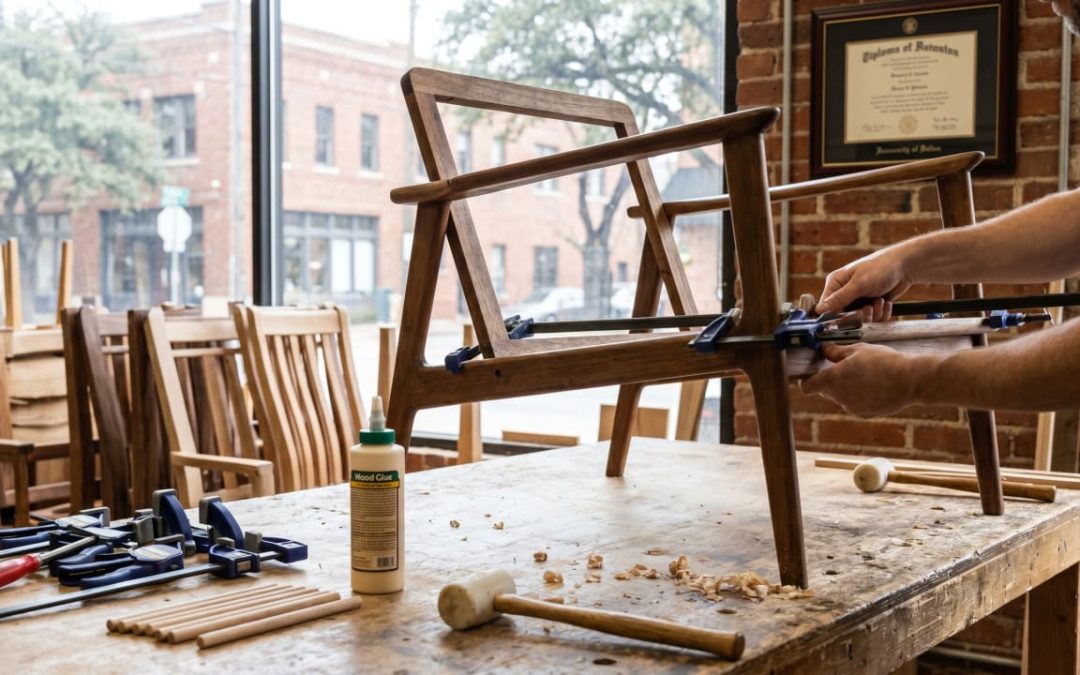
That Wobble Is Telling You Something
You pull a dining chair out from the table, and it shifts under you before you’ve even sat down. Or you notice a rung spinning freely in its socket when you carry the chair across the room. You’ve probably been ignoring it for a few weeks, maybe longer. Here’s what you should know: that wobble almost always starts small, and it rarely stays small.
A chair joint that’s just begun to loosen can often be fixed for $25-$50 per rung, or $100-$250 for a chair with several joints that need work. Leave it until the joint has fully failed, the structure has racked out of square, or a leg has cracked under the stress, and you’re looking at a significantly more involved repair. The piece is still savable in most cases, but the labor required doubles or triples. Catch it early, and it’s a straightforward shop job. Let it go, and it becomes a craftsman project.
At Andrew’s Refinishing, joint repair on solid-wood chairs is one of the most common calls we get from Dallas homeowners. The work is precise and requires patience, but for a quality chair, it’s almost always worth doing. Our Dallas furniture repair service handles everything from a single loose rung to a fully racked dining set that needs complete structural disassembly and reframing. This article walks through exactly what’s happening inside a wobbly joint, how we approach each repair category, and how to know which level of work your chair needs.
What’s Actually Wrong When a Chair Wobbles
Wood is alive in a meaningful sense: it expands and contracts with seasonal humidity changes. In Dallas, where summers pull interior humidity down sharply with air conditioning and winters bring periodic dry fronts, this cycle is pronounced. Over years of use, those dimensional changes work the glue bond at every joint. The tenon (the rounded or rectangular peg at the end of a rung or stretcher) gradually separates from the glue film inside the mortise (the hole it fits into), and you get movement.
The wobble you feel isn’t just cosmetic looseness. Once a joint starts moving, two things happen simultaneously: the remaining glue bond continues to fracture, and the wood fibers at the joint face begin to compress and round over from the constant micro-movement. That fiber compression is the hidden problem. A tenon that was originally machined to a precise diameter gets slightly rounded and slightly smaller over time, so even if you could re-glue it right now without disassembly, you’d be gluing a loose-fitting joint, and it would fail again quickly.
According to Fine Woodworking’s guide to chair joint repair, the only reliable long-term fix for a failed glue joint is complete disassembly of the affected area, thorough cleaning of both the tenon and mortise surfaces, and re-gluing with proper clamping pressure. Injection methods (squirting thin glue into a joint without disassembling it) are a short-term patch. They may feel solid for a season, but the glue has no clean wood surface to bond to, and the repair usually fails within a year.
The Family Handyman’s step-by-step guide to fixing a wobbly chair echoes this: clamping pressure during cure is as important as adhesive quality. Glue squeezed into a gap without clamping has no mechanical help setting the bond, and the joint will re-fail under load.
There are three tiers of joint failure, and knowing which tier your chair falls into determines everything about the repair approach.
The Three Tiers of Chair Joint Failure
Tier 1: Early Looseness, Glue Still Partially Intact
The joint has a little play but hasn’t fully separated. The glue film has cracked but hasn’t completely let go on all surfaces. You can feel the movement, but the chair doesn’t rock dramatically when empty.
At this stage, disassembly is still relatively clean. The joint can usually be separated by tapping the rung or stretcher with a rubber mallet, and the tenon surfaces are still reasonably smooth. After cleaning both surfaces down to bare wood, the joint can be re-glued with a modern structural adhesive under clamping pressure. This is the ideal scenario: the original joint geometry is preserved, no additional material is needed, and the repair, done correctly, is as strong as the original. Cost at this stage is typically $25-$50 per rung, or $100-$250 for a chair with multiple joints that need attention.
Tier 2: Full Joint Failure, Tenon Dimensions Compromised
The joint has separated entirely, or the tenon is visibly rounded and undersized from years of movement. Sometimes this becomes obvious when the rung or stretcher simply pulls out by hand. The mortise hole may also have worn slightly oval from the same motion.
Re-gluing alone won’t hold here, because there isn’t enough contact surface between a compressed tenon and a worn mortise. This is where dowel replacement comes in. A skilled craftsman drills out the center of the failed tenon (or the full tenon if it has broken off), inserts a new hardwood dowel matched to the original wood species and diameter, and reseats the joint. The new dowel restores the original diameter and provides clean grain surfaces for the adhesive to bond to.
Popular Woodworking covers the dowel replacement process in depth in their guide to regluing doweled chairs. The critical detail: the replacement dowel must be drilled straight down the center of the original tenon axis. Off-axis drilling changes the geometry of the joint and can cause the chair to sit crooked after reassembly. This is one of the main reasons chair joint work at this level is genuinely a shop job rather than a weekend DIY project.
Broken-leg repairs in this category follow a similar approach. When a leg has cracked at or near a joint, a dowel splice is drilled through both sections, glued, and clamped under pressure. This type of repair typically runs $150-$300 depending on the location and geometry of the break.
Tier 3: Structural Rack, Multiple Joint Failures, Frame Out of Square
This is what happens when a chair has been used in a compromised state for too long. When one joint fails and isn’t repaired, the load redistributes to the adjacent joints. Those joints then begin to fail under the asymmetric stress, and the chair gradually racks, twisting slightly out of square as the forces pull unevenly across the frame.
A racked chair can’t be repaired by fixing joints individually while the rest of the chair stays assembled. The racking means the geometry is wrong, and any new glue bonds made in the racked state will hold the chair in that distorted position. The only correct approach is complete disassembly: every rung, stretcher, and back slat removed, all old glue cleaned from every joint surface, every tenon and mortise assessed for wear, and the chair reassembled square on a flat surface with carefully set clamps.
Full structural reframing of a severely compromised chair is more labor-intensive, and the cost reflects that. But for a quality solid-wood chair, a handmade antique, or a set piece from a dining room that would cost significantly more to replace, it’s the right call. We’ve reframed chairs from Highland Park homes that were genuinely irreplaceable, matched sets from the 1950s and 1960s, solid walnut or cherry pieces that simply aren’t made the same way anymore.
What the Professional Repair Process Looks Like
Here’s how the repair sequence runs in our Carrollton workshop, from intake to finished piece:
Assessment and Documentation
Every piece gets an initial assessment to determine which tier of failure it falls into and whether any joints have damaged the wood around the mortise (enlarged mortise openings, or split wood near a failed joint). We photograph the chair in its current state and identify all joints that need attention, not just the ones the customer pointed out. It’s common for a homeowner to notice one wobbly back leg and bring the chair in, only to have the shop find two additional rungs that are just starting to separate. Better to address all of them at once than return the chair to service and get a call back in six months.
Disassembly
Joints are carefully separated using a rubber mallet and, when needed, controlled mechanical leverage. The goal is to separate the joint along the glue line rather than splitting the wood. On older chairs, some joints may be held by both glue and a small finish nail or pin from the original assembly, those fasteners are removed before the joint is separated. Rushing this step damages wood fibers and can enlarge the mortise, which complicates re-gluing.
Cleaning Old Glue
This is the most tedious part of the repair, and it’s the step that separates durable repairs from ones that fail again in a season. Every trace of old adhesive must be removed from both the tenon and the mortise before new glue is applied. Old hide glue (common on antiques) can often be softened with warm water; old PVA glue (white or yellow, the standard from the 1970s onward) requires mechanical cleaning. We use scrapers, shaped files, and sandpaper wrapped around appropriate mandrels to get the surfaces back to bare wood without changing the joint dimensions.
The reason this matters is simple: new glue bonds to wood fiber, not to old glue. A layer of failed adhesive between the new glue and the wood reduces the effective bond strength substantially, and the repair will re-fail under normal use.

Re-Gluing Under Clamping Pressure
After cleaning, joints are test-fitted dry to confirm the geometry is correct before any adhesive goes on. We use modern structural woodworking adhesives appropriate for furniture joint stress. The specific product varies by joint type, wood species, and whether the joint has any remaining slop that needs to be taken up. Glue is applied to both surfaces, the joint is seated, and clamping pressure is applied immediately.
For a full-chair re-glue where multiple joints are reassembled at once, this step requires careful sequencing. The chair has to be assembled in a controlled order, checked for square before the adhesive begins to set, and held under clamps until fully cured. If the chair comes out of the clamps even slightly twisted, it will rock on a flat floor, and that’s a different problem from a loose joint, one that requires heat and re-clamping to correct.
Dowel Replacement When Needed
When a tenon has lost enough diameter from wear or breakage that re-gluing alone isn’t viable, we drill out the tenon center and press-fit a new hardwood dowel matched to the original species. On a walnut chair, we use walnut dowel stock. On an oak chair, oak. The species match matters for both appearance (if any of the repair area is visible) and for wood movement compatibility, the replacement dowel needs to expand and contract at roughly the same rate as the surrounding material.
The replacement dowel is glued into the drilled cavity, allowed to cure, then shaped to the correct tenon dimensions and seated in the mortise under clamping pressure as a standard re-glue. On a leg with a dowel splice repair for a crack or break, the same matching principle applies, the splice dowel runs perpendicular to the crack plane to mechanically lock both sections together in addition to the adhesive bond.
Finish Touch-Up
Most chair joint repairs are structural only, and the existing finish on the rest of the chair doesn’t need to be touched. If the disassembly or re-gluing work has scratched or scuffed a small area of the finish, we can blend the affected area to match. This is localized color and sheen matching on a leg or stretcher face. Our Dallas furniture refinishing service handles full refinishing when the whole piece needs it, which is a separate scope from a structural repair.
If the disassembly reveals that the chair has other finish issues worth addressing (deep scratches, sun fading, worn lacquer), it often makes sense to combine the structural repair with full refinishing at the same time. The labor to disassemble and reassemble the chair is already part of both jobs, doing them together is more efficient than two separate shop visits.
Re-Gluing vs. Doweling vs. Reframing: How to Know Which One You Need
This is the question most homeowners want answered before they bring a chair in. Here’s a straightforward guide:
- Re-gluing only: The joint has some play but hasn’t fully separated. The tenon, when visible, looks intact and reasonably round. The chair has one or two affected joints and the overall frame is still square. This is the lowest-cost tier, typically $25-$50 per rung, or $100-$250 for a multi-joint chair.
- Dowel replacement: The rung or stretcher pulls out by hand, or the tenon is visibly compressed and undersized, or a leg has a crack or break at or near the joint. The frame is still basically square, but one or more joints have failed beyond what re-gluing alone can fix. A single broken leg with dowel splice: typically $150-$300.
- Full reframing: The chair has multiple failed joints and visibly racks when you press on it from one corner. It sits crooked on a flat surface even with no weight on it. At this stage, complete disassembly, cleaning, and reassembly is the only approach that produces a lasting repair.
If you’re unsure which category your chair falls into, the easiest test is to set it on a flat floor and press gently on each corner of the seat. A square chair will resist equally from all four corners. A racked chair will rock diagonally, pressing one corner down lifts the opposite corner. That diagonal rock is the signature of a chair that needs full reframing rather than spot repair.
According to Angi’s 2026 furniture repair cost guide, the national average for furniture repair ranges widely by scope, but straightforward joint work on solid-wood chairs consistently falls at the lower end of repair costs, particularly when addressed early. The cost penalty for delayed repair is real: once a frame racks, the labor required increases substantially because every joint must be addressed rather than just the ones that have already visibly failed.
Why Dallas Dining Chairs Work Harder Than You Think
The DFW climate is genuinely hard on wood furniture joints. Dallas summers with aggressive air conditioning create sharp swings between outdoor humidity and indoor dryness, the wood in your dining chairs is contracting and expanding noticeably across that gradient. Then in winter, heating systems pull indoor humidity down further. Furniture joints that might go 20 years without issue in a climate with moderate humidity can start to loosen after 8-10 years in a Dallas home.
Older homes in neighborhoods like Preston Hollow, East Dallas, and the Design District often have furniture that dates from the 1960s and 1970s, pieces assembled with hide glue, which was excellent in its time but has a finite lifespan and doesn’t tolerate extended dry conditions as well as modern structural adhesives. If you’ve inherited furniture from that era, or bought it at an estate sale in North Dallas or Highland Park, it’s worth having the joints assessed even if the chair isn’t currently wobbly. Preventive tightening before a joint fully fails is far cheaper than repair after failure.
For a broader look at what professional furniture repair covers across the DFW area, the wood furniture repair guide for Frisco, TX homeowners covers similar structural repair principles that apply equally well to Dallas and neighboring communities.
The Case for Professional Repair on Quality Chairs
Solid-wood dining chairs from the mid-20th century are often better constructed than mid-priced new chairs available today. Mortise-and-tenon joinery, matched wood species, solid hardwood throughout, these are construction standards that modern furniture at $100-$200 per chair typically doesn’t meet. A set of six solid-walnut dining chairs from the 1970s, properly repaired and refinished, will outlast a comparable new set purchased today.
The math is straightforward: if a set of four dining chairs costs $400-$1,000 on the used market (or significantly more new), and a full joint repair on the worst chair in the set runs $200-$250, the repair preserves a set worth keeping for a fraction of replacement cost. For a matched heirloom set that can’t be replaced at any price, a grandmother’s six-chair set in solid cherry, for instance, the calculation isn’t even primarily about money.

The woodworking principle underlying all of this repair work is worth understanding: wood-to-wood glue joints, properly fitted and bonded, are often stronger than the surrounding wood. A well-executed re-glue or dowel replacement isn’t a compromise, it restores the joint to its original structural performance. The repair doesn’t create a weak point; it creates a correctly bonded joint that will perform for years under normal use.
Lead Times and What to Expect
For single-chair joint repair work, our current turnaround is typically 2-4 weeks from drop-off to pickup. That allows time for proper adhesive cure between stages, particularly on multi-joint chairs where the re-gluing has to be sequenced carefully.
If the structural repair is being combined with full refinishing of the chair or a matched set, plan on 4-6 weeks or longer. The refinishing sequence, strip, sand, stain, finish coats, cure, takes time that can’t be compressed without compromising the result.
Pickup and delivery is available DFW-wide from our Carrollton workshop, starting at $250 round trip depending on location and job size. For most single-chair repairs, customer drop-off at the shop is the more economical choice. You can take a virtual tour of our Dallas furniture repair facility to get a sense of the workshop before you bring anything in.
Serving Dallas and the Surrounding DFW Area
Andrew’s Refinishing serves Dallas homeowners from our Carrollton workshop, with pickup and delivery available across the DFW metroplex. In addition to Dallas, we regularly work with clients from Plano, Richardson, Garland, Irving, and Lewisville. If you’re not sure whether your location falls within our service range, call us at 214-731-3060 or submit a photo estimate online and we’ll confirm logistics in our reply.
Common Questions About Wobbly Chair Repair in Dallas
How much does chair joint repair cost in Dallas?
A single loose rung or stretcher that needs re-gluing typically runs $25-$50. A Dallas chair with multiple loose joints is usually $100-$250. A broken leg requiring a dowel splice repair runs $150-$300 depending on complexity. These are the standard ranges for solid-wood chairs at our shop, a free photo estimate gives you the specific number for your piece.
Can I just inject glue into a loose joint without disassembling it?
Injection repairs are tempting because they’re fast, but they rarely last. New adhesive bonds to bare wood fiber, not to old glue residue. Without disassembly and surface cleaning, the injected glue has nothing solid to bond to, and the repair typically re-fails within a year, often leaving the joint harder to properly repair the second time around.
How do I know if my chair needs re-gluing or full reframing?
Set the chair on a flat floor and press gently on opposite corners of the seat. If it rocks diagonally, the frame has racked and needs full disassembly and reassembly. If it mostly feels solid but has a rung or two with play, re-gluing may be sufficient. When in doubt, a shop assessment will identify exactly what’s needed before any work begins.
Is it worth repairing a wobbly chair that isn’t an antique?
If the chair is solid wood and structurally sound aside from the loose joints, repair almost always makes financial sense compared to replacement. Solid-wood chairs from the mid-20th century are often better-constructed than comparably priced new furniture. Even a chair without sentimental value is usually worth repairing if it’s part of a matched set and you’d have to replace the full set to maintain matching pieces.
Do you handle pickup and delivery for chair repairs in Dallas?
Yes. Andrew’s Refinishing offers DFW-wide pickup and delivery from our Carrollton workshop, starting at $250 round trip depending on location and job size. For single-chair repairs, customer drop-off at the shop is typically more economical. Call 214-731-3060 to discuss logistics before booking.
Get an Honest Assessment Before That Wobble Gets Worse
The cost curve on a wobbly chair runs in one direction: the longer you wait, the more the repair costs. A single loose rung addressed early is a one-afternoon shop job. The same chair brought in after a year of continued use, with a racked frame and three additional failed joints, is a full disassembly-and-reframe project. The chair is still repairable in most cases, but the labor is substantially higher.
If you have a dining chair, side chair, or other solid-wood piece showing that familiar wobble, the practical move is to get a photo estimate now. The assessment is free, it’ll tell you exactly which tier of repair you’re dealing with, and no money changes hands until you decide to move forward.
Dallas homeowners can request a free online estimate by submitting a few photos through our website. Describe where the wobble is, note whether any joints have fully separated, and we’ll come back with a specific repair recommendation and price range. The shop has been family-owned and operated since 1980, and we’ve seen every variation of this repair, from a single rung on a breakfast chair to a set of twelve matched dining chairs that needed complete structural reframing. Whatever your chair needs, we can walk you through the right approach.