

Your Dallas Home Had a Fire. Now What Happens to Your Furniture?
A fire, even a contained kitchen fire or an apartment incident, leaves behind damage that goes far deeper than what you can see. The smoke and soot that penetrate your furniture’s finish, wood pores, upholstery fabric, and foam core don’t just discolor surfaces. They embed themselves chemically, and without professional intervention, the odor and residue will intensify over weeks as oxidation continues.
At Andrew’s Refinishing, our Carrollton workshop has been handling fire and smoke damage restoration for homeowners and insurance adjusters for 45 years, since 1980. We’ve worked on pieces from Preston Hollow estates, Lakewood bungalows, and craftsman homes across the metro. If you’ve just come through a fire claim in the DFW area, this guide will explain exactly what happens to smoke-damaged furniture, what we can restore, what we honestly cannot, and how the insurance billing process works. For a complete overview of our fire and water damage services, visit our Dallas fire and water damage furniture restoration page.
According to the ANSI/IICRC S700 Standard for Fire and Smoke Damage Restoration (2025 edition) the restoration industry’s authoritative guide, contents restoration after a fire event requires structured assessment, source removal, and odor management as distinct phases. That’s precisely the process we follow at our workshop, and it’s the documentation framework that insurance adjusters recognize and expect.
Why Smoke Odor in Furniture Is Not Just a Surface Problem
The biggest misconception homeowners have after a fire is that smoke smell can be cleaned off the way you’d wipe down a countertop. It cannot, and understanding why changes your expectations and your approach entirely.
Smoke is a suspension of fine particles, gases, and volatile organic compounds (VOCs). When those particles contact a cool surface, a wood dining table, an upholstered sofa, an oak credenza, they settle and begin to penetrate. On wood furniture, smoke particles enter the grain and the finish layer. On upholstered pieces, they saturate the fabric, pass through to the batting, and ultimately reach the foam core. Foam is particularly problematic: it is an open-cell material that absorbs VOCs and holds them for years. No amount of surface cleaning resolves foam contamination.
There are two fundamentally different categories of smoke residue, and they require different removal protocols:
- Dry smoke (protein and ash residue) Produced by slow-burning organic materials like wood, paper, or food. This residue is powdery, often lighter in color, and easier to vacuum and wipe from surfaces. However, it produces an extremely penetrating, pungent odor that embeds deeply even when the visible residue appears minimal. Common in kitchen fires and structural wood fires.
- Wet smoke (synthetic combustion residue) Produced when plastics, foam, rubber, or synthetic fabrics burn at lower temperatures. This smoke is sticky, smearing, and much harder to remove from wood finishes and fabric weaves. It frequently causes secondary staining on adjacent surfaces and leaves a heavier, more acrid chemical odor. Common in apartment and condo fires involving electronics, modern furnishings, or HVAC system fires.
Diagnosing which type of residue you’re dealing with, or which combination, is the first step our team takes when a piece arrives at the shop or when we conduct an on-site assessment. The protocol for stripping a walnut dining table damaged by dry smoke is not the same as the protocol for a sofa exposed to wet synthetic smoke from a burning television. Getting this wrong wastes time and money, and it fails the documentation standard that adjusters require.
Coverage in the Restoration and Remediation Magazine’s analysis of the IICRC S700 standard confirms that contents restoration requires assessment of both the intensity of impact and the type of residue before any cleaning protocol begins. This isn’t cautious bureaucracy, it’s the difference between a piece that smells clean at week two and one that off-gases odor for months.

Restoring Wood Furniture After Smoke Damage: Our Workshop Process
Wood furniture, dining tables, dressers, armoires, side tables, beds, cabinet pieces, responds well to smoke damage restoration in most cases, provided the structural integrity is intact and the smoke hasn’t caused charring through the wood itself. Here is the step-by-step process we use at our Carrollton workshop:
Step 1: Initial Cleaning and Soot Removal
Dry soot is vacuumed using HEPA filtration to prevent re-suspension of particles in the workspace. Chemical sponges, dry, rubber-based sponges designed specifically for fire restoration, are then used to wipe surfaces in single, straight passes. We never scrub in circular motions, which drives soot deeper into the grain and finish scratches. Wet smoke residue requires a chemical degreaser formulated for fire restoration, applied carefully to avoid finish damage on pieces where the existing finish is still salvageable.
Step 2: Finish Assessment, Seal or Strip?
After the initial cleaning, fire-damaged pieces always get completely stripped and sanded back to bare wood. We don’t try to seal smoke odor under the existing finish, since residual smell almost always re-emerges weeks later as the finish breathes and the wood off-gasses. Stripping is mandatory regardless of the original finish type, and it’s the only reliable way to address smoke that has penetrated past the surface layer into the wood itself.
Step 3: Stripping and Raw-Wood Odor Sealing
When we strip a smoke-damaged piece, we remove all finish layers down to raw wood. The raw wood is then inspected under raking light for soot embedding in the grain. In most cases, a light sanding removes surface contamination. Once clean, we apply a shellac-based sealer coat as a primer layer before any decorative finish. Shellac has been used as an odor barrier by restorers for generations, its film-forming properties physically seal the wood pores and block residual VOC off-gassing before the top coat goes on. You’ll see this same technique referenced throughout our Dallas furniture refinishing service because shellac sealing applies to any deeply contaminated wood substrate, not just fire-damaged pieces.
Step 4: Ozone Chamber Treatment
If residual odor persists after a full strip and sand, we move the piece into our ozone treatment chamber. Ozone is a last-resort tool, not a routine step, we use it when stripping and cleaning alone haven’t fully cleared the smell. Industrial ozone at controlled concentrations oxidizes residual VOCs, the molecular compounds responsible for smoke smell, by chemically altering them rather than masking them. The piece is treated in an enclosed space, away from people and occupied areas, and then allowed to off-gas the ozone itself before finishing proceeds. This step is particularly effective on dry protein smoke residue from kitchen and wood fires.
Step 5: Refinishing to Pre-Loss Specification
Final refinishing follows our standard process: stain matching to the original or a requested color, then finish build in our spray booth with the appropriate cure time between coats. The result is a piece indistinguishable from its pre-fire condition, fully documented with before-and-after photos at every stage for the insurance file.
Smoke-Damaged Upholstered Furniture: What Actually Has to Happen
Upholstered pieces, sofas, sectionals, dining chairs, club chairs, ottomans, require a more involved process than wood furniture, and we want to be direct with homeowners and insurance adjusters about what that process entails.
The foam must almost always be replaced. This is the single most important fact in smoke-damaged upholstery restoration. Foam is an open-cell material with enormous surface area inside each cell. Smoke VOCs penetrate foam rapidly and bond to the cellular structure in ways that no surface treatment, no cleaning product, no ozone exposure, no enzyme spray, can fully reverse. A sofa whose foam has been saturated by a fire will continue to off-gas odor for months or years if the foam is not physically removed and replaced. Cleaning the fabric while leaving the foam in place produces a piece that smells acceptable for a few weeks and then reasserts the smoke odor as temperature and humidity fluctuate, which, in the Texas climate, means frequently.
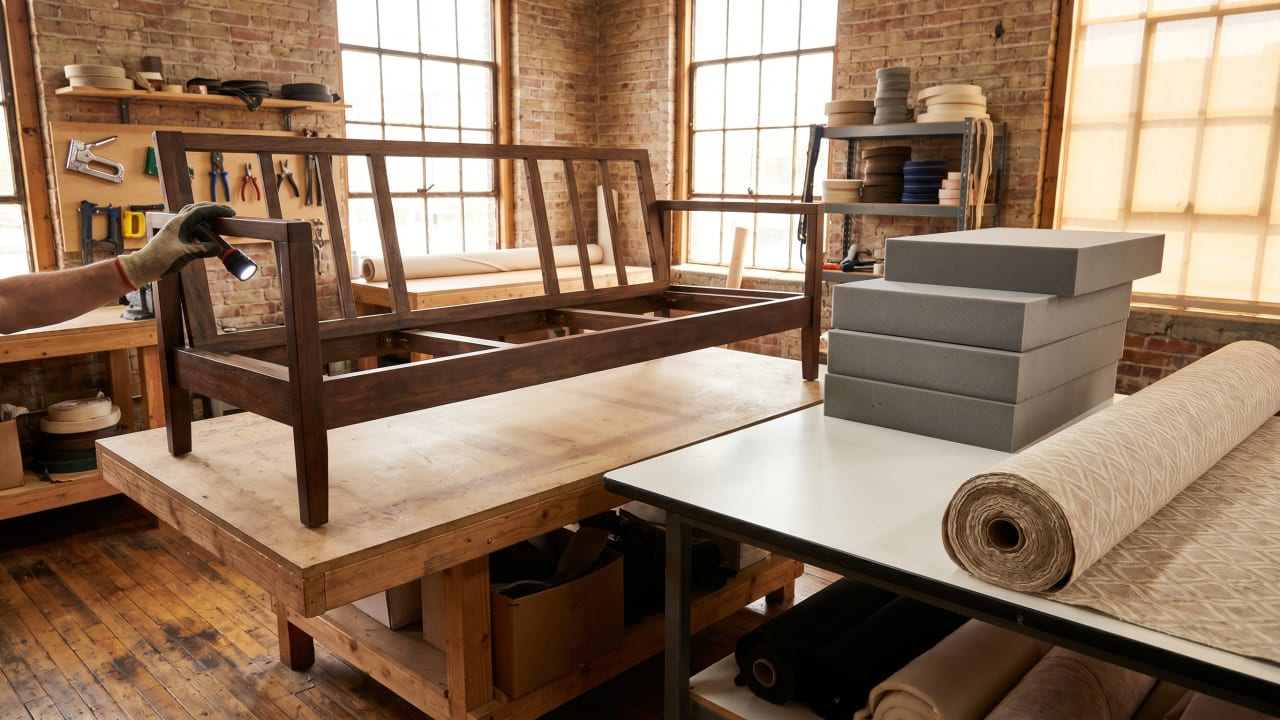
Our upholstery restoration process for smoke-damaged pieces follows these phases:
- Full fabric removal: All fabric, welt cord, dust covers, and trim are stripped from the frame. Fabric is assessed for salvageability, on insurance claims, the adjuster typically covers new fabric when the existing material has been smoke-contaminated, which applies to almost all fabric in a fire-affected home.
- Foam and batting removal: All foam, dacron batting, and fiber fill are stripped and disposed of. Our cushion and foam replacement service then rebuilds each seat, back, and arm cushion to original specifications, the correct density, ILD rating, and dimension, or to updated specs if the customer wants to improve the comfort profile while the piece is apart.
- Frame cleaning and sealing: The exposed wooden frame is cleaned of soot residue and, if smoke penetration is present in the wood, sealed with shellac before re-upholstering. Frames on pieces exposed to severe fires sometimes show heat stress at joints, we assess and structurally repair those before any fabric goes back on.
- Ozone treatment of the stripped frame: Stripped frames go into the ozone chamber to eliminate any residual VOCs in the wood substrate before new materials are applied.
- Re-upholstery to specification: New fabric, either matched to the original, selected from our swatch books (ordered in, typically about a week to arrive), or customer-supplied, goes on over new foam and batting. The result is structurally and aesthetically equivalent to the pre-fire piece, with complete photo documentation for the insurance file.
For homeowners and renters, particularly those in apartment buildings, the upholstery restoration path is often the costliest portion of the furniture claim. But it is also the most complete. A sofa rebuilt to these specs will not reassert odor. For full details on our upholstery capabilities, see our Dallas upholstery and reupholstery service.
How the Insurance Claim Process Works for Furniture Restoration in Dallas
One of the most consistent sources of stress for homeowners after a fire is the insurance documentation process. We’ve been working directly with adjusters on furniture restoration claims for decades, and the process is more straightforward than most homeowners expect, provided the contractor you hire documents correctly from the start.
Before Anything Moves: Condition Photography
Before any piece leaves your home, or before we assess it on-site, we document its pre-restoration condition with detailed photographs: overall condition, close-up of soot and smoke residue, finish condition, upholstery condition, any pre-existing damage separate from the fire event, and identifying features that establish the piece’s identity. These photos are the foundation of the insurance file and the baseline against which restoration success is measured. Note: photo-based estimates submitted through our online form are free; on-site smoke inspections carry a fee, usually around $150-$200 depending on job size and location, due at the time of the inspection.
Itemized Written Estimate by Piece
We provide a written, itemized estimate that separates each piece of furniture and lists the specific restoration scope: surface cleaning, stripping, foam replacement, fabric selection, re-upholstery labor, refinishing, ozone treatment. This format matches what adjusters expect and what most standard homeowner and renter policies cover under contents restoration. We can send the estimate directly to the adjuster, the policyholder, or both, depending on the claim structure.
For homeowners dealing with a new or pending claim, you can submit photos of smoke-damaged pieces through our free online estimate form this gets a preliminary scope and rough valuation into your hands quickly, which is useful for the initial adjuster conversation before a formal in-person assessment is needed.
Direct Billing to the Insurance Carrier
We are experienced with direct billing arrangements where the restoration invoice goes to the insurance carrier rather than the policyholder out of pocket. This requires coordination on the claim number, adjuster contact information, and policy limits, but it is a standard arrangement we’ve handled many times on furniture claims. Insurance carriers generally prefer restoration over replacement when a piece can be professionally restored to its pre-loss condition, a strong argument for involving an experienced furniture restoration shop early in the claim process, before items are discarded or cleaned improperly.
Timeline Expectations for Claims
A standard smoke-damage furniture restoration claim, assuming prompt delivery to our workshop, typically completes in 4 to 6 weeks from intake to return delivery, depending on the volume of pieces and the complexity of each scope. Cases involving full re-upholstery on multiple large sofas, or extensive refinishing on antique or custom pieces, can take longer. We communicate proactively with the adjuster throughout the project and provide a final invoice with all supporting documentation, before photos, after photos, materials receipts, and labor breakdown, at completion.
What We Can Save, and What We Cannot (An Honest Assessment)
We’ve been doing this work in the DFW area long enough to tell you the truth. Not every piece that comes through our workshop after a fire can be economically or practically restored. Being honest about this serves our customers better than overpromising, and it keeps insurance claims clean and defensible.
Pieces That Restore Well
- Solid wood furniture with intact structural integrity, dining tables, dressers, armoires, sideboards, bed frames, and end tables
- Well-constructed upholstered pieces with sound wood frames, quality sofas, club chairs, and dining chairs built on solid-wood or hardwood-ply frames
- Antique and heirloom pieces with sentimental or market value that justifies the restoration cost
- Mid-century and earlier case goods and cabinet pieces, typically better constructed than modern equivalents and worth restoring on quality grounds alone
Pieces Beyond Practical Restoration
- Pieces with structural charring through the wood frame, when the wood itself has burned significantly, structural repair cost typically exceeds replacement value
- Particleboard and MDF-core furniture, these materials swell and delaminate when exposed to heat and firefighting moisture, and smoke penetrates the substrate permanently. Most flat-pack and big-box furniture falls into this category.
- Pieces whose restoration cost would exceed 70–80% of their replacement value, depending on whether the policy is actual cash value or replacement cost value, replacement may be the correct claim outcome
When we assess a piece and it falls into the non-restorable category, we document that determination in writing with supporting photos, which supports the replacement portion of the insurance claim rather than undermining it. That documentation is just as valuable to a policyholder as a successful restoration write-up.
Industry guidance on the replace vs. restore decision for fire and smoke damaged furniture identifies the same key variables we evaluate: construction quality, extent of smoke penetration, structural integrity after heat exposure, and the sentimental or market value of the piece. Our intake assessment evaluates all four before we commit to a scope.
Dallas Apartment and Condo Fires: A Special Category
A significant portion of the smoke damage restoration work we handle comes from multi-family situations, apartment fires, condo incidents in Uptown high-rises, townhome fires, and similar urban-density scenarios. These cases have characteristics worth understanding separately.
In a multi-unit building, smoke travels through HVAC systems, under doors, and through shared walls, even into units that weren’t directly affected by the fire. A renter or owner in an adjacent unit may have furniture showing significant smoke odor and surface contamination with no direct flame exposure. This is smoke migration damage, and it is covered under most standard renters’ and homeowners’ policies as secondary smoke damage. Renters are often surprised to learn their furniture qualifies for restoration coverage even when their unit wasn’t the fire’s origin point.
We provide pickup and delivery throughout Dallas, including Downtown, Lakewood, and surrounding neighborhoods, with our Carrollton workshop approximately 25 to 35 minutes from most addresses. For furniture in a high-rise building where elevator access and building logistics are involved, we coordinate pickup timing with the building management team.
For commercial properties, restaurants, hotels, office buildings, our commercial furniture restoration services extend to fire and smoke damage on a volume basis. A restaurant that sustains a kitchen fire affecting dining chairs, banquettes, and host furniture can have those pieces processed as a batch with phased return delivery to minimize operational disruption. We carry the proper commercial documentation and can work within COI requirements for building management companies.
Serving Dallas and the Surrounding DFW Communities
Andrew’s Refinishing serves Dallas homeowners and businesses throughout the DFW metroplex from our Carrollton workshop at 2425 Parker Rd. Bldg. 5. For smoke odor removal and fire damage furniture restoration, we provide pickup and delivery to Dallas and surrounding communities including Richardson, Irving, Garland, Plano, and Lewisville. We also regularly serve clients in Fort Worth, Frisco, McKinney, Allen, and Addison, as well as the high-value residential areas of Highland Park, University Park, and Southlake. Whether your damage occurred in a Dallas condo, a Plano single-family home, a Fort Worth neighborhood, or a Garland or Irving commercial property, we handle pickup, restoration, and return delivery with full insurance documentation throughout the process.
Frequently Asked Questions: Smoke Damage Furniture Restoration
Will insurance cover smoke damage restoration for my furniture in Dallas?
In most cases, yes. Standard homeowner and renter policies cover contents restoration, including furniture, as part of a fire or smoke damage claim. The key requirement is professional documentation: itemized estimates, before-and-after photos, and an itemized invoice upon completion. We provide all of this as standard practice. Policies vary in how they value contents (actual cash value vs. replacement cost value), so reviewing your specific policy language with your adjuster before scope is finalized is always worthwhile.
Can smoke-saturated fabric be saved, or does it always need replacement?
Fabric can sometimes be cleaned if smoke exposure was minimal and the material is a tightly woven, low-absorbency type. In practice, most upholstery fabric that was in a smoke-affected home has been penetrated beyond what surface cleaning can reverse, and more critically, the foam underneath it cannot be cleaned, only replaced. Since re-upholstery requires removing all fabric anyway, we assess the fabric once it’s off the frame. In the majority of insurance claim situations, the adjuster covers new fabric as part of the restoration scope, which produces a better long-term result than attempting to salvage smoke-affected material.
How long does smoke odor removal and furniture restoration typically take?
Most smoke-damaged furniture restoration projects complete in 4 to 6 weeks from intake at our workshop. This covers surface cleaning, stripping where needed, ozone treatment, foam replacement when applicable, re-upholstery or refinishing, and final quality review. More complex cases, large sectional sofas, antique pieces requiring color-matched refinishing, or multi-piece dining sets, can take longer. We provide realistic timelines at intake and communicate proactively throughout. For insurance purposes, we can often prioritize the pieces you need most urgently, a primary bed frame or main sofa, and return those first while completing the remainder.
Do you work directly with insurance adjusters on claims?
Yes. We have a well-established process for working alongside adjusters on furniture contents claims. We communicate directly with the adjuster, provide the written estimate in the format they require, accept the claim number and carrier billing information, and submit a final invoice directly to the carrier. Homeowners don’t need to act as the go-between on documentation. According to guidance on navigating smoke damage insurance claims involving a professional restoration contractor early, before items are discarded or improperly cleaned, is one of the most important steps a policyholder can take to protect their claim.
Can you assess smoke damage from photos before I make an insurance claim?
Yes, this is how most claims start with us. You can submit photos of each affected piece through our online estimate form and receive a preliminary scope and valuation within 1 to 2 business days. For pieces we need to inspect on-site, a fee applies, usually around $150-$200 depending on job size and location, due at the time of the inspection. We don’t handle emergency on-site cleanup, our role is to photograph for the insurance file and price the restoration scope. Either path gives homeowners a professional third-party assessment to bring into the adjuster discussion from a much more informed position.
Start Your Smoke Damage Claim with a Free Furniture Assessment
If you’re a homeowner, renter, or property manager dealing with the aftermath of a fire, the most useful step you can take right now, before the adjuster finalizes the contents scope, is getting a professional furniture restoration assessment in writing. The photo-based assessment turns around in 1 to 2 business days, and it puts accurate restoration valuations in your hands before any negotiation begins.
You can request a free online estimate by submitting photos of your smoke-damaged furniture directly through our website. We’ll respond with a preliminary scope, timeline, and valuation that supports your insurance file. Or call us at 214-731-3060 to speak with someone at our workshop about your specific situation, pickups throughout the metroplex are part of the service.
Andrew’s Refinishing has been restoring DFW furniture since 1980. Fire and smoke damage claims are some of the most time-sensitive projects we handle, and some of the most meaningful, because the pieces involved often carry significant personal or financial value. We’re glad to help you navigate both the restoration work and the insurance process, from the first photo assessment through the final return delivery.