

Running a Fort Worth Hotel Refresh Without Closing the Property
If you manage or own a hotel property in Fort Worth, whether it’s a downtown property near Sundance Square, a boutique in the Cultural District, or a full-service hotel near the airport, you already know the furniture math. Case goods cycle out every seven to ten years, soft goods faster. Brand standards don’t wait. And closing an entire floor, let alone an entire property, for a furniture refresh isn’t an option when occupancy is the lifeblood of the operation.
The answer isn’t to ignore the wear or push it another two years hoping guests don’t notice. The answer is phasing: a coordinated, floor-by-floor, lot-by-lot approach that lets your property keep selling rooms while the FF&E gets restored or refreshed. At Andrew’s Refinishing, we’ve handled commercial furniture projects for hotels, restaurants, churches, and offices across the Dallas-Fort Worth metroplex since 1980. Our commercial furniture refinishing and reupholstery services are built around the operational reality that hospitality clients face: work has to happen around guests, schedules need to flex, and every piece that comes back to a room needs to meet the same finish and fabric standard as the piece next to it.
This guide is for property managers, GMs, and FF&E coordinators who want a clear picture of how a phased hotel refresh actually works, the planning, the logistics, the finish specifications, and the vendor accountability questions you should be asking before you sign anything.
According to industry FF&E planning guidelines hotel operators should maintain a reserve of 4–5% of annual revenue specifically for FF&E capital expenditure, a figure that underscores just how significant furniture lifecycle management is to the bottom line. Getting the refresh strategy right isn’t a nice-to-have; it’s a budget discipline. And for properties competing in a market that runs the gamut from historic charm to modern convention-center full-service, the furniture tells the brand story whether you intend it to or not.
Hospitality Refresh Cycles: What the Industry Actually Expects
The hospitality industry runs on two parallel furniture clocks, and they rarely align. Soft goods, upholstered seating, headboards with fabric panels, banquette cushions, lobby chairs, typically cycle on a four-to-seven-year schedule driven by visible wear, brand standards audits, and the accelerated punishment that commercial upholstery takes compared to residential use. A lobby chair in a busy hotel absorbs more daily contact in a week than a residential sofa sees in a month.
Hard goods, the wood case goods that make up the bulk of guest room furniture (dressers, nightstands, desks, TV consoles, headboard frames), have a longer lifespan. Well-constructed solid-wood case goods, properly finished, can legitimately run seven to twelve years before they need anything beyond routine maintenance. The problem is that most mid-market hotel case goods aren’t solid wood; they’re veneer over MDF or particleboard, and that construction is far less forgiving. Moisture from air conditioning condensation, housekeeping chemical exposure, and the general abuse of high-turnover rooms adds up quickly. According to hotel FF&E planning resources the average furniture asset lifecycle in hospitality is seven years, but that figure conceals significant variance between solid-wood and engineered-panel construction.
Brand standards add another layer of urgency. Franchise agreements often mandate Property Improvement Plan (PIP) compliance on a fixed schedule, typically every five to seven years, and a PIP audit that finds worn or mismatched case goods can trigger required capital spend whether you’ve budgeted for it or not. Understanding which pieces in your property are refinishable versus which ones are genuinely at end-of-life is a critical first step in controlling that spend.
The good news: industry data on hotel case goods refinishing consistently shows that refinishing solid-wood case goods costs roughly 6–10% of replacement cost, with a quality catalyzed finish that’s actually more durable than the factory-applied coating on most new commercial furniture being delivered today. That’s a meaningful number when you’re looking at a 100-room property with six or seven pieces per room. At those ratios, case goods refinishing can represent savings of $70,000–$180,000 compared to full replacement, before factoring in disposal logistics or new-furniture lead times.
Refinishing vs. Replacement: The Property Manager’s Math
The refinish-or-replace decision should be made piece by piece, not as a blanket policy. Here’s the framework we use when a hotel client walks us through their inventory:
Strong candidates for refinishing:
- Solid-wood or solid-wood-veneered case goods with structurally intact frames. Surface damage, scratches, finish wear, edge dings, heat marks from guest irons, is entirely restorable.
- Lobby occasional tables, console tables, and reception millwork. These are often custom or semi-custom pieces that genuinely can’t be replaced like-for-like without a long lead time and significant cost premium.
- Conference and banquet chairs with solid frames but worn finishes or failed upholstery. Reupholstering with a Crypton or performance-spec fabric and refinishing the wood frame gives you a piece that will easily outlast a direct replacement from a catalog source.
- Historic or architecturally significant millwork in legacy properties. These pieces often can’t be matched with new product at any price and represent significant character value for the property.
- Headboard frames and desk units where the structure is sound but the finish has oxidized, chipped, or darkened unevenly across a floor.
Better candidates for replacement:
- Particleboard or MDF-core pieces with swollen or delaminated substrate from moisture exposure. Once the core fails, the finish doesn’t have anything solid to hold.
- Pieces with major structural damage, shattered drawer runners, carcass separation, failed joinery that has been re-glued multiple times already and lost its integrity.
- Upholstered pieces where the foam core has fully collapsed and the frame itself is also compromised beyond practical repair.
On a typical 100-room hotel refresh, we regularly find that 60–75% of the case goods are solid refinishing candidates. For an even deeper look at how our refinishing process works on commercial and residential lots alike, see our furniture refinishing service page which covers the stripping, staining, and finish sequence in detail.
Phasing the Work: Floor by Floor, Low-Occupancy Windows, and Swing Rooms
A well-executed hotel furniture refresh doesn’t look like a construction site. It looks like a rotating schedule that the front desk manages the same way they manage rooms under a maintenance hold. The key is treating furniture refresh as an operational project with a logistics plan, not a renovation event that gets bolted onto normal operations and hoped for the best.
Here’s how a typical phased refresh works with Andrew’s Refinishing as the furniture vendor:
Floor-by-floor sequencing. We typically work one floor at a time, staging pickup and return of case goods to align with your housekeeping and front desk schedules. A standard guest floor of 15–20 rooms can be cycled through our Carrollton shop, stripped, refinished with catalyzed lacquer, and returned, in two to three weeks, depending on scope per piece. That means one floor is always in rotation while the rest of the property operates normally. According to occupied hotel renovation best practices phasing in 25–50 room increments is the industry standard for maintaining 75–85% of sellable inventory during a refresh, a principle that applies just as well to a furniture refresh as to a hard renovation.
Low-occupancy windows. Downtown and convention-corridor properties experience predictable soft weeks between major bookings. University-adjacent hotels have shoulder windows at semester breaks. Airport-adjacent properties often have mid-week lulls in leisure booking. We work with your revenue manager to front-load pickup and delivery during weeks when three to four floors can come out simultaneously without impacting sellable inventory, accelerating the overall project timeline without increasing room pressure.
Swing room strategy. For properties that want to accelerate the timeline, we can work with a dedicated block of swing rooms, rooms that stay held throughout the project and serve as the temporary staging point for freshly-refinished pieces before they rotate back into service. This approach lets us move faster without the piece-by-piece logistics of individual room holds.
In-room touch-up vs. shop refinishing. Not every piece in a property requires a full shop refinish. For guest rooms with minor surface wear, light scratches, small edge nicks, finish dulling, our technicians can perform in-room touch-up work during a planned maintenance window. Full refinishing (strip-to-bare-wood, restain, catalyzed topcoat) happens at our Carrollton shop; touch-up work can happen on-site. We assess each piece during the initial walk-through and quote both options so you can allocate budget and schedule accordingly.
The critical variable in all phasing scenarios is lead time. Our shop runs commercial lots on a scheduled basis, not a same-week turnaround. A 100-room case goods refresh at the lot sizes we typically handle runs eight to fourteen weeks from first pickup to last return. That’s planning work, and it’s why we strongly recommend a walk-through or detailed photo survey three to four months before your target completion date.
Finish and Fabric Standards: What Holds Up in a Hotel
Finish specification is where hospitality work diverges most sharply from residential refinishing. A guest room dresser is handled by hundreds of different people over a year, each with different cleaning habits, different chemical exposures from housekeeping carts, and wildly varying levels of care. The finish has to be genuinely durable, not just beautiful on day one.
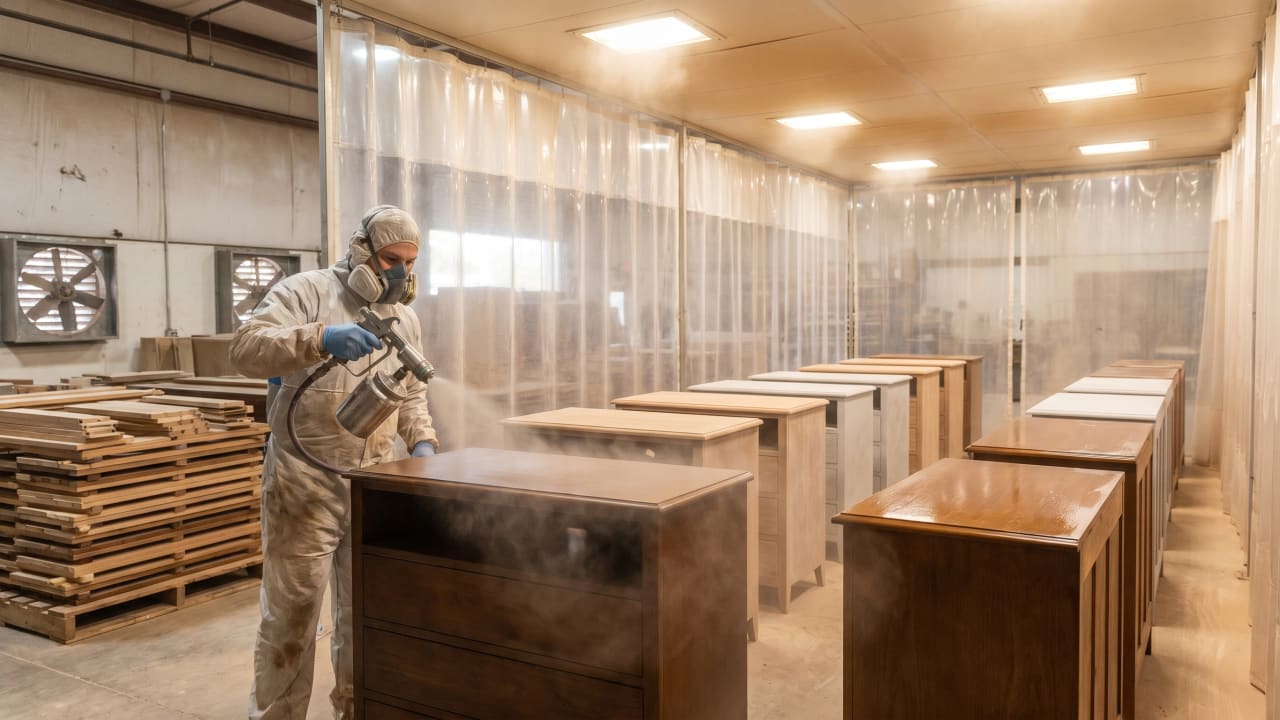
For all hard-good case goods in hotel environments, we specify polyurethane or pre-catalyzed lacquer, commercial-grade finish systems that produce a surface hardness and chemical resistance well beyond standard residential nitrocellulose lacquer. These industrial-grade coatings are applied heavier than most factory finishes on new commercial furniture and hold up better against the cleaning chemicals, moisture, and mechanical abrasion that hotel housekeeping generates daily. This is not a product available at a hardware store; it’s a professional-grade commercial finish system that requires a proper spray environment to apply correctly, and it’s what we use on every hotel engagement.
For upholstered commercial pieces, lobby seating, banquette upholstery, dining and banquet chairs, conference seating, fabric specification matters as much as construction. We recommend and source Crypton and Sunbrella contract-grade performance fabrics for all high-contact hotel applications. Crypton’s commercial contract line is the preferred specification of major hotel brands including Marriott, Hilton, and Disney because it delivers PFAS-free stain, moisture, and microbial resistance in a fabric that still looks and feels like designer-quality upholstery, over 60 million yards installed in hotels, restaurants, cruise ships, and healthcare facilities. Sunbrella’s commercial upholstery line provides comparable durability with exceptional UV and fade resistance, making it an important option for lobby and lounge spaces with significant sun exposure through west-facing windows or large atriums, a common architectural feature in DFW hotel stock.
For a comprehensive overview of our upholstery services and fabric capabilities, see our upholstery service page. We work with commercial fabric reps for large specified lots and keep swatch books at the shop for sample review, so hotel clients aren’t waiting on third-party sourcing to get their project moving.
Cushion and foam specification for hotel seating deserves its own mention. Compressed or failed foam is one of the most visible quality signals in a lobby or lounge, guests notice immediately when a chair seat has bottomed out. We rebuild commercial seating cushions to original or upgraded density specs, with high-resilience foam appropriate for contract-use frequency. For details on commercial cushion rebuilds, see our cushion and foam replacement service page.
Vendor Accountability: What Property Managers Should Require
Hotel furniture refresh projects involve significant per-room investment, tight operational windows, and brand-standard compliance stakes. The vendor accountability requirements for this kind of work are different from a residential refinishing job, and property managers and GMs should expect their refinishing contractor to meet commercial project standards as a baseline.
Certificate of Insurance (COI). We provide COIs naming the property management company and ownership entity as additional insured parties as standard practice on any commercial engagement. Minimum commercial general liability of $1 million per occurrence / $2 million aggregate is standard; we can match higher limits for large or complex projects. Workers’ compensation coverage is current and on file. If your hotel management agreement or franchise agreement specifies vendor insurance minimums, send us the requirements upfront, we’ve handled COI requests for national flag properties before and the process is routine.
Written project schedule. Every commercial hotel engagement includes a written room sequence and return schedule, shared with your front desk and housekeeping leads so they know exactly which rooms are in rotation at which time. We don’t show up and improvise; phased hotel work runs on a schedule that your revenue management team can plan around from day one of the engagement.
Before-and-after documentation. Every piece that leaves your property for shop refinishing is photographed in its pre-work condition, and the finished piece is documented before return. This serves two purposes: it protects both parties from damage disputes, and it creates a visual record of the refresh that property owners can use in PIP compliance documentation.
Volume pricing on identical-specification lots. Hotel case goods are typically spec’d to a single standard, every dresser is the same footprint, the same stain, the same hardware. That’s actually ideal for refinishing efficiency, because once we’ve matched the stain formula and dialed in the finish schedule for the first room’s worth of pieces, every subsequent lot runs faster. We reflect that efficiency in volume pricing, quoted on a per-piece basis against the total lot. The larger the lot, the better the per-unit economics.
One additional note for properties that have experienced water intrusion events, HVAC failures, or other damage events: our fire and water damage restoration service is insurance-billable and we work directly with adjusters. If a floor of guest rooms sustained furniture damage from a roof leak or plumbing failure, the restoration path runs through an adjuster-approved scope of work, and refinishing damaged-but-structurally-intact case goods is almost always on the approved list as a lower-cost alternative to full replacement.
Fort Worth Hotel Submarkets We Serve
Fort Worth’s hotel inventory is spread across several distinct submarkets, each with its own property type and operational profile. We work with commercial clients across all of them:
- Sundance Square and downtown. Full-service and boutique properties in the urban core. Lobby millwork, banquet and event furniture, and conference room case goods are common projects here. Phasing windows are tightly coordinated with convention and event calendars.
- Cultural District. Properties near the Kimbell, the Modern, and the Amon Carter attract a design-conscious guest. Lobby and lounge upholstery spec matters here, performance fabric that also reads as premium is the standard.
- Stockyards historic properties. These properties often have custom millwork, period-appropriate finishes, and case goods that genuinely cannot be replaced with catalog product. Refinishing is often the only viable path to maintaining the property’s aesthetic character and guest experience.
- TCU area and the southwest side. Extended-stay and mid-select properties with high per-piece volume and predictable semester-break scheduling windows that work well for accelerated phasing.
- DFW Airport corridor and Alliance area. High-volume business travel properties with heavy daily case goods use. Catalyzed finishes and contract-grade upholstery are non-negotiable specifications for these environments.
From our Carrollton workshop at 2425 Parker Rd. Bldg. 5, Fort Worth is typically 45–55 minutes depending on routing and time of day. For large commercial lots, we operate our own pickup and delivery, furniture doesn’t sit in an unfamiliar moving truck. We coordinate directly with your housekeeping and front desk teams for every pickup and return.
Hotel Furniture Types We Refinish and Reupholster
For property managers scoping a refresh, here is a practical breakdown of the furniture types we handle most frequently in commercial hospitality projects:
- Guest room dresser and nightstand sets. Typically three to five pieces per room. Full strip-refinish with catalyzed topcoat. Hardware replacement or polish quoted separately based on condition.
- Desk and desk chair units. Desk surfaces take significant daily abuse from laptops, bags, and cleaning chemicals. We refinish the carcass and apply an abrasion-resistant catalyzed topcoat calibrated for high-use horizontal surfaces.
- Headboard frames and upholstered panels. Wood frames refinished; fabric panels reupholstered in specified performance fabric to match brand standard. We can match existing headboard profiles or adapt to a new specification.
- Lobby occasional tables and console tables. Often the highest-visibility pieces in a property. We restore these to a finish level appropriate for the hotel’s tier and the local market.
- Dining and banquet chairs. Frame refinishing plus reupholstery in Crypton or Sunbrella contract fabric. Large-lot pricing available for full event inventory.
- Restaurant and lounge banquette upholstery. Full strip-and-rebuild on banquette seating, with commercial-grade foam and performance fabric. This work typically happens during an overnight or early-morning window in food-and-beverage spaces.
- Conference tables and credenzas. Large surface refinishing with a durable catalyzed finish appropriate for conference room use, resistant to pens, cups, and laptop abrasion.
- Lobby millwork and built-in reception desks. Decorative wood columns, millwork panels, reception desk faces. In-place or shop work depending on scope and property configuration.
Service Area: Fort Worth and the Surrounding DFW Metroplex
Andrew’s Refinishing serves Fort Worth hotel and commercial clients from our Carrollton workshop, with pickup and delivery covering the full Dallas-Fort Worth metroplex. In addition to Fort Worth properties, we regularly work with commercial clients in Dallas, Irving, Arlington, Lewisville, Grapevine, Southlake, and Flower Mound. For hotel groups with multiple properties across DFW, we coordinate multi-property lot scheduling from a single project scope, which simplifies vendor management and COI paperwork for regional property managers. Call 214-731-3060 or use our online estimate form to start the conversation.
Starting Your Hotel Refresh: The Walk-Through Process
For commercial hotel projects, we do not quote blind. A photo survey works well for smaller lots, 20 to 30 pieces, where condition and spec can be read clearly from images. For a full-floor or full-property refresh, we recommend an on-site walk-through. A walk-through takes two to three hours on a standard mid-select property and covers: piece-by-piece condition assessment, substrate identification (solid wood versus veneer versus composite), finish condition scoring, upholstery assessment, and preliminary lot sizing. You receive a written quote broken down by room type within five to seven business days of the walk-through.
The walk-through is free for qualifying commercial projects. It’s how we avoid surprises, for you and for us. A piece that photographs as a refinishing candidate sometimes turns out to have a compromised substrate when seen in person, and it’s better to know that before a contract is signed than after work has started.
Property managers can request a free commercial estimate online with photos to get a ballpark before scheduling the walk-through. Include the number of pieces by type, the property address, and your target timeline in the estimate request, and our commercial team will respond within one business day to discuss next steps.
For context on the full range of commercial work we handle across the DFW area, including restaurant furniture, church seating, and office case goods, visit our full services page.
Frequently Asked Questions: Hotel Furniture Refresh
How do you minimize room downtime during a hotel furniture refresh?
We work from a written room sequence schedule coordinated with your front desk and housekeeping teams before a single piece leaves the property. Typically, we stage pickup to align with your lowest-occupancy nights and return pieces within the agreed turnaround window, usually two to three weeks per floor for a full case goods refinish. Swing rooms, low-occupancy block scheduling, and in-room touch-up work for minor surface repairs that don’t require shop time all further reduce room-out-of-service days. You receive the project schedule in writing before work begins so revenue management can plan around it and block rooms accordingly.
Can you handle a 100-room dresser refinish lot for a hotel property?
Yes. Our Carrollton shop is configured for commercial lot work, and identical-specification pieces benefit from a dialed-in workflow where the stain formula and finish schedule are established on the first batch and applied consistently to every subsequent piece. A 100-room property with six to eight case goods pieces per room represents a lot of 600–800 pieces, which we phase through the shop over an eight-to-fourteen-week period coordinated with your property’s occupancy calendar. Volume pricing applies to lots of this size and is quoted on a per-piece basis against the total lot count. Pickup and delivery to and from your property is included in the commercial scope.
What finishes hold up for hospitality use?
For hotel case goods, we specify polyurethane or pre-catalyzed lacquer, commercial-grade finish systems that produce a surface hardness and chemical resistance well beyond standard residential lacquer. Industrial-grade commercial finishes withstand repeated exposure to housekeeping cleaning chemicals, moisture, and the mechanical abrasion of daily hotel use better than most factory-applied finishes on new commercial furniture. For upholstered pieces, we specify Crypton or Sunbrella contract-grade performance fabrics, the same specifications used by major hotel brands worldwide for stain, moisture, and microbial resistance in high-contact hospitality applications.

Do you provide COIs and work on PO terms for hotel accounts?
Yes on both. We issue Certificates of Insurance naming the property management company and ownership entity as additional insured parties as standard practice on any commercial engagement. Minimum CGL coverage is $1 million per occurrence / $2 million aggregate; higher limits are available for large-scale projects. For established hotel accounts and property management groups overseeing multiple DFW properties, we work on purchase order terms with net-30 invoicing after delivery. Large-scale projects can be structured with a phased payment schedule aligned to the delivery milestones in the written project schedule.
Do you handle fire or water damage furniture restoration for hotel insurance claims?
Yes. When a hotel property experiences a damage event, water intrusion from a roof or plumbing failure, smoke and soot from a kitchen or HVAC incident, we work directly with your insurance adjuster on an approved scope of work. Refinishing structurally intact case goods is typically approved as a lower-cost alternative to full replacement, and our before-and-after documentation process satisfies standard adjuster requirements. We have handled insurance-billable commercial furniture restoration for DFW properties and understand the documentation and timeline constraints that come with a covered claim. Learn more about our fire and water damage restoration services for commercial and hotel clients.
Ready to Plan Your Hotel Furniture Refresh?
Forty-five years of commercial furniture work across the Dallas-Fort Worth metroplex has given Andrew’s Refinishing a clear picture of what a well-executed hotel refresh looks like, and what goes wrong when the planning and vendor accountability aren’t in place from the start. The properties that get it right treat furniture refresh as an operational project: phased, scheduled, documented, and delivered to a finish standard that stands up to what hospitality environments actually demand.
We serve hotel properties and commercial clients across the DFW area from our Carrollton workshop. We bring the same craft-level quality to a 200-piece banquet chair lot as we do to a single residential dining table, because a catalyzed finish applied without care fails just as visibly on a commercial piece as on an heirloom. Call us at 214-731-3060 to discuss your property’s timeline and scope, or to schedule a complimentary walk-through.
Property managers can request a free commercial estimate online include your piece count by room type, the property address, and your target timeline, and our commercial team will follow up within one business day to schedule a walk-through or discuss a photo-based quote for smaller lots.