
Solid-Wood Repair for Preston Hollow Homes
The dining table in the front room has been in your family since before you were born. One leg wobbles every time someone pulls a chair. The top has a deep gouge from a move fifteen years ago, and two of the mortise-and-tenon joints on the sideboard creak whenever you open a drawer. You know the piece is worth fixing. You just want someone who actually knows how.
Preston Hollow has always been a neighborhood with furniture worth keeping. Estate homes that have traded hands over generations often come with the dining sets, bureaus, buffets, and armchairs that furnished them. Quality solid-wood pieces from the mid-twentieth century, particularly American walnut, mahogany, and cherry, were built with joinery methods that hold up for decades. When they finally fail, it is almost never the wood itself. It is the glue, the dowels, or decades of seasonal movement working on joints that were never reinforced.
At Andrew’s Refinishing, we have been doing this work out of our Carrollton workshop since 1980, when John founded the shop. Forty-five years of solid-wood structural repair means we have seen every joint failure, gouge depth, and veneer separation that DFW kitchens and dining rooms can produce. If you have a piece in Preston Hollow worth saving, our Dallas furniture repair service is the resource most homeowners in this part of the city rely on when a piece is too good to lose.
This article walks through the specific types of solid-wood structural repair we handle most often for clients in this area: loose and failed joints, crack and leg repairs, two-part epoxy gouge fills, veneer patching, cane and rush replacement, and finish blending on repaired surfaces. We will cover what each repair actually involves, when a piece crosses from repair into full refinishing, and what to expect on pricing and lead time.
Why Preston Hollow Furniture Joints Fail (and What We Do About It)
Solid-wood furniture expands and contracts with humidity across every season. In the Dallas climate, that movement is significant: humid summers followed by winters when forced-air heating drops interior relative humidity into the 20-to-30 percent range. Over time, that cycling loosens glue bonds in mortise-and-tenon joints, doweled connections, and corner blocks. The joint does not fail all at once. It loosens gradually over years, and by the time you notice the wobble, the old glue has usually become a barrier rather than a bond.
According to Popular Woodworking’s guide on re-gluing furniture, the single biggest mistake in a joint repair is applying new adhesive over old. Old hide glue or PVA residue prevents fresh adhesive from penetrating the wood fibers, and the joint fails again within a year or two. This is why a proper re-glue requires complete disassembly, mechanical removal of the old adhesive from both mating surfaces, and fresh glue applied to clean wood.
For antique pieces that used hide glue originally, which includes most furniture built before 1960, we often re-glue with a compatible adhesive that allows for future repairs without damaging the piece. For structural doweled joints, we follow the practice detailed by HowStuffWorks on repairing wooden furniture joints: disassemble the joint completely, extract or drill out the old dowels, and replace with fresh hardwood dowels sized to restore the original geometry. The new dowels are scored along their length to improve glue distribution, then set with fresh adhesive and clamped for a full 24-to-48 hours.
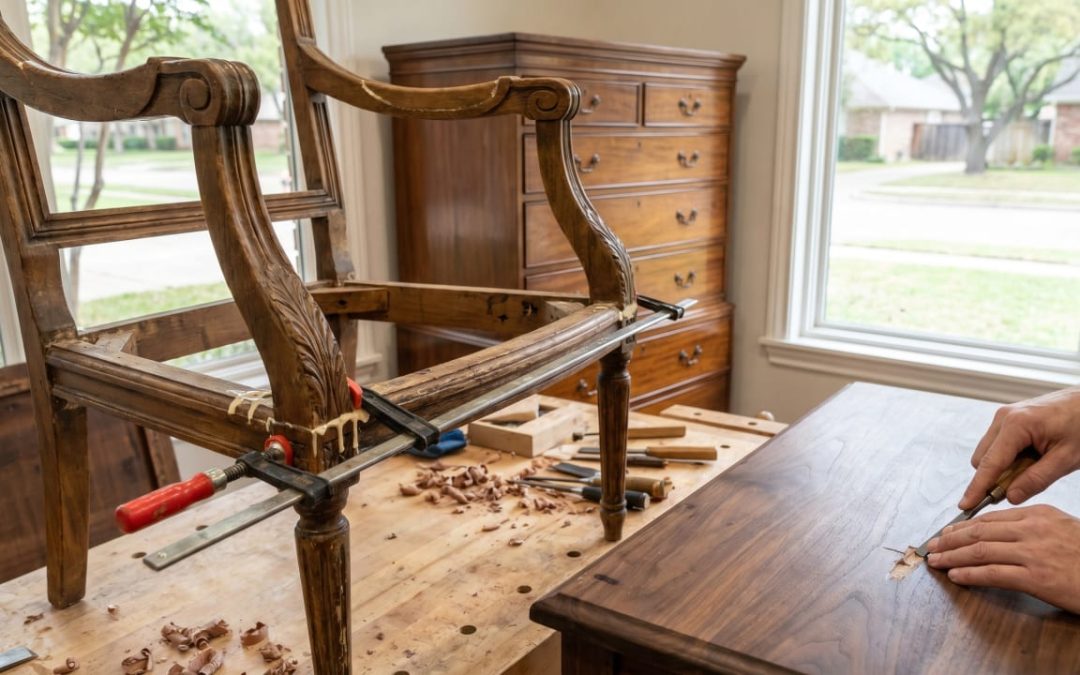
For dining chairs, which are the most common repair job we receive from the Preston Hollow area, a full re-glue typically means disassembling the chair down to its individual components. If only one joint has failed, the surrounding joints are almost certainly close behind. Tackling all of them in a single pass gives you a chair that should hold for another thirty to forty years rather than returning to the shop in two.

Gouge Fills, Crack Repairs, and Leg Work
Surface damage on a solid-wood piece tells different stories depending on its depth. A shallow scratch that catches a fingernail is a finish problem, not a wood problem, and can often be addressed during a finish-blending pass without touching the wood at all. A gouge that has removed wood fiber is different. It needs to be filled before finish work can begin.
For deep gouges on furniture surfaces, we use a two-part epoxy fill. As explained by Family Handyman’s guide to epoxy wood repair, two-part epoxy is ideal for furniture gouge fills because it does not shrink as it cures, bonds mechanically to the surrounding wood fibers, and can be sanded flush without leaving a depression. Once the epoxy is fully cured and sanded to the surrounding surface profile, we apply toner and finish in multiple passes to blend the repaired area into the existing finish. On tabletops, we do not do spot touch-ups: tops always receive a full refinish to achieve a consistent result across the entire surface.

For cracks in solid-wood chair legs, table aprons, or case sides, the approach depends on whether the crack is structural or cosmetic. A surface check along the grain is typically stabilized with thin cyanoacrylate followed by a finish repair. A structural split, where the wood has separated enough to affect load-bearing capacity, is re-glued under clamping pressure with an appropriate adhesive, then allowed to cure fully before any finish work.
Leg repairs are among the most structurally demanding repairs in furniture work. A broken leg joint at the seat rail or apron typically requires complete disassembly of the surrounding chair structure, replacement of failed dowels or tenons, and careful re-clamping to restore the original geometry. When a leg is too damaged to save, replacement legs can be turned to match the original profile from an appropriate species, provided the existing leg is available as a template.
Veneer Patching and Cane or Rush Replacement
Many pieces from this part of Dallas, particularly case furniture from the 1950s through the 1980s, use solid wood for the structural components and veneer for the panel faces. Veneer lifts when the substrate adhesive fails, typically along the edges and corners where moisture infiltration is most likely. Patching veneer requires carefully lifting the affected area, removing the failed adhesive, and re-bonding with fresh adhesive under clamping pressure or a vacuum press. When the original veneer is too damaged to save, we source matching species veneer for the patch.
One scope note worth knowing: we refinish particleboard and MDF furniture when it carries a real wood veneer face. The veneer is workable; the substrate just needs to be structurally sound. If the particleboard core itself has swelled or delaminated, we will tell you honestly at the estimate stage whether repair makes economic sense.
Cane and rush seat replacement surprises many clients who assumed those chairs were beyond help. We handle traditional hand-woven cane and rush seating on chairs and settees. This is entirely different from wicker or vinyl webbing, which is outside our scope. If you have dining chairs with woven cane seats that have sagged, split, or developed holes, or rush seats that have dried and broken down, those are strong candidates for restoration rather than full chair replacement.
Finish Blending on Repaired Areas
Getting the structural repair right is only half the job. The repaired area also needs to disappear visually, and that requires careful color-matching and finish blending. We match color directly on the actual piece, not from sample boards or paint chips. The reason is simple: two boards of the same species can differ significantly in tone based on age, prior finish, and grain pattern. Matching to the actual piece means matching to what is in front of us.
Color matching typically takes three to six passes. We apply toner, evaluate under shop lighting, adjust, and repeat until the repaired area reads the same as the surrounding surface. One firm boundary: we cannot stain wood lighter than its natural color. If the existing finish has darkened significantly with age or prior stain applications, the goal is to match that aged tone.
For residential furniture, our standard finish is lacquer. It gives a consistent, professional result, dries hard enough to withstand daily use, and can be repaired in future passes if the piece is damaged again. We do not use oil finishes, wax, or conversion varnish on residential pieces.
The distinction between a repair-with-finish-blend and a full refinish matters for both scope and budget. When the damaged area is isolated, a repair and blend keeps the rest of the original finish intact, which often has the patina and character the owner wants to preserve. When the damage is extensive or the existing finish has failed across the whole piece, a full strip and refinish is the right call. We will tell you which category your piece falls into before any work begins.
What Makes a Piece Worth Repairing
The repair-versus-replace question comes down to three factors: structural integrity of the solid-wood components, species and construction quality, and sentimental or monetary value.
As noted in Mumford Restoration’s overview of the heirloom restoration process, solid-wood furniture built before the 1980s was almost universally constructed with joinery methods and wood thicknesses that far exceed contemporary production furniture. A 1960s American walnut dining table has more structural material in its aprons and legs than most new tables at the same price today. That underlying quality is what makes repair economically sensible: you are preserving something genuinely well-built, not patching something marginal.
For a piece to be a strong repair candidate, the primary solid-wood structural components need to be sound. Cracked and failed joints can be re-glued. Broken dowels can be replaced. Surface damage can be filled and blended. What we cannot reverse is core wood that has rotted or been so severely compromised that replacement parts would cost more than a comparable new piece.
The pieces we see most often from Preston Hollow that reward repair include American walnut dining sets from the 1950s and 1960s, mahogany case furniture, cherry bedroom furniture, and mid-century side tables and accent pieces. These were built to last generations. With the right structural work and a fresh finish where needed, they will last several more.
Pricing and Lead Times for Wood Furniture Repair
Repair pricing at Andrew’s Refinishing is based on the actual scope of work, assessed from a photo estimate or in-person evaluation. Basic repair jobs start at our $125 shop minimum. For structural repairs on individual pieces, expect a starting range of $275 to $650 for smaller items like dining chairs, side tables, and accent pieces. More complex structural work on case furniture, dressers, or buffets runs $1,200 to $2,200 depending on the scope of joint repair, veneer work, and finish blending involved. When a full refinish is part of the repair scope, refinishing starts at $600.
Lead times for single pieces run 4 to 6 weeks. Standard refinishing takes 5 to 6 weeks. We do not rush work, because the adhesive cure stages in a proper re-glue require real time. Clamping overnight and calling it done produces joints that fail again within a season.
Pickup and delivery is available across Preston Hollow and the surrounding Dallas area, starting at $250 round trip. For multiple pieces, we can often schedule a single pickup run to reduce that cost per piece. Photo estimates are binding once confirmed for a final scope, so you will know what you are committing to before anything leaves your home.
Where We Work: Preston Hollow and Surrounding Dallas Areas
Our Carrollton workshop at 2425 Parker Rd. Bldg. 5 is a straightforward drive from Preston Hollow, and we provide pickup and delivery across the full Dallas area. Beyond Preston Hollow, we regularly work with clients in North Dallas, Bluffview, University Park, Highland Park, and Addison. Whether your piece needs to come to us or you would prefer to discuss scope first, reach us at 214-731-3060 or through our online estimate form.
Frequently Asked Questions: Wood Furniture Repair in Preston Hollow
How much does wood furniture repair cost in Preston Hollow, Dallas?
Repair pricing depends on scope. Basic repair jobs start at our $125 shop minimum. Structural repairs on smaller pieces like dining chairs start at $275 to $375. Larger case pieces such as dressers and buffets typically run $1,200 to $2,200 when joint repair, veneer work, and finish blending are all involved. Refinishing, when part of the repair scope, starts at $600. We provide photo estimates that are binding once scope is confirmed, so there are no surprises.
Can a wobbly antique dining chair be repaired, or does it need to be replaced?
Almost always repaired, provided the solid-wood components are structurally sound. Wobbly chairs fail at their glue joints and doweled connections, not in the wood itself. We disassemble the chair, remove old adhesive from both mating surfaces, replace failed dowels with fresh hardwood dowels, and re-glue and clamp for a full 24 to 48 hours. A well-executed re-glue on a quality antique chair should hold for decades.
Do you repair furniture with deep gouges on the surface?
Yes. Deep gouges that have removed wood fiber are filled with a two-part epoxy that does not shrink as it cures. Once sanded flush with the surrounding surface, we apply toner in multiple passes to color-match the repair to the existing finish. On tabletops, we do not spot-patch: the top receives a full refinish for a consistent result across the entire surface.
Do you offer pickup and delivery in Preston Hollow, Dallas?
Yes. Pickup and delivery is available across Preston Hollow, North Dallas, Highland Park, University Park, Bluffview, Addison, and the surrounding DFW area. Service starts at $250 round trip. For multiple pieces, we can schedule a single run to make it more efficient. Call 214-731-3060 or submit a photo estimate online to get started.
How long does furniture repair take at Andrew’s Refinishing?
Lead times for single pieces run 4 to 6 weeks. When a piece requires a full refinish as part of the repair, plan on 5 to 6 weeks. The time reflects actual cure stages in the adhesive and finish work. Re-glued joints need full clamping and cure time before any stress is applied, and finish work requires dry time between coats.
Ready to Get Your Piece Evaluated?
If you have a solid-wood piece that needs structural repair, gouge filling, veneer work, or cane replacement, the clearest next step is a photo estimate. Send photos of the damage from multiple angles and we will assess scope, give you a binding price range, and let you know where your piece falls in our current schedule.
Preston Hollow homeowners can submit a free online estimate directly through our site, or call the shop at 214-731-3060. You can also read what past clients across the Dallas area have said on our reviews page. We have been doing this work since 1980 and the quality of the repair is something you will be able to feel and see for years after the piece comes back.
For a full overview of the structural and cosmetic repair services we offer across the Dallas area, visit our Dallas furniture repair page. For clients whose pieces need more than repair, our Dallas furniture refinishing service covers full strip-and-refinish work when the scope calls for it.