
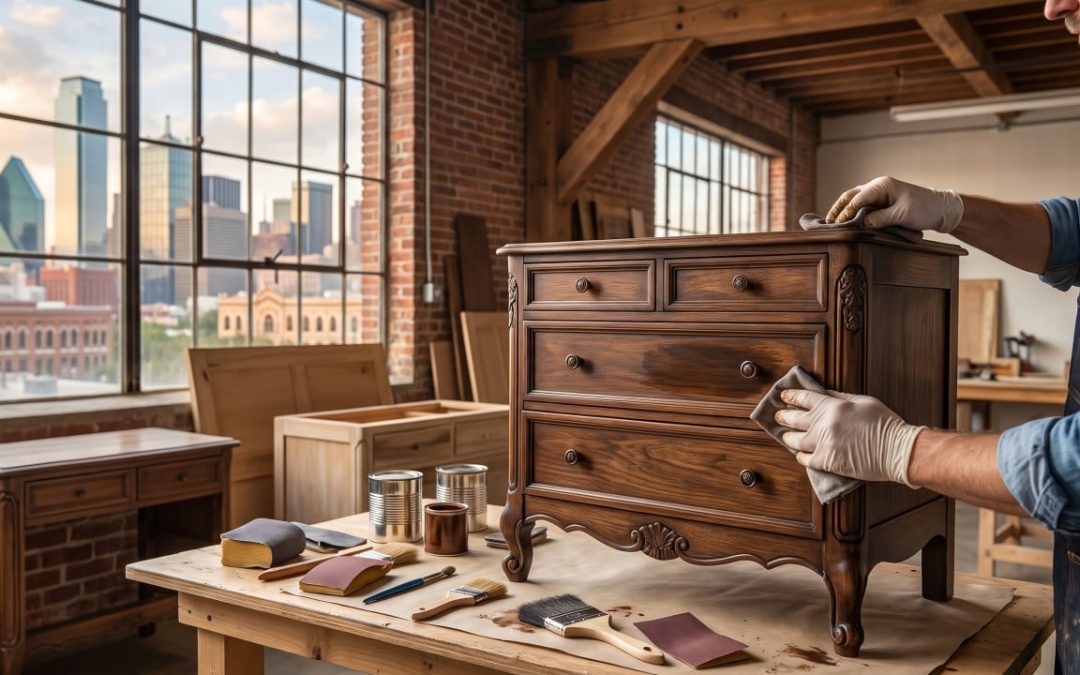
If you live in one of Downtown Dallas’s converted lofts or high-rise condos, you already know your furniture works a little differently than it would in a house out in the suburbs. A dining table that fit a 1920s warehouse floor plan, a grandmother’s dresser that made the move from a Dallas ranch home into a 22nd-floor unit, a mid-century credenza picked up at an estate sale across town: these pieces carry weight beyond their square footage. When the finish starts to crack or the joints go loose, refinishing usually makes more sense than replacing, and it’s one of the services we hear about most from clients here downtown.
Andrew’s Refinishing has been restoring wood furniture across the Dallas-Fort Worth metroplex since 1980, working out of a full-service Carrollton workshop about twenty minutes from Downtown. This guide walks through what furniture refinishing in Downtown Dallas actually involves, from stripping and staining to the logistics of getting a piece out of a high-rise. For the full rundown of our finishing services, see our Dallas furniture refinishing services page. Furniture waste is a bigger problem than most homeowners realize: EPA data on furniture and furnishings waste shows more than 80 percent of discarded furniture in the U.S. ends up in a landfill, much of it structurally sound pieces that could have been restored instead.
Why Downtown Dallas Lofts and High-Rises Need a Different Approach
Much of Downtown Dallas’s residential stock sits inside buildings that were never built as apartments. Warehouses along Elm and Commerce, early-20th-century office towers, and former lofts near the Arts District have been converted into condos and rentals over the past few decades, part of a broader wave of adaptive reuse that Preservation Dallas has documented across the central business district. That history shapes what’s inside these units too. Smaller floor plans mean residents keep fewer pieces, but the pieces they keep are often solid wood originals worth restoring rather than replacing once a move or years of use catch up with the finish.
It also means the logistics are different. A single-family house has a driveway and a front door. A downtown high-rise has a building manager, a freight elevator with a scheduled window, and sometimes a certificate of insurance requirement before a vendor’s truck gets near the loading dock. We build that into the estimate and the pickup schedule rather than treating it as a surprise, and our step-by-step refinishing process covers what happens once a piece actually arrives at the Carrollton workshop.

What Furniture Refinishing in Downtown Dallas Actually Involves
Refinishing isn’t a wipe-down and a fresh coat of stain. A proper job starts with stripping the old finish completely, whether that’s 1980s polyurethane gone amber or an original lacquer that’s crazed with age. We use a laser stripper for most pieces, which removes finish layer by layer with heat instead of chemicals, and a chemical overflow method for jobs where the stripper needs to flow over carved details or turned legs as we brush it on. We don’t submerge pieces in stripper and we don’t use a heat gun, both of which risk scorching or warping solid wood.
After stripping comes sanding, working through progressively finer grits to prepare the bare wood for stain. Staining is where color matching happens, and we do that step on the actual piece rather than relying on a sample board, since the way a stain reads depends on the specific grain and density of the wood in front of us. One limit worth knowing upfront: we can only stain as light as the natural wood allows. If you’re hoping to lighten a piece well beyond its raw color, refinishing alone won’t get you there. Once the color is dialed in, usually after a few test passes, the piece gets sprayed with its topcoat in our finishing booth.
- Strip the existing finish (laser stripper or chemical overflow method)
- Repair structural issues, like loose joints and dowels, before finishing begins
- Sand through progressively finer grits
- Match and apply stain directly on the piece
- Spray the topcoat in a controlled finishing booth
The Finishes We Use, and the Ones We Don’t
For residential interior furniture, we finish almost everything in lacquer. It sprays clean, dries fast enough to keep a job moving, and holds up well under normal household use. Lacquer is the one finish we apply on interior residential work. Various oil-based products and heavier-bodied topcoats you’ll see recommended in general woodworking guides simply aren’t part of how we finish furniture at the shop. Lacquer application involves solvents, and peer-reviewed research on VOC emissions from coated furniture is part of why we spray in a dedicated, ventilated booth rather than in a customer’s home or a shared building hallway, which also happens to solve the logistics problem for a high-rise condo downtown, where hallway spraying was never going to be an option anyway.
Wood species matters too. Oak, walnut, and mahogany all take stain differently depending on how open or tight their grain is, which is one reason a sample board in a showroom rarely matches what happens on your actual dining table. We wrote a longer piece on this if you want the details: why oak takes stain differently than other species. For antique shellac pieces, we strip the original finish and refinish in modern lacquer rather than trying to revive or match the original shellac, which is a far more fragile finish than most heirloom furniture can afford to keep wearing.

Freight Elevators, Loading Docks, and Getting Your Piece to Carrollton
Most downtown refinishing jobs start with pickup rather than drop-off, simply because hauling a dresser or dining table down from a high-rise unit isn’t a one-person job. We schedule around building freight elevator windows, provide a certificate of insurance when a property requires one, and coordinate loading dock access ahead of time so pickup doesn’t turn into a stalled truck out front during rush hour. Pickup and delivery across the metro starts at $250 round trip, with the exact fee depending on distance from Carrollton and the size of the job.
If you’re downsizing out of a larger home into a downtown unit, this is also a good moment to be selective. Smaller square footage means fewer pieces get to come with you, so it’s often worth having two or three heirloom pieces properly refinished rather than trying to force an entire dining set into a floor plan that was never going to hold it.
What Furniture Refinishing Costs and How Long It Takes
Refinishing jobs typically start around $600, though the final number depends on the piece’s size, condition, and how much repair work is needed before finishing even begins. A few reference points from recent jobs:
- Single dining chair: $275 to $375
- Dining table, top only, standard finish: $120 per running foot
- Full dining set with six chairs: $2,500 to $4,000
- Dresser or hutch: $1,200 to $2,200
- Nightstand: starts around $650
Every job starts with a free online estimate based on photos of the piece, so you know roughly what to expect before anything leaves your unit. On timeline, standard furniture refinishing runs 5 to 6 weeks from drop-off to delivery, and single pieces typically fall in the 4 to 6 week range depending on how busy the shop is. We’ll give you a realistic date at the estimate stage rather than a best-case number that slips.
Solid Wood, Veneer, and What We Can’t Refinish
A lot of the furniture we see from converted buildings, especially mid-century and 1970s-1980s pieces that get passed down or picked up secondhand, isn’t solid wood all the way through. Particleboard or MDF cores with a real wood veneer on top are extremely common, and we can refinish those the same way we refinish solid wood, since the surface being stripped, sanded, and stained is genuine wood veneer. What we can’t refinish is particleboard or MDF with a laminate, essentially a plastic layer, over the top, since there’s no wood surface underneath to work with. We also can’t structurally repair a particleboard or MDF core once it’s failed. If you’re not sure which one you have, a photo estimate will usually sort it out quickly.
Caring for a Refinished Piece in a High-Rise
Once a piece comes back from the shop, a few habits keep the new finish looking right for years instead of months. Floor-to-ceiling windows are a common feature in downtown units, and direct sun through unfiltered glass will fade a lacquer finish and the wood underneath it faster than in a house with smaller, shaded windows, so a UV window film or a drawn shade near a favorite dresser or table is worth considering. HVAC systems in high-rise buildings also tend to run drier than a single-family home, especially in winter, and wood expands and contracts with humidity swings whether the swing comes from a Texas summer or an overactive vent blowing straight onto a piece of furniture. Keeping a freshly refinished piece a few feet from direct airflow, using coasters and trivets on tabletops, and adding felt pads under anything that sits on hardwood or tile floors all go a long way toward protecting the work.
Is It Worth Refinishing, or Should You Replace It?
This is the question we get most often, and the honest answer depends on more than dollars. The neighborhood’s own building stock tells a similar story: much of the neighborhood’s growth over the past few decades has come from restoring historic structures rather than tearing them down, a trend Dallas Innovates has covered in detail. Furniture works the same way. Solid wood and wood-veneer pieces are almost always mechanically worth restoring, since a well-built frame from decades ago often outlasts a comparable piece bought new today. But sentimental value counts too. A grandmother’s dresser or a dining table that’s hosted every holiday for twenty years can be worth refinishing even when a strict cost comparison says otherwise, and that’s a completely reasonable reason to restore something. If you’re furnishing a condo with a mix of new pieces and inherited ones, refinishing the inherited pieces to match your finish palette is often the more affordable path to a cohesive room. Kitchens follow similar logic: if your unit’s cabinets are original to a converted building, our guide to cabinet refinishing in downtown high-rises and lofts covers that project specifically.
Serving Downtown Dallas and the Surrounding DFW Metro
Our Carrollton workshop serves Downtown Dallas alongside the rest of the Dallas-Fort Worth metroplex, including Uptown Dallas, Highland Park, University Park, and Preston Hollow. Wherever your piece is coming from, pickup and delivery is available across the metro, and the process at the shop stays the same regardless of which neighborhood it started in.
Frequently Asked Questions About Furniture Refinishing
How much does furniture refinishing cost in Downtown Dallas?
Most jobs start around $600, though full sets and larger case pieces run higher. A single dining chair typically runs $275 to $375, a full six-chair dining set runs $2,500 to $4,000, and a dresser or hutch runs $1,200 to $2,200. We give you an exact number through a free online photo estimate before any work begins.
How long does furniture refinishing take for a Downtown Dallas pickup?
Standard refinishing takes 5 to 6 weeks from pickup to delivery, and single pieces typically fall in the 4 to 6 week range. Pickup itself is scheduled around your building’s freight elevator window, so we usually confirm exact timing once we know your property’s requirements.
Can you refinish furniture from a historic loft or converted warehouse building?
Yes. Solid wood furniture and wood-veneer furniture from Downtown Dallas lofts and converted buildings refinish the same way as furniture from anywhere else in the metro. The only real difference is logistics: freight elevators, loading docks, and sometimes a certificate of insurance for the building.
Do you pick up furniture from Downtown Dallas high-rises and condos?
Yes, pickup and delivery is available across the DFW metro starting at $250 round trip. We coordinate with building management on freight elevator scheduling and provide a certificate of insurance when your property requires one.
Can you match the stain color on an antique or heirloom piece?
Yes. Color matching is done directly on the actual piece rather than from a sample board, since grain and density affect how a stain reads. Keep in mind we can only stain as light as the natural wood allows, so significantly lightening a piece beyond its raw color isn’t possible through refinishing alone.
If you have a piece waiting on a refinish in your downtown Dallas home, whether it’s a dining table that made the move from a family house, a dresser picked up at an estate sale, or a chair that’s been wobbling longer than you’d like to admit, start with a free online estimate. Send a few photos and we’ll give you a realistic price and timeline before anything leaves your unit. You can also call the Carrollton workshop directly at 214-731-3060. If your building has commercial furniture that needs attention too, our guide to phased hotel furniture refreshes downtown covers that side of the work. Forty-five years in, we still think the best furniture is the one you already have.