
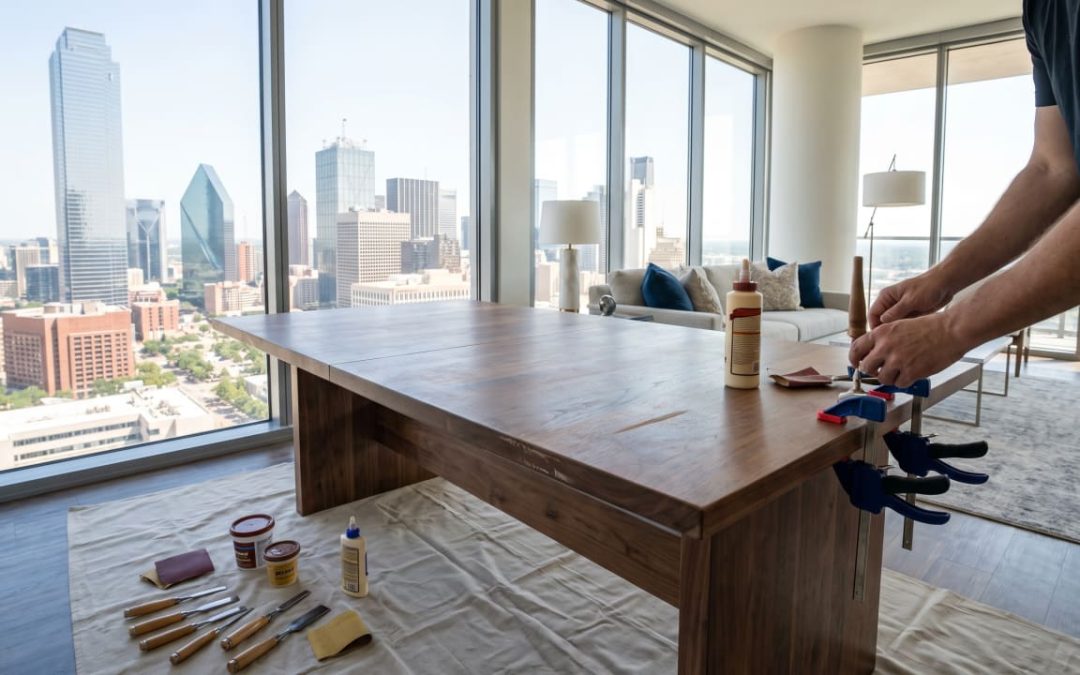
Wood Furniture Repair in Uptown Dallas: What High-Rise Living Does to Solid Wood
If you live in a high-rise or mid-rise near McKinney Avenue or Cedar Springs Road, you already know Uptown Dallas furniture takes a different kind of beating than a house in the suburbs. Elevators, tight hallway turns, and a thermostat that swings between office-cold and Texas-humid all put stress on solid wood joints that a single-family home rarely sees. When a dining chair starts to rock or a dowel finally lets go, you need someone who repairs the piece, not someone who tells you to replace it.
Andrew’s Refinishing has been doing structural wood repair from our Carrollton workshop since 1980, and it is one piece of the broader lineup covered on our Dallas furniture repair services page, which serves the whole metro area including Uptown. This guide is narrower: it is about wood, specifically the loose joints, cracked legs, gouges, and worn cane seats that show up again and again in Uptown Dallas condos and apartments, and what actually happens when you bring one of those pieces to us. For context on the neighborhood itself, Uptown Dallas Inc., the nonprofit that manages the district, is a good primer on just how dense and vertical this part of the city has become.
Why Uptown Dallas High-Rises Are Hard on Solid Wood Furniture
Most solid wood furniture problems we see from Uptown Dallas trace back to one thing: rapid humidity and temperature swings. A condo tower runs central air aggressively in the summer and heat in the winter, and units near a floor-to-ceiling window can see bigger daily temperature shifts than a ranch house with attic insulation. Wood expands and contracts with moisture content, and the joints, the mortise-and-tenon corners, the dowels, the glued rails under a chair seat, are where that movement concentrates.
This is not just a hunch. Wood-joint research published through BioResources found that increased humidity and temperature can reduce joint stiffness by roughly a quarter and cut load-carrying strength by as much as 40 percent, and that the speed of a humidity swing matters more than the total range. A slow seasonal shift is manageable. A unit that goes from an over-air-conditioned 68 degrees to a balcony door left open on a humid August afternoon is exactly the kind of rapid swing that loosens a dowel joint years before it should fail.
Add in how furniture gets into these buildings in the first place, freight elevators, loading docks, tight corner turns into a unit, and you have a second source of stress entirely separate from climate. A dresser that survives twenty years in a house can develop a cracked leg or a sprung joint in its first freight-elevator ride into a high-rise.
What We Actually Repair: Loose Joints, Dowel Failure, and Leg Cracks
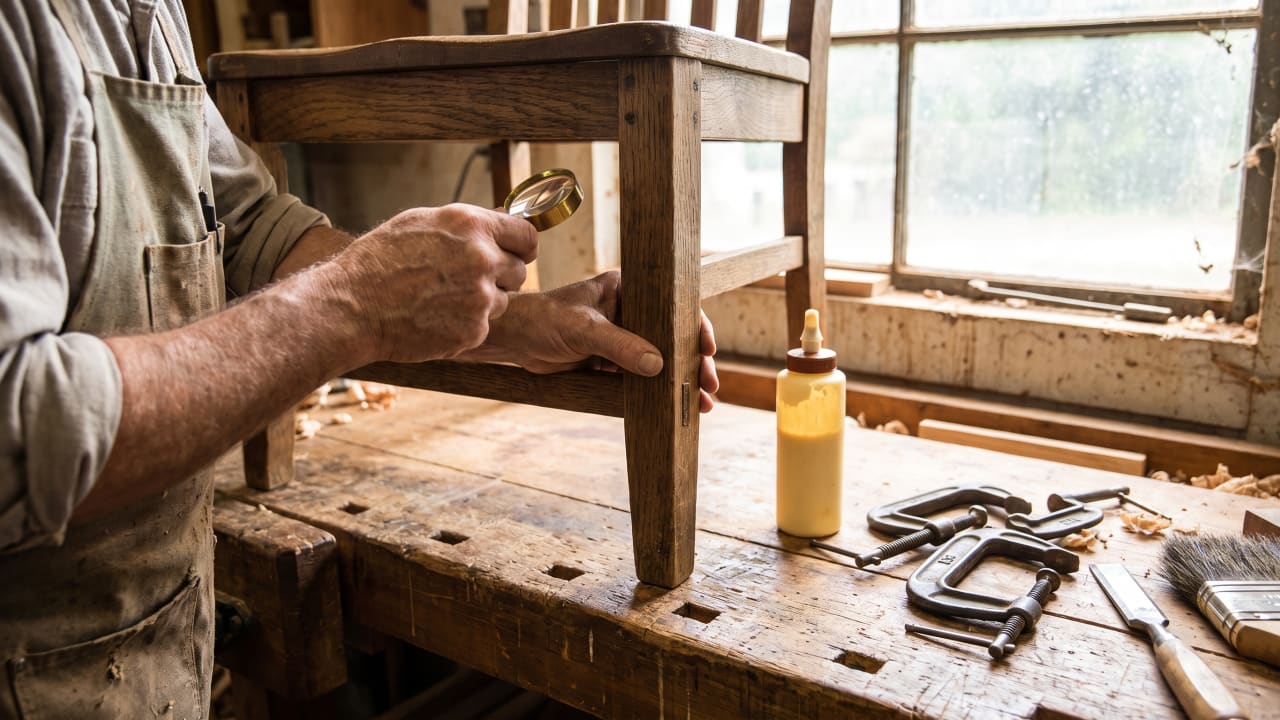
Structural wood repair is the bread-and-butter of our shop. When a chair, table, or case piece comes in loose, we take the joint apart, clean out the old glue, and re-glue it properly rather than injecting glue into a joint that is still assembled, which is a common shortcut that fails again within a year. Broken or worn dowels get replaced, not just re-glued in place. Leg cracks, whether from a hard bump during a move or from long-term stress at a mortise joint, get cleaned, reinforced, and glued so the repair carries load the way the original joint did.
We wrote a companion piece on this exact problem for a nearby Dallas neighborhood: loose joints and wobbly chair repair in Dallas goes deeper into how we diagnose which joint is actually the culprit, since a wobble at the seat can trace back to a joint at the leg you would not expect. If you have a set of dining chairs from an older home that got passed down into a smaller Uptown Dallas footprint, this kind of repair is usually far cheaper than trying to source a match.
We are seeing more of this from downsizing clients specifically. A family sells a larger house nearby and moves into a two-bedroom high-rise unit, and the pieces that make the cut are the ones worth keeping properly, not just patching. A related post covering that scenario in more detail is our wood furniture repair guide for nearby Preston Hollow, which shares a lot of overlap with what we see downtown.
The furniture we see coming out of these units skews a particular way: mid-century walnut and teak-look case goods, Drexel- and Henredon-era dressers passed down from a parent or grandparent, and the occasional Danish-style dining set with turned legs and exposed joinery. That construction style holds up well structurally, real mortise-and-tenon joints, real dowels, but it also shows its age the same way every 40 to 60 year old joint does. The good news is that this era of furniture was built to be taken apart and re-glued, which is exactly what a proper repair does.
Gouge Fill, Scratches, and Finish Blending
A deep gouge, the kind left by a dropped moving dolly or a set of keys dragged across a tabletop edge, is not something you can sand out without removing a visible amount of surrounding wood. For gouges like that, we use a two-part epoxy fill. The epoxy gets built up in thin layers, shaped once cured, and then sanded flush with the surrounding surface before the finish work begins.
The general method lines up with what most professional woodworkers recommend for this kind of repair. Family Handyman’s guide to epoxy wood repair describes the same layered build-up-and-sand approach we use in the shop, and it is a useful read if you want to understand why a rushed, single-pour fill tends to shrink, crack, or sand unevenly compared to a properly layered one.
Once the fill is level, we blend the finish around it so the repaired area does not read as an obvious patch. This is color-matching work done on the actual piece, testing passes directly on the wood rather than relying on a sample chip, since lighting in a condo with floor-to-ceiling glass reads finish color very differently than a showroom.
A shallow scratch is a different job than a deep gouge, and it is worth knowing the difference before you call around for quotes. A scratch that has not broken through the finish layer can often be blended without a full epoxy fill, just careful sanding and re-coating of that section. A true gouge, one you can catch a fingernail in, needs the epoxy build-up because sanding alone would remove too much surrounding wood trying to level it out. Store-bought wood filler pens and putty sticks are a common DIY first attempt, but they tend to shrink as they dry and rarely match stain color the way a proper epoxy-and-finish system does, which is usually why a piece ends up at our shop after a DIY fix did not hold.
Cane and Rush Seat Replacement
Cane and rush seats show up constantly on the kind of mid-century and antique dining chairs that end up in older Uptown Dallas buildings and the estate pieces families bring in from elsewhere. Both are hand-woven natural materials, cane strands woven through drilled holes around a chair’s seat frame, rush twisted and wrapped around the seat rails, and both eventually wear through from years of regular use.
We replace worn or broken cane and rush seats as part of our structural repair work. This is a different service from wicker or rattan furniture restoration, which we do not offer. Cane and rush are woven seating materials on an otherwise solid wood chair frame; wicker and rattan construction is a different craft entirely, and it is one we have chosen to stay out of so we can do the wood and cane work well.
Re-caning a single chair seat is hand work, strand by strand through the drilled holes, and it takes real time to do properly, which is why we usually schedule it alongside whatever other repairs the piece needs rather than as a rush job. If you have a full set of six or eight cane-seat chairs and only one or two seats have actually failed, it is worth having the whole set evaluated at once. A seat that looks fine today is often close behind the one that already broke, and doing them together saves a second round trip.
What We Don’t Repair: Tops, Water Damage, and a Few Other Limits
A shop that tells you exactly what it will not do is usually more trustworthy than one that says yes to everything, so here is where our wood repair scope ends. We do not spot-touch a damaged table top or dresser top. If the top has a gouge, a ring, or a worn patch, the whole top gets fully refinished rather than blended around a single repair, because a partial touch-up on a top almost never holds up or matches under real light.
We also do not repair structurally water-damaged pieces, since the substrate itself is usually too compromised to hold a repair. Bubbling veneer, where the veneer has separated and formed a raised blister, is outside our scope as well, though lifted veneer edges and missing veneer sections are very much repairable. And a piece with a laminate surface over particleboard, as opposed to a real wood veneer over particleboard, is not something we can refinish, since laminate does not accept stain or take a proper finish the way wood veneer does.
We do not take on hardware-only jobs, meaning we will not swap drawer slides or realign hardware as a standalone visit, though that work is included when it is part of a larger repair or refinishing job. And we do not do leather repair of any kind. If your Uptown Dallas piece is a leather-topped desk or a leather dining chair seat, the wood frame and structure fall within what we do, but the leather itself does not.
Getting Furniture In and Out of a High-Rise: Elevators, Loading Docks, and COI
Logistics matter more here than almost anywhere else we work in DFW. Most Uptown Dallas buildings require a reserved freight elevator window, and quite a few require a certificate of insurance on file with the building management before a crew can move a piece in or out, sometimes with a minimum coverage amount specified by the HOA or property manager. We handle that paperwork as a routine part of scheduling a pickup rather than something you have to chase down yourself.
Pickup and delivery starts at $250 round trip depending on distance and the size of the job, which covers a straightforward trip to and from our workshop. High-rise pickups with a loading dock reservation and a freight elevator window sometimes take a bit more coordination on timing, but the underlying process, and the pricing structure, is the same one we use everywhere we work.
If your building or unit also needs upholstery work done alongside the wood repair, that is a separate scope we cover in a companion article on reupholstery in Uptown Dallas, and if it is a full refinish rather than a repair, our piece on designer furniture refinishing for Uptown Dallas interiors covers that angle.
What a Repair Actually Costs and How Long It Takes
Basic repair work starts at our shop minimum of $125, which covers small jobs like a single loose joint or a small gouge fill. A single dining chair repair, joint work plus any needed finish blending, typically runs $275 to $375. A full set, or a piece that needs cane replacement across multiple seats, gets priced individually once we have seen photos, since the range of possible work is wide.
Timelines run 4 to 6 weeks for most single-piece repairs, start to finish, which includes the pickup, the shop queue, the actual repair and finish blending, and delivery back to you. Extensive joint work, multiple cane seats, or a piece that needs several rounds of color matching can run a bit longer. We give you a specific window once we see the piece rather than quoting a generic estimate up front, because a straightforward re-glue and a piece with three failed joints and a cracked leg are not the same job.
Restore or Replace? A Practical Take for High-Rise Living
Not every piece is worth repairing, and we will tell you that honestly during a photo estimate. But for solid wood furniture, and for particleboard or MDF pieces with a real wood veneer, repair is very often the better math, both financially and environmentally. EPA data on durable goods waste shows that Americans send well over 12 million tons of furniture to landfills each year, and only a sliver of it gets recycled. A repaired chair leg or a re-glued joint keeps a well-built piece out of that stream entirely.
There is also a quality argument that matters a lot in older Uptown Dallas buildings and the estate pieces that land there. Furniture built in the 1960s through 1980s, before particleboard-and-laminate construction took over the mid-tier market, was often built with real mortise-and-tenon joinery that is worth saving. New replacement furniture at a comparable size and finish quality frequently costs more than the repair itself, and it will not have the same joinery to begin with.
None of that means the decision is purely financial, and it does not need to be. A dresser that belonged to a grandparent, or a dining table that has hosted every holiday for twenty years, can be worth repairing on sentimental grounds even when the math is closer to a wash. We try to give you both sides during the estimate: what the piece is realistically worth to repair, and what a comparable replacement would cost, so the decision is an informed one rather than a guess.
Serving Uptown Dallas and the Surrounding DFW Metro
Our Carrollton workshop is a straightforward pickup or drop-off from anywhere in Uptown Dallas, and we serve the surrounding areas just as regularly, including Highland Park, University Park, Preston Hollow, Downtown Dallas, and North Dallas. Whether your piece is a single dining chair with a loose joint or a full set that needs cane seats rewoven, the process starts the same way: a free online estimate, then a scheduled pickup that works around your building’s freight elevator and loading dock rules.
Frequently Asked Questions
Can you repair a wobbly dining chair or side table in my Uptown Dallas condo?
Yes. Loose joints, cracked legs, and dowel failure are the most common repairs we handle, and we can usually work around a building’s freight elevator schedule for pickup. A single dining chair repair typically starts around $275 to $375 depending on what the joint needs.
Do you touch up a scratch on a table top, or does the whole top get refinished?
The whole top gets refinished. We do not spot-touch table or dresser tops, since a partial repair rarely blends well or holds up under real light, especially in a unit with a lot of natural window light like most Uptown Dallas high-rises have.
How does pickup and delivery work for a high-rise building?
We coordinate directly with your building’s management for freight elevator reservations and any certificate of insurance requirements. Pickup and delivery is available metro-wide and starts at $250 round trip depending on distance and job size.
Can you fix a water-damaged dresser or table?
Not if the substrate has structural water damage; that level of damage is usually beyond what a repair can hold. We can evaluate cosmetic water rings and some finish-level damage separately from structural warping or swelling, so it is worth sending photos for a free estimate either way.
How long does a typical wood furniture repair take?
Most single-piece repairs run 4 to 6 weeks from drop-off to pickup, sometimes a bit longer for extensive joint work or cane seat replacement on multiple chairs. We will give you a specific window once we see the piece.
Get a Free Estimate for Your Piece
If you have a piece with a loose joint, a cracked leg, a deep gouge, or a cane seat that has finally given out, Uptown Dallas residents can request a free online estimate by sending photos through our site, no in-person visit required to get a starting number. Or call the Carrollton workshop directly at 214-731-3060 and we will walk you through what a repair like yours typically involves, freight elevator scheduling included.