
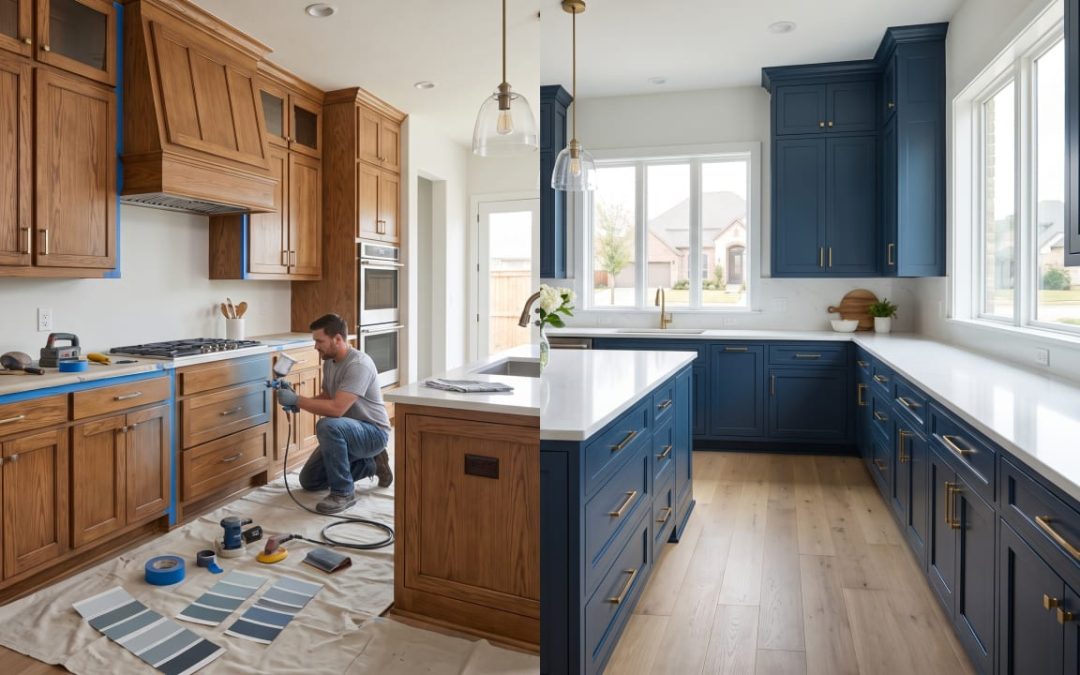
If you are weighing custom kitchen cabinet refinishing in Coppell, TX, you are probably looking at a kitchen with good bones and tired surfaces: solid doors, well-built boxes, and a finish that has yellowed, chipped near the sink, or simply stopped matching how you live. Replacing custom cabinetry is the most expensive decision in a kitchen remodel, and often the least necessary. Our Dallas-area kitchen and bath cabinet refinishing service exists for exactly this situation.
This guide is organized as seven practical things to understand before you call anyone. It comes from a family shop that has refinished furniture and cabinetry across the metroplex since 1980, working from our Carrollton workshop right next door to Coppell. If you want to skip ahead, you can always request a free online estimate with photos of your kitchen.
1. Custom Cabinetry in Coppell Homes Is Usually Worth Keeping
Coppell grew quickly from the 1980s onward, and many homes here carry cabinetry that was built with real hardwood frames, solid or veneered door panels, and dovetailed or well-doweled drawer boxes. That construction is the whole point. A cabinet box that has held up for twenty or thirty years will usually hold up for another twenty once the surface is renewed.
Wood is a remarkably stable building material when it is kept at normal indoor humidity. The USDA Forest Service’s Wood Handbook documents how properly dried hardwood holds its shape for decades, which is why the structure of an older custom kitchen is rarely the problem. The finish is. Kitchens are hard on finishes: steam, grease, hand oils around the pulls, and Texas sun through a west-facing window all take their toll long before a door or frame fails.
In our experience, the cabinets worth refinishing share a few traits:
- Doors and frames that are square, with no structural cracking or swollen joints.
- Solid wood or real wood veneer faces. Real wood veneer over particleboard or MDF refinishes beautifully, and it accounts for a large share of the cabinetry we see in Coppell kitchens.
- A layout you already like, so the only thing you want to change is color and condition.
- Hardware and hinges that work, or that you are happy to replace with something newer during the same project.
One honest limit: laminate and thermofoil-style doors are not refinishable, so if your cabinets are faced that way throughout, replacement is the realistic path. A quick photo tells us which camp your kitchen is in before anything leaves your house.
2. Why Coppell Homeowners Refinish Rather Than Replace
Cost is the headline, but it is not the only reason. Industry rules of thumb put refinishing at roughly 30 to 50 percent of the cost of new cabinetry, and that gap widens with custom work, because custom boxes and doors are priced by the hour and by the board foot. Replacing them means demolition, lead times on new doors, countertop disturbance, and weeks without a working kitchen.
Refinishing avoids most of that. Your countertops, backsplash, and plumbing stay put. Cabinetry is typically the largest single line item in a kitchen remodel (the National Kitchen & Bath Association publishes current design and budgeting resources), so trimming that line is where the savings live. Many families put the difference toward new counters, lighting, or appliances instead.
There is also the matter of what you get. A refinished custom cabinet keeps its original joinery, its original proportions, and its original wood. A new stock or semi-custom replacement often trades solid parts for thinner panels. If you chose your cabinetry deliberately the first time, there is a good chance you do not want to lose it.
For a broader look at the trade-offs, our North Dallas guide to cabinet refinishing versus replacement walks through what actually changes and what stays the same.
3. How the Work Is Split Between Your Kitchen and Our Shop
The most common question we hear is whether we take everything out of the house. The answer is no, and the split is deliberate:
- Cabinet boxes and face frames are refinished in place, in your kitchen. They are fixed to the wall and are not practical to remove without damaging drywall and countertops.
- Doors and drawer fronts come off and go to our workshop, where they can be stripped, sanded, and finished flat in a controlled booth.
- Hinges and pulls are removed and either reinstalled or replaced when the doors come back, as part of the same job.
The in-home portion on the boxes typically runs one to two days. Because the doors are being worked on at the shop at the same time, the whole kitchen generally wraps up in about two weeks. That is much faster than the five to six weeks we quote for standalone furniture, because cabinet work is scheduled as a single coordinated project rather than a queue of individual pieces.
We protect floors, counters, and appliances with masking and drop cloths before any sanding or spraying starts, and we clean up when the in-home work is done. You will still want to clear the countertops and empty the cabinets beforehand, since everything has to come out of the boxes.
Why our neighbors in Coppell tend to like this arrangement: the shop is just down the road, so doors do not travel far, and you are not relying on a crew that disappears for weeks.

4. What Actually Happens to the Wood: Stripping, Staining, and Finish
Refinishing is not painting over what is already there. Whether the goal is a fresh stain or a clean painted look, the quality of the result depends on what happens before the first coat goes on.
Stripping the old finish
On doors that are being restored to a stained wood look, we remove the old finish with our laser stripper or a chemical overflow method, where stripper flows over the piece as we brush. This gentle approach protects the grain, the glue joints, and any veneer on the door. After stripping, the surface is sanded smooth and checked for repairs, such as chips, dings, or a loose rail.
Color, stain, and matching
Stain color is matched on the actual wood, not guessed from a sample board. We apply test passes, adjust, and repeat until the color reads right in your own light. Expect several passes. One firm rule applies to every job: we can only go as light as the natural wood allows. If your cabinets are dark cherry or mahogany, a pale blonde result is not possible without replacing the wood.
For woods with open grain, such as oak, we use a dye-plus-pigment stain approach to keep color even and avoid a muddy look. If your kitchen is oak from the 1990s, the grain pattern is part of its character, and the right stain can make it look deliberate rather than dated.
The finish itself
Residential cabinetry in our shop receives a lacquer topcoat, sprayed in a booth and allowed to cure fully before the doors come back. Lacquer is durable, repairable, and forgiving over the decades, which matters in a kitchen. For context on why ventilation matters around finishing work, the EPA publishes guidance on volatile organic compounds and indoor air quality. Our spraying happens in the shop booth rather than in your home for exactly that reason.
If you would like to see the bigger picture of how we handle stripping, sanding, and finishing across all our work, the furniture refinishing process page lays it out step by step.

5. Older Kitchens, Painted Surfaces, and a Safety Note
Homes built before 1978 may have lead-based paint somewhere in the house, including on old cabinet finishes. Coppell is a relatively young city compared with older neighborhoods, so most homes here postdate that era. Still, if you own an older house or bought a cabinet set from a salvage source, it is worth knowing about.
The EPA’s Renovation, Repair and Painting Program sets work-practice rules for contractors who disturb painted surfaces in pre-1978 housing. If your home falls in that category, mention it when you request an estimate so we can plan the work properly.
Painted cabinets are a separate topic from stained ones. Painted finishes can hide minor wood flaws, but they also show every surface imperfection, so the prep stage matters even more. If you are choosing between a clear stained look and a solid painted color, send us a photo of your doors and tell us what you are leaning toward. We can tell you which direction suits the wood you have.
6. Timeline, Cost, and Why Kitchens Get a Detailed Estimate
A whole-kitchen refinishing project typically finishes within about two weeks. Within that window, the in-home work on the boxes is one to two days, and the rest is door and drawer-front work at the shop. Busy seasons, especially the weeks before the holidays, can stretch scheduling, so it is smart to reach out before you need the kitchen done.
Kitchen cabinets are priced one kitchen at a time, because a kitchen is not a standard unit. The number of doors and drawers, the condition of the existing finish, the wood species, whether you want stain or paint, and whether any repairs are needed all change the scope. Rather than give a number that will be wrong for your kitchen, we provide a detailed estimate based on photos of your actual cabinets.
To make that estimate accurate, send us:
- A wide photo of each wall of cabinets.
- Close-ups of any damaged areas, such as chips, water marks near the sink, or worn edges.
- A photo of the inside of one door and one drawer, so we can see the construction.
- A rough count of doors and drawers if you have it.
When you are ready, you can start a free online estimate from your phone. If you would rather talk it through, the shop line is 214-731-3060.
7. Choosing the Right Shop for Cabinets That Matter to You
Cabinet refinishing attracts a wide range of providers, from specialty shops to general painters. The difference shows up three to five years later, when a thin coating starts to peel at the edges or yellow near the stove. A few questions can separate careful work from quick work:
- Where are the doors finished? A controlled booth produces a smoother, more durable result than a garage or a driveway.
- What is the process before the topcoat? Real stripping and sanding, not just a light scuff.
- How is color matched? On your actual wood, with test passes, not from a chip card alone.
- Who is doing the work? In our shop, refinishing is always handled in-house by our own craftspeople.
- How long has the shop been around? We have been in business since 1980, founded by John and passed to his son Simon, and many of our cabinet customers come back for furniture.
It also helps to read what other homeowners say. Our customer reviews page is a good place to start, and our Farmers Branch cabinet refinishing story shows what a similar neighborhood project looks like from start to finish.
Where We Work: Coppell and the Surrounding DFW Cities
We serve Coppell homeowners every week, along with neighbors in Carrollton, Irving, Lewisville, Flower Mound, Grapevine, and Dallas. Pickup and delivery is available across the metroplex, and for cabinet projects the in-home portion is done at your address, so there is no need to move anything yourself.
Frequently Asked Questions About Cabinet Refinishing in Coppell
Can you refinish custom kitchen cabinets in Coppell without removing them?
Yes. The cabinet boxes and face frames are refinished in place in your kitchen, which usually takes one to two days. The doors and drawer fronts are taken to our workshop for stripping, sanding, and finishing, then reinstalled when they are done.
How long does cabinet refinishing take for a Coppell kitchen?
A whole-kitchen job typically finishes within about two weeks. That includes the in-home work on the boxes and the shop work on doors and drawers. Scheduling can run longer during busy seasons, so we recommend reaching out early.
How much does custom kitchen cabinet refinishing cost?
Every kitchen is different, so we provide a detailed estimate rather than a flat number. Door and drawer count, wood species, current finish condition, and whether you want stain or paint all affect the price. Photos through our free online estimate are enough to start.
What finish do you use on refinished kitchen cabinets?
Residential cabinetry receives a lacquer topcoat, applied in our shop booth over dye-plus-pigment stain that is color-matched on the actual wood. The result is a durable, repairable surface that stands up to Coppell kitchen life.
Do you serve my Coppell neighborhood for cabinet refinishing?
Yes. Our Carrollton workshop is right next door to Coppell, so we regularly handle kitchens across the city. The cabinet boxes are refinished at your address, and the doors travel only a short distance to our shop and back.
Ready to Talk About Your Coppell Kitchen?
Custom cabinets are worth taking seriously, because the structure is already the hard part. If yours are sound, a proper refinish can change the look of the entire room in about two weeks, without a demolition crew and without losing the wood you chose the first time. Our approach is simple: strip properly, match color on the real wood, finish in a booth, and keep you informed at every step.
Coppell homeowners can request a free online estimate with a few photos, or call 214-731-3060 to talk with the shop. You can also see how we approach similar work at our Dallas kitchen and bath cabinet refinishing page, which covers kitchen and bath projects across the metro.