
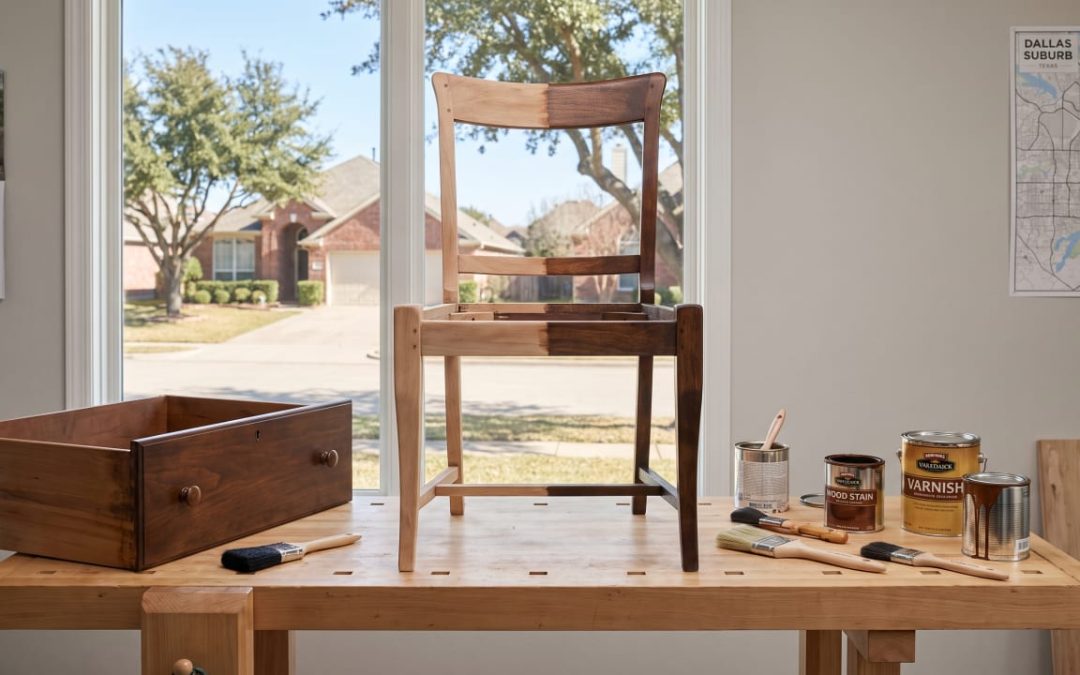
If you’ve typed “furniture refinishing Richardson TX” into a search bar, you’re probably staring at a dining table, a dresser, or a hand-me-down desk that’s lost its shine somewhere between the 1970s and now. Solid wood furniture from that era was built to last, and in most cases the piece in front of you is worth bringing back rather than replacing. This guide covers what furniture refinishing actually involves, what it costs, how long it takes, and what our Carrollton workshop does for the homes we serve nearby.
Andrew’s Refinishing has been doing this work across the Dallas-Fort Worth metroplex since 1980, when Andrew’s father John opened the shop. Forty-five years later, the process is still hands-on: strip the old finish, repair what needs repairing, stain to match, and spray a real furniture-grade lacquer. For the broader picture of what we offer across the metro, our Dallas-Fort Worth furniture refinishing page covers the service at a high level. This article stays narrow: refinishing in Richardson specifically.
One quick note before we get into it. If your piece is more about a wobbly leg, a cracked joint, or a worn cane seat than a tired finish, refinishing may not be the job you actually need. We’ve already written dedicated guides on furniture repair in the area and on when restoration beats replacement, and either one might be the better read. This guide is specifically about refinishing: stripping, staining, and finishing.
Why Richardson Homeowners Choose Refinishing Over Replacing
Neighborhoods here built up mostly from the 1950s through the 1970s, alongside the growth of UT Dallas and the telecom corridor, and a lot of the wood furniture that ended up in those houses is genuinely well made. Dining sets, dressers, and buffets from that period tend to use real hardwood joinery: mortise and tenon joints, dowel construction, and drawer boxes that were cut rather than stapled together. Furniture built this way can typically be repaired and refinished more than once over its life, which is exactly why a piece that looks finished is often structurally fine underneath a tired topcoat.
There’s a cost and environmental case for refinishing too, beyond sentiment. EPA waste-tracking data shows the large majority of discarded furniture in the U.S. ends up in a landfill instead of getting reused, and separate restoration-industry research puts the energy savings of refinishing over replacement at close to 97 percent, with a comparably steep drop in carbon emissions. For a household weighing a dining set restoration against a new set that often costs more and won’t hold up as well, the math usually favors the piece already in the room.
Not every job pencils out purely on dollars, and that’s fine. A Richardson family with a dresser that came from a grandparent’s house, or a dining table that’s hosted three decades of holidays, often decides to refinish it even when a comparable set could be bought new for less than the restoration costs. Sentimental value is a legitimate reason to refinish, right alongside the practical one. We’ll always tell you honestly what a piece is worth restoring versus what it will cost, and let you make the call from there rather than pushing one answer over the other.
Stripping: How We Actually Remove the Old Finish
Every refinishing job starts with getting the old finish completely off, and this is where a lot of DIY attempts go wrong. Heat guns scorch wood and raise the grain unevenly. Submerging a piece in a stripping tank oversaturates the joints and can loosen glue that was never meant to get wet. Neither method is something we use in our workshop.
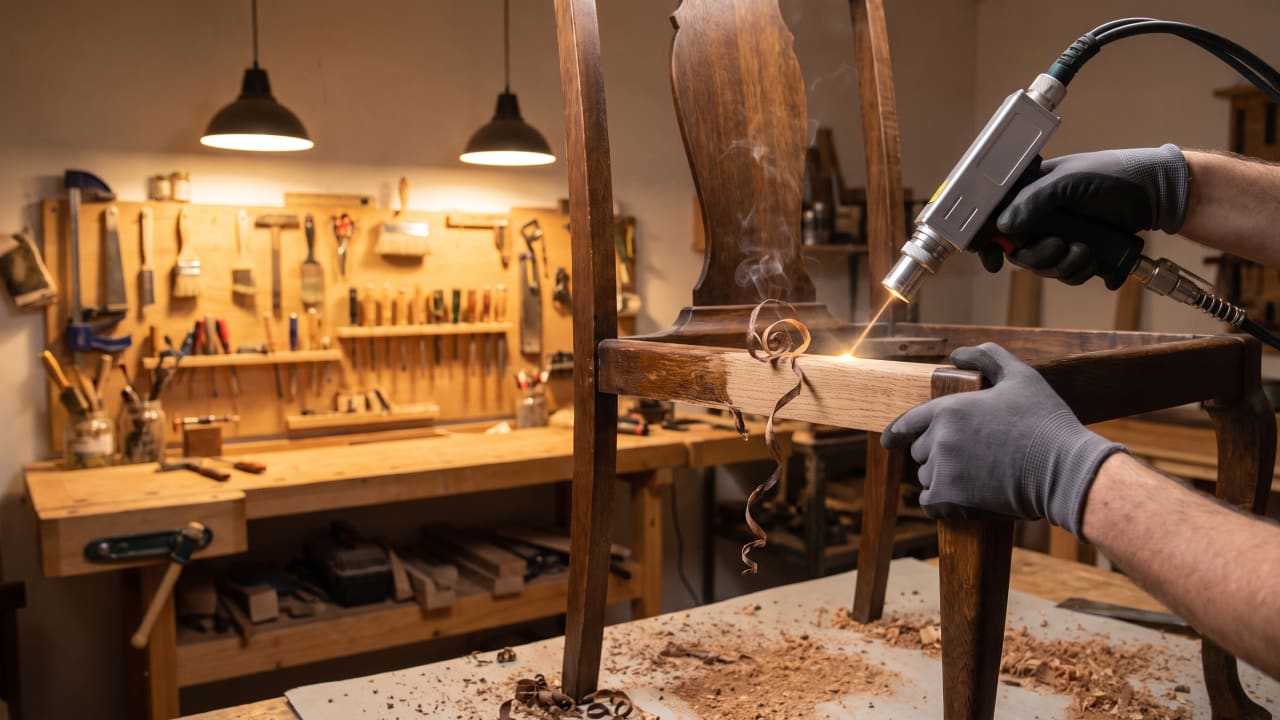
Instead, we strip most pieces using either a laser stripper, which burns off finish layer by layer without touching the wood underneath, or a chemical overflow method where stripper is brushed on and flows over the piece rather than submerging it in a tank. For top-only jobs, like a tabletop that needs a fresh finish while the legs and apron are fine, we’ll sometimes use a gel stripper instead, since it stays put and won’t run down onto parts of the piece we’re not touching. The goal either way is the same: get down to bare wood without damaging it so the stain takes evenly. Our full breakdown of our Carrollton workshop’s refinishing process walks through every stage in more detail.
The laser stripper in particular is worth mentioning because most independent refinishing shops don’t own one. It’s a slower, more controlled way to lift decades of old lacquer, paint, or varnish without introducing moisture or heat stress into the wood, which matters most on antique joints that have already been glued and re-glued once or twice over their life. It’s one of the tools that’s let us keep taking on delicate, older pieces well into our fifth decade of doing this work.
Staining and Color Matching Without Guesswork
Once a piece is stripped to bare wood, staining is where its character comes back. We use a dye-and-pigment stain system rather than a single gel product, which gives more control over depth and evenness, especially on woods like oak that have open, prominent grain and tend to take stain unevenly if you’re not careful. Walnut, cherry, pine, and maple all behave differently under the same stain, so matching an existing set (say, a hutch you’re keeping alongside four chairs that need refinishing) takes real judgment rather than picking a color off a chip card.
Color matching happens on the actual piece in front of us, not just a sample board, and it’s common to run three to six test passes before landing on the right combination. One limitation worth knowing up front: stain can only go as light as the bare wood underneath allows. If you’re hoping for something noticeably lighter than the wood’s natural tone, that’s more a question about the wood species itself than about the stain we use.
The wood itself drives a lot of these decisions. We’ve written a longer piece on why oak takes stain so differently than other species, and the short version is that open-grained woods like oak and ash soak up pigment unevenly unless you pre-condition them, while tighter-grained woods like maple and cherry tend to blotch if you’re not careful with the dye step first. Pine splits the difference: it’s soft enough to dent easily but takes a lighter touch well. None of this is guesswork on our end, it’s just knowing which wood you’re dealing with before the first coat goes on.
Lacquer: Our Standard Finish for Interior Furniture
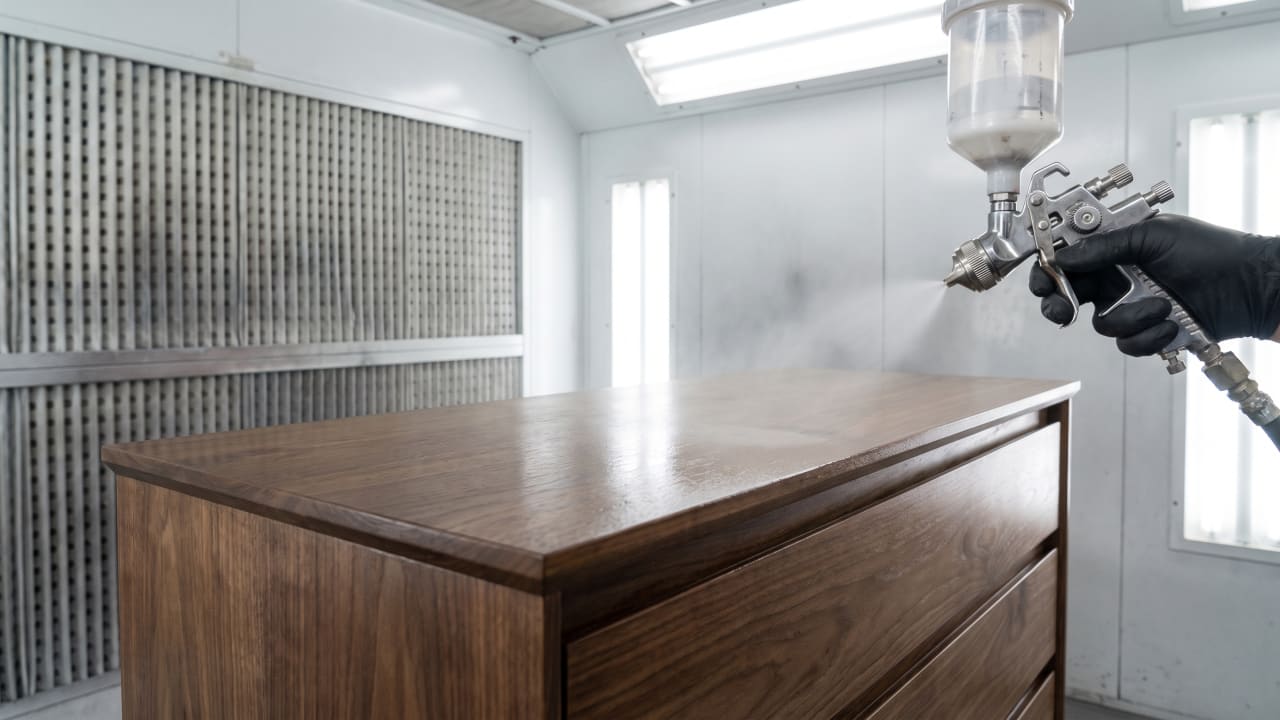
For residential interior pieces, we finish in lacquer, sprayed in our shop’s booth rather than brushed on by hand. Lacquer dries hard, resists water rings and everyday scuffs well, and it doesn’t yellow the way some older varnishes do over time. Comparisons between lacquer and other common wood finishes generally back up what we see on the bench: lacquer holds up to daily use with very little upkeep, and small scuffs can often be blended back in rather than requiring a full strip and redo.
We don’t use conversion varnish, wax topcoats, or oil finishes like Danish or tung oil on interior furniture. Those products have a place in other shops’ processes, but lacquer is what our spray booth and workflow are built around, and it’s what we recommend for dining tables, dressers, and any piece that sees regular daily use.
Commercial interior pieces, think office conference tables or restaurant dining chairs, sometimes get polyurethane or a pre-catalyzed lacquer instead, since those finishes hold up slightly better under heavier, more constant traffic. For a house full of furniture that gets normal residential use, though, standard lacquer is almost always the right call, and it’s what leaves the shop on the vast majority of the pieces we refinish.
What’s Included in a Full Refinishing Job
A full refinish means the whole surface gets stripped, sanded, stained, and finished, not just the parts that look worn. If a tabletop needs attention, the entire top gets refinished rather than spot-touched, because a blended patch never quite matches once it ages differently from the surrounding finish. The same logic applies to dresser tops. It’s a more thorough approach than a quick touch-up, but it’s also the only way the result looks intentional rather than repaired.
We also get asked often whether a piece is even a candidate for refinishing in the first place. Solid wood, obviously, is. So is particleboard or MDF that has a real wood veneer on top, which covers a surprising share of furniture built from the 1960s onward, including a lot of dresser and hutch construction. What we can’t refinish is particleboard with a plastic laminate surface, since there’s no wood underneath the laminate to strip down to and stain. If you’re not sure which category your piece falls into, a couple of photos in the free online estimate form usually settles it quickly.
What Furniture Refinishing Costs Near Richardson
Every quote starts with a free online photo estimate, and the final number depends on the piece’s size, its condition, and how much repair work gets bundled in before refinishing begins. That said, here’s the general range we quote most often:
- Refinishing jobs generally start around $600
- A single dining chair typically runs $275 to $375
- A tabletop-only refinish in a standard finish runs about $120 per running foot
- A full dining set with six chairs usually falls between $2,500 and $4,000
- A dresser or hutch typically runs $1,200 to $2,200
- A nightstand refinish starts around $650
These are starting points, not final quotes. Every estimate accounts for the actual condition of the piece and whether repair work is needed first, but the photo estimate we send back is binding, not a lowball number that grows once the piece is on our bench.
How Long Refinishing Takes
Standard furniture refinishing runs 5 to 6 weeks from drop-off or pickup to delivery. Single pieces sometimes move a little faster, closer to 4 weeks, while larger or more complex sets, a full dining set with a hutch, for example, tend to land on the longer end of that same window. We’ll give you a realistic date at the time of your estimate rather than a placeholder that slips once the piece is actually on the bench.
Kitchen cabinet refinishing runs on a shorter, separate timeline, closer to two weeks for a whole kitchen, but that’s a distinct service from furniture refinishing with its own estimate and schedule.
The Furniture We See Most Often Near Richardson
A lot of what comes through our shop from this part of the metro reflects when the area was built. Ranch-style homes from the 1960s and 70s tend to have solid oak or pecan dining sets, dressers with dovetailed drawer boxes, and the occasional mid-century credenza that’s more valuable today than it was new. Newer construction closer to the CityLine and University of Texas at Dallas corridor brings in a different mix, more particleboard-with-veneer case pieces and the occasional inherited antique that’s changed hands a generation or two.
Either way, the questions homeowners bring us tend to repeat: is this worth refinishing, what will it cost, and how long will I be without my dining table. Those are exactly the questions this guide is meant to answer, and if a piece falls outside what refinishing alone can fix, we’ll say so upfront rather than quoting a job that won’t get the result you’re picturing.
Serving Richardson and the Surrounding DFW Suburbs
Our Carrollton workshop is a short drive from Richardson, and we offer pickup and delivery across the metro starting at $250 round trip. Beyond Richardson itself, we regularly work with homeowners in Plano, Garland, North Dallas, Addison, Carrollton, and Lake Highlands, along with the rest of the Dallas-Fort Worth area. If you’re not sure whether your address falls inside our normal service radius, the free online estimate form is the fastest way to find out, with no obligation attached to asking.
Frequently Asked Questions
How much does furniture refinishing cost in Richardson, TX?
Most refinishing jobs start around $600, with a single dining chair running $275 to $375 and a full six-chair dining set typically falling between $2,500 and $4,000. The exact number depends on the piece’s size and condition, which is why every job starts with a free online photo estimate.
How long does furniture refinishing take?
Standard refinishing takes 5 to 6 weeks. Single, smaller pieces sometimes finish closer to 4 weeks, while larger sets or pieces that need repair work first can run toward the longer end of that window.
Can you match the stain color on furniture I’m keeping?
Yes. Color matching is done directly on the piece rather than only a sample board, usually with several test passes. The one real limit is that stain can’t go lighter than the wood’s natural, bare-wood color.
Do you offer pickup and delivery for refinishing jobs?
Yes, pickup and delivery is available DFW-wide starting at $250 round trip depending on distance and job size. The fee is always quoted upfront as part of your estimate.
What’s the difference between furniture refinishing and furniture repair?
Refinishing addresses the finish itself: stripping the old topcoat, staining, and applying a new lacquer finish. Repair addresses structural issues like loose joints, cracked legs, or worn cane seats. Many pieces need both, and we’ll tell you honestly which one your piece actually needs during the estimate.
Ready to Get Your Piece Back on the Bench
A tired finish rarely means a piece is done. In most cases it just means the wood underneath is waiting on a proper strip, stain, and lacquer topcoat to look right again, and that’s the work our Carrollton shop has been doing near Richardson for 45 years. If you’ve got a dining table, dresser, or heirloom piece that needs this kind of attention, request a free online estimate and we’ll get back to you with real pricing, not a placeholder. You can also call the shop directly at 214-731-3060 if you’d rather talk through your piece before sending photos.