
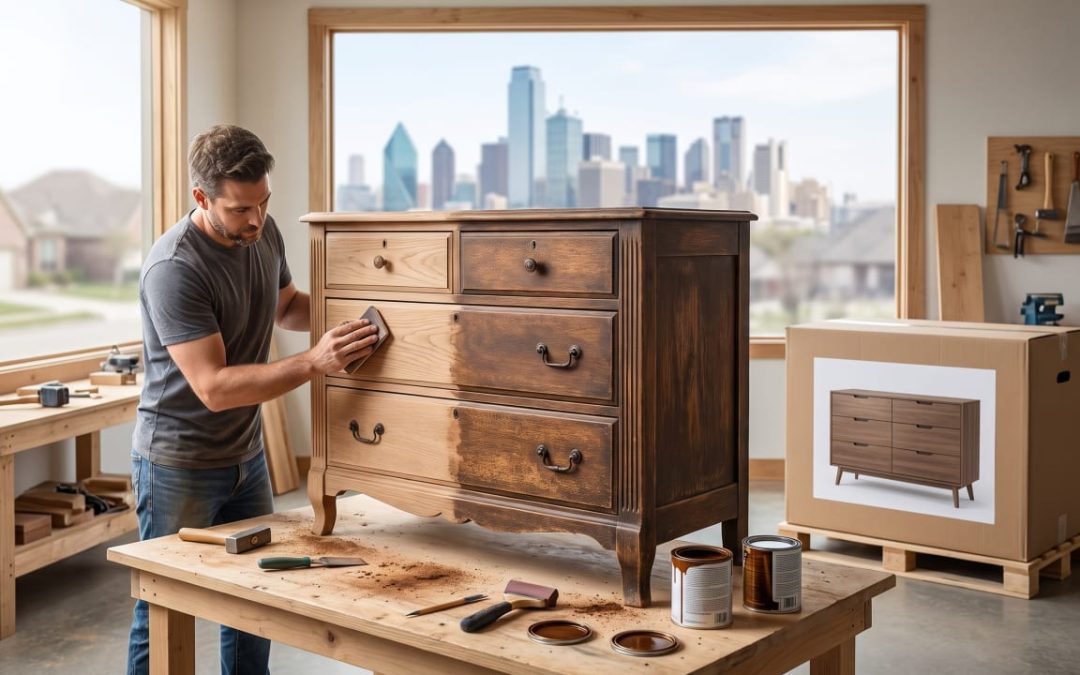
You are standing in front of a dining table with a sun-faded top, a dresser with a stubborn water ring, or a chair that wobbles every time someone sits down, and the question lands: do you fix it or haul it out and buy something new? For many households, furniture refinishing vs replacement in Dallas-Fort Worth comes down to a handful of facts about how the piece was built, what it will cost to restore, and what it would cost to replace with something of equal quality. Our Dallas-Fort Worth furniture refinishing service exists for exactly that decision, and after 45 years at the same Carrollton workshop, we have a pretty reliable sense of which pieces are worth saving.
This guide walks through the same questions we ask when a customer sends photos for an estimate. It is not a sales pitch for refinishing everything. Some pieces really should go. But a surprising number of the dressers, hutches, and dining sets that homeowners are ready to give up on are better built than anything in the mid-priced showroom today, and that changes the math.
There is also a bigger picture. According to the EPA’s durable goods data, Americans generated about 12.1 million tons of furniture and furnishings waste in 2018, and more than 80 percent of it went to landfills. Wood was the largest material category in that stream, and the EPA’s separate wood material data shows how much of it never gets a second life. Refinishing a solid-wood piece keeps that material in service, which is a nice side benefit even if your main concern is your budget.
Why DFW Homeowners Are Choosing to Refinish Rather Than Replace
A lot of furniture bought in the 1950s through the 1990s was made with solid hardwood, real dovetail joinery, and thick veneers over quality cores. Much of it has been passed down, inherited from a parent’s home, or picked up at an estate sale. When that furniture shows its age, the finish is almost always what is failing, not the structure. Finishes yellow, craze, scratch, and take on watermarks. Wood itself is remarkably durable, and the USDA Forest Products Laboratory’s Wood Handbook documents just how well properly seasoned and joined lumber holds up over decades of use.
Compare that with a lot of what is sold new today. Entry-level and mid-priced furniture is frequently built from particleboard or MDF wrapped in laminate or printed paper, held together with staples and cam locks. It looks fine in the showroom, but it cannot be refinished when it chips, and it rarely survives a second move. A solid-wood replacement of comparable quality costs considerably more than refinishing what you already own, and in nearly every case we see, refinishing the existing piece comes out ahead on price.
Then there is the intangible part. Sentimental value counts. Even when a piece does not pencil out on paper, the table where your family ate for thirty years may be worth restoring regardless. We never dismiss that reasoning, and neither should you.
What Refinishing Actually Involves (and Why It Beats a Quick Fix)
Customers sometimes imagine refinishing as a coat of fresh stain and a wipe-down. It is more thorough than that. We strip the old finish completely, using our laser stripper or a chemical overflow method where stripper flows over the piece as we brush it. That controlled, hands-on approach protects glue joints, veneer, and the wood surface. For a top-only job, such as a dining tabletop where we want to keep stripper off the legs, we use a gel stripper.
After stripping, we sand, repair, and color-match. Matching is done on the actual piece with test passes, not just against a sample board, and three to six passes to dial in a color is normal. One honest limitation: we cannot stain a piece lighter than the natural wood, so the bare wood sets the lightest possible tone. We use dye-plus-pigment stain systems, then finish with lacquer for residential furniture. You can read the full sequence in our step-by-step refinishing process.
Tabletops and dresser tops get a full refinish across the entire surface. Patched areas tend to show under raking light, so treating the whole top gives you a single, even finish that looks like it came out of the original factory run.
Cost Side by Side: Refinishing Versus Buying New
Everything below is a starting or typical range, and your final number comes from a free photo-based estimate. For a deeper breakdown, see our full guide to what furniture refinishing costs in the DFW area.
- Small pieces such as end tables and side chairs: roughly $275–$650.
- A single dining chair: $275–$375.
- A nightstand: starts around $650.
- A dresser or hutch: typically $1,200–$2,200.
- A dining tabletop with a standard finish: about $120 per running foot.
- A full dining set with six chairs: $2,500–$4,000.
Refinishing jobs start at $600, and basic repairs start at the $125 shop minimum. Now price the alternative. A new solid-wood dining table and six chairs from a reputable maker is a major purchase, and delivery, assembly, and removal of the old set add to it. A new solid-wood dresser of equal quality tends to cost more than refinishing yours. If you are comparing against particleboard furniture, replacement may look cheaper up front, but you are buying something that cannot be refinished later and often will not outlast a decade of daily use.
Replacement wins on price only in a few situations, which we cover below. In most of the others, the question is not whether refinishing is cheaper but whether the piece deserves the money.
Signs a Piece Is Worth Saving
Pull out a flashlight and go through this checklist. If most of the answers are yes, refinishing is probably the right call.
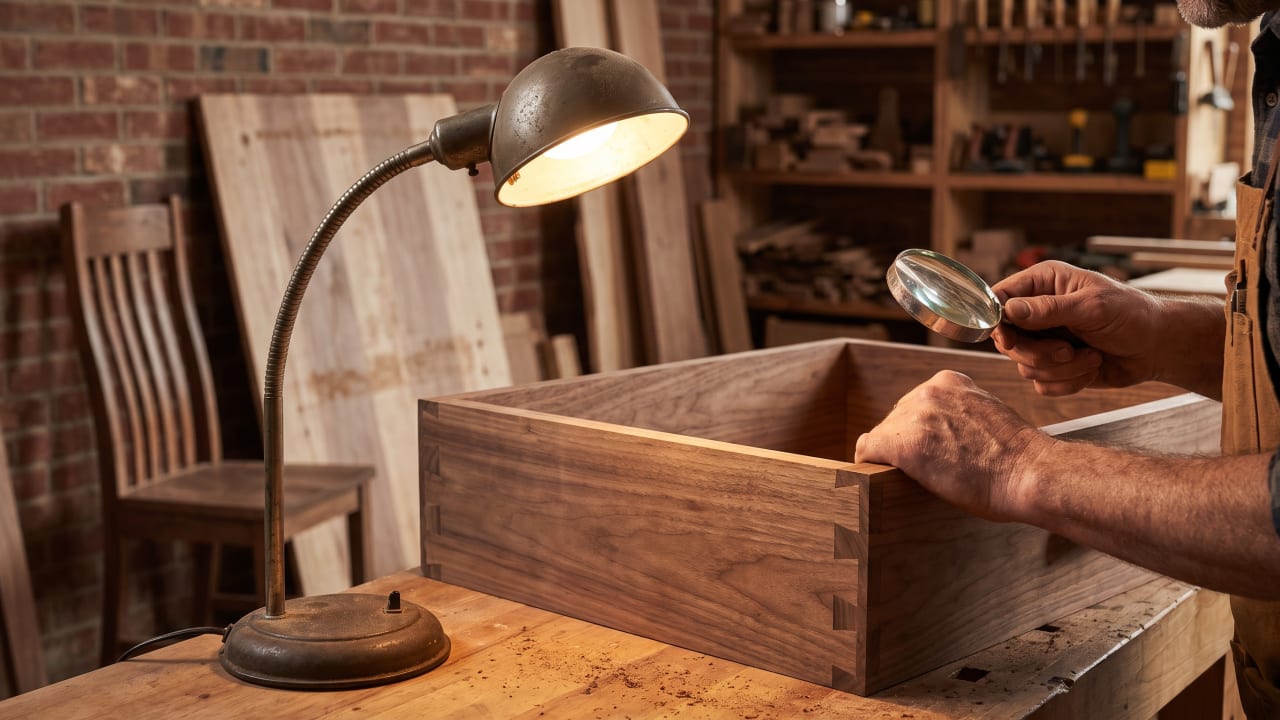
- It is solid wood, or wood veneer over a sound core. Pull a drawer. Dovetailed corners and visible grain on the drawer sides are good signs. Particleboard or MDF with a real wood veneer is a large share of the jobs we do, and it refinishes well.
- It is heavy for its size. Weight usually means dense hardwood and thick components.
- The joints are sound or fixable. A loose chair leg or a wobbly rail is a repair, not a death sentence. Re-gluing, dowel replacement, and joint work are bread-and-butter for us.
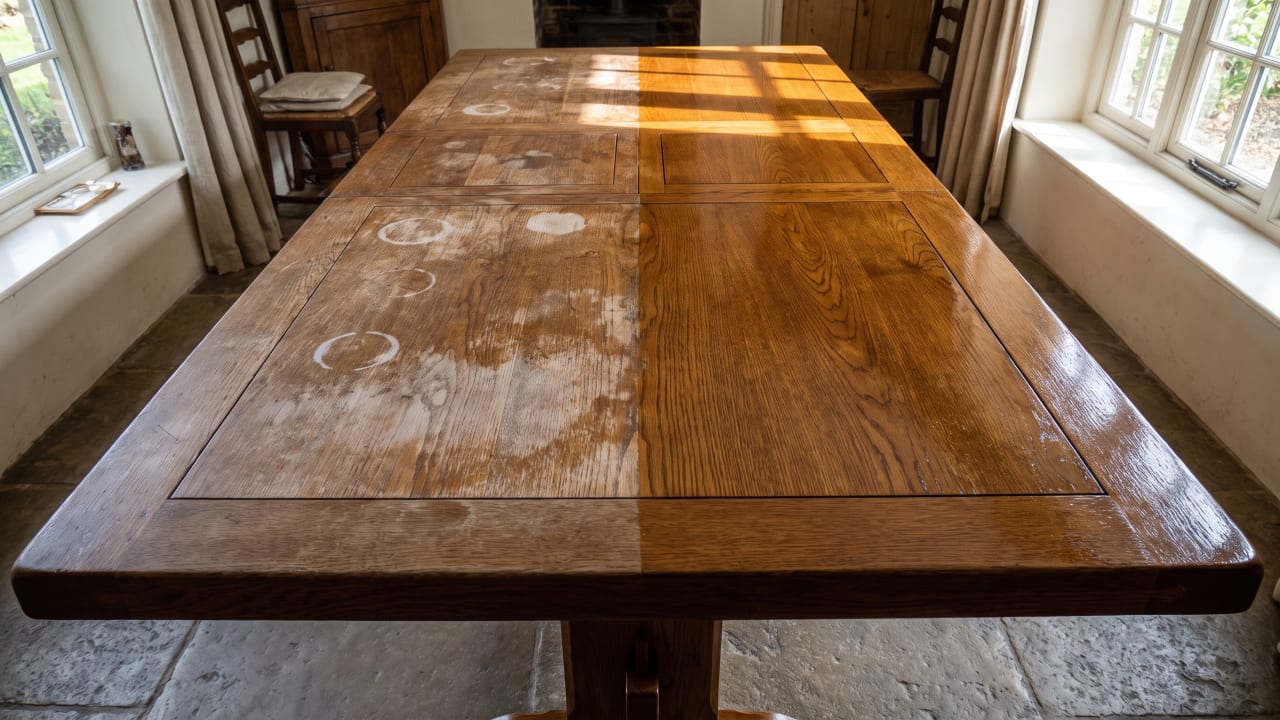
- The damage is in the finish. Scratches, sun fade, cloudy topcoat, ring marks, and worn arms all come off when the finish is stripped. Deep gouges can be filled with two-part epoxy.
- You like the design. Proportions, carving, and scale are the hardest things to replace. Color is the easy part.
If a piece has a missing veneer section or a lifted corner, that is generally repairable. For a related decision on wobbly pieces, our guide to re-gluing, doweling, and reframing loose chairs explains what the shop can do before you consider replacing a chair outright.
When Replacement Is the Honest Answer
We would rather tell you the truth than take a job that will disappoint you. Here are the cases where we usually suggest buying new.
- Laminate over particleboard, or a crumbling core. Plastic laminate has no real wood to strip and stain, and once a particleboard or MDF core swells or breaks apart, it cannot be structurally repaired. These are the pieces where buying new is the honest answer.
- You simply dislike the style. Refinishing changes the color dramatically, but the shape stays the same, so a pedestal table remains a pedestal table.
Be aware that sentimental value can tip the scale even for a borderline piece. Just go in with your eyes open about what is achievable. If you are unsure which category yours falls into, a photo estimate is free and takes a few minutes, which is much less trouble than loading a heavy dresser into the truck to find out.
Sofas, Club Chairs, and Other Upholstered Pieces
The same logic applies to upholstery, with different numbers. A well-made sofa frame, with a kiln-dried hardwood structure and tight joinery, can outlast several fabric cycles. The fabric and foam are what wear out. Reupholstering a three-seat sofa has labor starting at $1,500, with fabric typically adding roughly $1,200, so complete jobs begin at around $2,500. A skirted club or wingback chair runs $650–$900 for labor, plus roughly $700 for fabric. That is real money, and it should be weighed against what a new frame of comparable quality costs. Our upholstery and reupholstery services page has more detail on how those jobs work.
Fabric choice makes a big difference to how long your investment lasts. The Martindale test measures how many abrasion cycles a fabric survives, as this overview of the Martindale test explains. For a sofa that sees regular use, we recommend 30,000 rubs or higher, and 50,000 or higher for high-traffic rooms. Commercial jobs get fabric rated at 100,000 rubs or higher. You select from our Greenhouse Fabrics swatch books, or bring your own fabric (a $35 per yard fee applies for customer-supplied material). Because fabric is ordered from the swatch books, it takes about a week to arrive, so we handle fabric selection and the deposit before pickup so your material is already at the shop when we start.
Cushions sewn into the body of the piece are handled as part of a full reupholstery, which refreshes the foam, batting, and fabric together. That is the path we recommend for attached cushions, and it gives a sofa or chair a clean, uniform result.
Time, Pickup, and What to Expect
Refinishing is not instant, and that is the one place where buying new can feel faster. Standard furniture refinishing runs 5–6 weeks, and single pieces typically take 4–6 weeks, sometimes longer in our busy seasons. Reupholstery takes 6–12 weeks depending on workload. If you need a table for a holiday gathering, plan well ahead. For more on timing, see our realistic refinishing timeline.
We offer pickup and delivery across the metroplex, starting at $250 round trip depending on location and the size of the job. The fee is quoted up front in your estimate, so there are no surprises. Many customers bring smaller pieces to the shop themselves instead.
Keeping the Finish Looking Good After It Comes Home
Choosing to refinish is only half the value. The other half is how long the new finish lasts, and a few habits make a real difference. Lacquer reaches its full hardness over several weeks, so be gentle with a freshly returned piece. Use felt pads under lamps and décor, coasters under glasses, and trivets under hot dishes. Wipe spills promptly with a soft, slightly damp cloth, and avoid silicone-based aerosol sprays, which can build up and make future repairs harder.
Sunlight is the other enemy of a fresh finish. Ultraviolet light fades stain and dries out wood over time, so if a piece sits beside a big west-facing window, consider rotating accessories or repositioning the piece so the exposure is even. Steady indoor humidity helps too, since wood expands and contracts with big swings in moisture. None of this is complicated, and it is the same advice we give anyone who picks up a finished table.
Compare that ongoing care with the reality of a replacement purchase. A mass-produced particleboard piece has no second act. When its surface chips or swells, the only option is the curb. A solid-wood piece you refinish now can be refinished again in thirty years, which is the clearest sign that restoring is the longer-term investment.
A Simple Decision Framework for Your Piece
Run through these four questions in order.
- Is the piece solid wood or real wood veneer? If not, replace it.
- Is the structure sound or repairable? If joints can be re-glued, keep going.
- Does the restoration cost land comfortably below a quality replacement? For solid wood, it nearly always does.
- Does the piece matter to you? Sentimental value is a legitimate yes.
If you answered yes to all four, refinishing is the stronger choice. Cabinets follow similar reasoning, and our look at cabinet refinishing versus replacement applies the same tests to a whole kitchen.
Serving Homeowners Across Dallas-Fort Worth
Our workshop is at 2425 Parker Rd., Bldg. 5, in Carrollton, and we serve homeowners across the metroplex, including Dallas, Fort Worth, Plano, Frisco, Richardson, Irving, and Allen. Wherever your piece lives, we can start with photos. If a repair is what you need instead, our furniture repair service covers broken joints, legs, and gouges.
Frequently Asked Questions About Refinishing vs Replacing in DFW
Is it cheaper to refinish or replace furniture in Dallas-Fort Worth?
For solid-wood pieces, refinishing is almost always cheaper than buying new furniture of equal quality. A dining set refinishes for roughly $2,500–$4,000, while a comparable new solid-wood set costs more once delivery and removal are included.
How can I tell if my furniture is worth refinishing?
Check for solid wood or real wood veneer, dovetailed drawers, and sound joints. Damage that is limited to the finish is ideal. Send photos for a free online estimate and we will tell you honestly.
What kinds of furniture are best to refinish in Dallas-Fort Worth?
Solid-wood dressers, hutches, dining tables, and chairs are the strongest candidates, along with pieces made from real wood veneer over a sound core. Many DFW homes have inherited or estate-sale furniture with excellent construction, and a new finish brings it back to life at a fraction of replacement cost.
How long does furniture refinishing take?
Standard refinishing runs 5–6 weeks, and single pieces typically take 4–6 weeks. Reupholstery takes 6–12 weeks depending on workload.
Make the Call With Real Numbers
Most of the time, the furniture you already own is the better value. It is better built, it carries your history, and it can look new again at a fraction of what a quality replacement costs. When it does not make sense, we will say so. Homeowners throughout Dallas-Fort Worth can request a free online estimate with a few photos, or call us at 214-731-3060 to talk it through with the family that has been refinishing furniture here since 1980.