
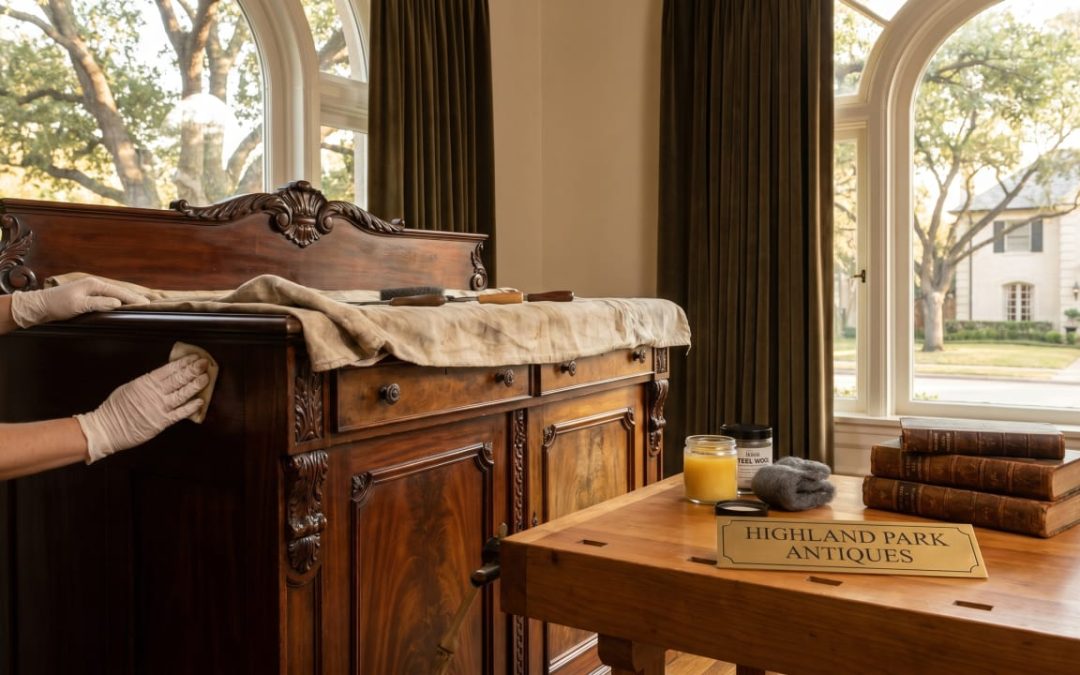
What Mahogany Restoration Really Means for Highland Park Homeowners
Mahogany is the wood that furnished the great houses. Sideboard sets built in the 1920s. Bedroom suites ordered from department catalogs in the 1940s. Georgian-style dining tables that came into Highland Park homes as wedding gifts and never left. If you live in a house in Highland Park, Dallas, there is a reasonable chance you have at least one mahogany piece that has been quietly aging in a corner, its surface somewhere between worn and wonderful.
The question that lands in our Carrollton workshop regularly is: should we strip and refinish it, or try to save the original finish? The answer is almost never automatic. It depends on the wood, the finish underneath, the damage, and what the piece means to you. Our shop has been working through exactly that decision on behalf of Dallas-area clients since 1980, when Andrew’s father John started this business. The nuance built up over 45 years is what this article is about.
If your mahogany piece has its original finish intact, even if it looks dull or a little tired, you may be sitting on more value than you realize. Before you hand it over to anyone with a chemical stripper, read this. And when you are ready to talk specifics, our Dallas furniture refinishing services cover the full spectrum from light conservation to complete restoration, with the same hands doing the work at every stage.
Why the Original Patina on Mahogany Antiques Is Worth Protecting
Patina is not just a romantic word for old furniture. It is a measurable, visible record of how a piece aged. On mahogany, it shows up as a deepening of color toward red-amber-brown tones, a slight translucency in the finish, and subtle surface movement that flat new wood simply does not have. According to antique furniture appraisal research from AppraiseItNow, original finish and intact joinery consistently command higher prices than even immaculately refinished alternatives. The antique market prizes the story in the surface.
For pieces that are true antiques, meaning over 100 years old, collectors and appraisers widely agree that removing original patina through sanding or stripping can permanently erase that history and reduce value substantially. A refinished piece, however beautifully done, reads differently to a buyer who knows what they are looking at. The warmth and depth that developed over a century cannot be reproduced in a spray booth.

That said, there is a wide spectrum between “leave it alone” and “strip it to bare wood.” Most of the mahogany pieces we see from Highland Park, Dallas households fall somewhere in the middle: the underlying wood is genuinely beautiful, the structural integrity is sound, but the finish has degraded to the point where it no longer protects or presents well. The right answer is almost always the lightest intervention that gets the piece back to honest, functioning condition.
Identifying the Finish Under Your Mahogany’s Surface
Before any restoration work begins, we need to know what finish is on the piece. This is not academic; it determines everything about how we approach the job. Mahogany furniture made before roughly 1940 was almost universally finished in shellac, often applied by hand in the French polish tradition. Pieces from the 1940s through 1970s transitioned to lacquer. More recent production furniture may have a catalyzed or UV-cured finish.
Shellac behaves very differently from lacquer in day-to-day use. It dissolves readily in alcohol, which means a spilled drink or a harsh cleaner can cloud or lift a shellac surface, and it offers very little resistance to heat, water, or scratches. Knowing that your 1920s mahogany sideboard has its original shellac finish means we handle it entirely differently than a 1965 lacquered set. That identification is an experience-based read our craftsmen make at estimate and intake, drawing on the piece’s age, construction, and the way its surface has worn. As this restorer’s guide to historical wood finishes explains, shellac-era pieces require a fundamentally different approach than later lacquer or synthetic finishes.
One thing we are straightforward about with antique owners: we do not re-create or revive French polish. It is a beautiful finish to look at, but a very delicate one, with virtually no resistance to heat, water, or scratches, which is why it rarely survives on furniture that actually gets used. When an antique shellac piece comes through our shop, we strip it carefully and refinish it in modern lacquer, matched to a period-appropriate color and sheen, so the piece keeps its character while gaining a surface that can handle daily life. For a deeper look at how we sequence these decisions in our shop, see our furniture refinishing process overview.
When the Patina Cannot Be Saved: Making the Call to Strip
Sometimes preservation is not possible. We get pieces in with finish so far gone, so crazed and lifting, that no amount of careful cleaning will restore a functional surface. And we see pieces where a previous owner already stripped the original finish improperly, leaving a blotchy mess that needs to come off entirely before anything honest can be applied.
When a full strip is warranted, method matters enormously on mahogany, especially on veneered pieces. Our shop uses a laser stripper or a chemical overflow method where the stripping agent flows over the piece as we brush it on. We never use submersion, heat guns, or sandblasting. Those approaches are too aggressive for the thin cross-banding and delicate veneer inlays common on traditional mahogany furniture. Chemical overflow gives us control: we can work section by section, rinse and neutralize carefully, and protect areas that do not need attention.
For pieces where only the top surface has failed (a dining table top that is deeply hazed or scratched, for instance) and the base still has a good original finish, we will sometimes strip just the top and blend the new finish on the apron and legs rather than touching the original. It takes more time and judgment to pull off, but it preserves more of what is original. A photo sent to our team through the online estimate page gives us enough information to make a preliminary read on which approach your piece needs.
Color-Matching Mahogany: Getting the Depth Right
Mahogany’s richness comes from a combination of factors: the interlocked grain structure that creates a shimmering ribbon figure, the natural reddish-brown base tone that deepens with age, and the way light interacts with the finish built on top of it. Matching that on a repair or re-finish requires working with dye stains and pigment toners, not the gel stains that are common in home-improvement circles. Gel stains sit on the surface and muddy the figure; mahogany deserves a transparent dye that lets the grain character show through and a pigment toner applied over the sealer to build the exact tone of the adjacent original surface.
There is one non-negotiable rule in our shop: we cannot stain mahogany lighter than its natural color. If the wood has darkened with age, if it has absorbed decades of surface material even after stripping, the stain can only go darker. This is worth knowing before you commit to a restoration. If you have a piece where one section has been heavily bleached by sunlight, getting it to match the darker original tone on the shaded side is achievable. Going the other direction is not.
All color-matching at our shop is done on the actual piece, not from sample boards or chips. Mahogany varies considerably between boards in the same piece, between old-growth Honduran mahogany (the most prized, commonly found in furniture made before 1960) and plantation-grown alternatives used in later production. The eye judgment of a craftsman who has worked with this species for years is what closes the gap. We mix toners and adjust until the repair reads seamlessly under multiple light sources. You can see the breadth of our restoration work across the Dallas furniture repair services page, where structural work and finish work come together on the same piece.

Veneer Care on Mahogany Pieces: What Changes
A significant portion of the mahogany furniture built in the 20th century used veneer over a substrate, most commonly solid mahogany or poplar. Veneer on genuine antiques is quite thin by modern standards, sometimes as little as 1/28 of an inch. That means every decision about stripping, sanding, and finish application has to account for a surface layer that cannot tolerate heavy abrasion.
When veneer lifts at a corner or along an edge (usually a consequence of moisture infiltration or old hide-glue failure), re-gluing is the first order of business. We inject fresh adhesive under the lifted section, clamp it flat, and let it cure before any finish work touches the area. If the veneer has cracked or a section is missing entirely, we can patch from matching veneer stock. Getting the grain direction and figure to align is the craft part; getting the stain and finish to blend over the patch is where the years of color-matching experience pay off.
We also work on mahogany pieces with real-wood veneer over particleboard substrate, which became common from the 1970s forward. Refinishing these is entirely viable as long as the veneer is intact and well-bonded. What we do not do is structural repair on particleboard that has swollen or delaminated from water exposure; that substrate cannot be restored, and at that point replacement is the honest recommendation. But where the board is sound and the veneer is solid, the refinishing result looks exactly like solid wood once it is done.
What Highland Park, Dallas Clients Typically Bring Us
The homes in Highland Park carry a disproportionate share of the DFW area’s genuinely old furniture. Tudor-revival houses built in the 1920s and 1930s were furnished in the period aesthetic, which meant mahogany: heavily carved dining sets, partner desks with inset writing surfaces, bedroom suites with mirror-backed dressers. Many of those pieces stayed in the families who originally bought them. What we see coming to us from this part of Dallas is often three or four generations deep.
That history adds a layer of weight to the conversation about restoration. A 1930s mahogany dining set that has been in the family is not just furniture; it is a material record of the family’s life in this neighborhood. Our approach starts with listening to that context before we recommend anything. If the goal is to keep the piece in the family for another generation while getting the dining room table functional again, we make decisions accordingly. If the client is considering selling and wants the piece to show well at appraisal, that shapes a different recommendation entirely.
According to research on how refinishing affects antique value, well-conceived and well-executed restoration typically enhances rather than diminishes the value of most old furniture. The key phrase is “well-conceived.” That is where the initial assessment matters as much as the technical work that follows it.
The work we do for clients in Highland Park, University Park, Preston Hollow, and surrounding parts of Dallas tends to cluster around a few recurring jobs: dining set restoration (table tops that have been refinished poorly at some point and need to come back to a consistent surface), bedroom suite repairs (drawer fronts that have lost veneer at the edges, mirror frames with finish flaking), and the occasional partner desk or secretary where the wood surround needs a careful refinish.
The Finish We Apply: Lacquer on Mahogany
When a mahogany piece needs a fresh finish, our residential standard is lacquer. It builds quickly, levels beautifully, and dries hard enough to be practical in a dining room or bedroom setting. It is also reversible if needed, which matters on pieces that may have ongoing conservation interest. A skilled lacquer application on mahogany produces a surface with genuine warmth and depth, not the plastic-looking flatness that some people associate with spray finishes from less careful shops.
Sheen level is something we discuss with every client. The original finish on a 1930s piece was typically quite flat by today’s standards; the resins used in shellac and early lacquers did not produce a mirror-like surface. When we are trying to restore a piece to its original character, we match the sheen level to period-appropriate standards. That usually means a satin to low-semi-gloss, which reads as furniture rather than as a coating. The piece looks right in the room.
What we do not use: conversion varnish (too hard and irreversible for antique work), gel stain (muddy on figure-rich mahogany), Danish oil, tung oil, or any wax topcoat. These may come up in online forums or home-center advice, but they are not how a professional finishing shop approaches mahogany restoration. The finish has to protect the wood, add to the appearance, and be maintainable over time. Lacquer meets all three requirements when applied by hands that know what they are doing.
What Mahogany Restoration Costs and How Long It Takes in 2026
Pricing for mahogany restoration varies with scope, but here are the ranges we work with in 2026. A dresser or hutch refinish runs $1,200 to $2,200. A full dining set (table plus six to eight chairs) falls in the $2,500 to $4,000 range. Individual pieces, a side chair or a small table, start at $275 to $650 depending on what is involved. Refinishing in general starts at $600 for a project worth taking on, and your photo estimate locks the price before anything comes into the shop.
Lead times for standard refinishing work run 5 to 6 weeks from drop-off to pickup for most single pieces. Complex antique restoration with extensive veneer repair or careful color-matching may run toward the longer end of that window. Pickup and delivery across the Dallas area, including Highland Park and the surrounding Park Cities corridor, starts at $250 round trip. For clients who prefer to bring pieces directly to us, our Carrollton workshop is at 2425 Parker Rd. Bldg. 5, Carrollton, TX 75010, about 20 minutes from most of Highland Park by the tollway.
One practical note on the estimate process: color-matching decisions and veneer assessment really do require seeing the actual piece. Photos give us enough to quote a solid price range, but the final color formula and the confirmation of what intervention level is right happen in the shop. We do not do remote final quotes on complex antique work because the piece itself always has something to teach us that a photograph cannot fully show. You can reach us at 214-731-3060 to talk through what you have before committing to a drop-off or pickup.
Where We Serve Across the Dallas Area
We pick up and deliver across the DFW metroplex. Clients come to us regularly from Highland Park, University Park, Preston Hollow, Uptown Dallas, Downtown Dallas, and North Dallas. Our Carrollton workshop, where all the restoration work happens, has been at the same address since the shop opened in 1980. If you are anywhere in the Park Cities corridor or the broader Dallas area and have a mahogany piece that needs attention, pickup and delivery starts at $250 round trip. You are also welcome to bring the piece directly to us. See our location and contact page for directions and hours.
Frequently Asked Questions: Mahogany Restoration in Highland Park, Dallas
Will refinishing my mahogany antique in Highland Park reduce its value?
It depends on how old the piece is and what state the original finish is in. For true antiques over 100 years old with an intact original finish, conservation and light restoration preserve value better than full stripping. For pieces from the mid-20th century with a degraded finish, professional refinishing typically maintains or improves value. We assess each piece individually and will tell you honestly when the lighter intervention is the right call.
How do I know if my Highland Park mahogany piece has its original shellac finish?
Age is the most reliable clue. Pieces made before roughly 1940 were almost universally finished in shellac, while furniture from the 1940s onward generally carries lacquer or a later synthetic finish. Our craftsmen confirm what is on a piece with an experience-based assessment at estimate and intake, reading its age, construction, and the way the surface has worn. Either way, a failed shellac finish is stripped and the piece is refinished in modern lacquer, which stands up to heat, water, and scratches far better than the original ever could.
Can you match the color of an existing mahogany finish if only part of the piece needs work?
Yes. Color-matching partial repairs is one of the core skills at our Carrollton workshop. We use dye stains and pigment toners mixed on the actual piece, not from sample boards, to match the existing tone. The one hard limit: we cannot stain wood lighter than its natural color after stripping. If a section has darkened significantly, we can match it; if it has lightened, we work within that constraint.
How much does mahogany furniture refinishing cost in Highland Park, Dallas?
In 2026, dresser or hutch refinishing runs $1,200 to $2,200. A full dining set runs $2,500 to $4,000. Individual smaller pieces start at $275 to $650 depending on scope. Refinishing projects generally start at $600. Pickup and delivery across the Dallas area, including Highland Park, starts at $250 round trip. Send photos for a free online estimate and we will give you a specific range before anything comes to the shop.
Do you do veneer repair on antique mahogany pieces from the Highland Park area?
Yes. We repair lifting veneer, edge chips, and missing veneer sections on mahogany pieces regularly. The veneer work and the finish work are handled by the same team in our Carrollton shop, so color-matching across the repair happens seamlessly as part of the overall restoration. We can also refinish solid wood and real-wood-veneer pieces on particleboard substrate when the veneer is intact.
Ready to Restore Your Mahogany Piece?
If you have a mahogany piece in Highland Park, Dallas that has been quietly asking for attention, the first step is a conversation, not a commitment. Send photos and we will give you a frank read: whether the piece needs conservation, a targeted repair, or a full refinish, and what it will cost. There is no pressure to proceed and no guesswork on pricing once we see the piece in person.
We have been doing this work out of our Carrollton workshop since 1980. The craft knowledge that goes into a mahogany restoration at Andrew’s Refinishing is 45 years deep, and the same care that went into the first job John did goes into every piece that comes through the door today. Highland Park homeowners can request a free online estimate anytime, or call us directly at 214-731-3060 to talk through what you have before scheduling a pickup.