
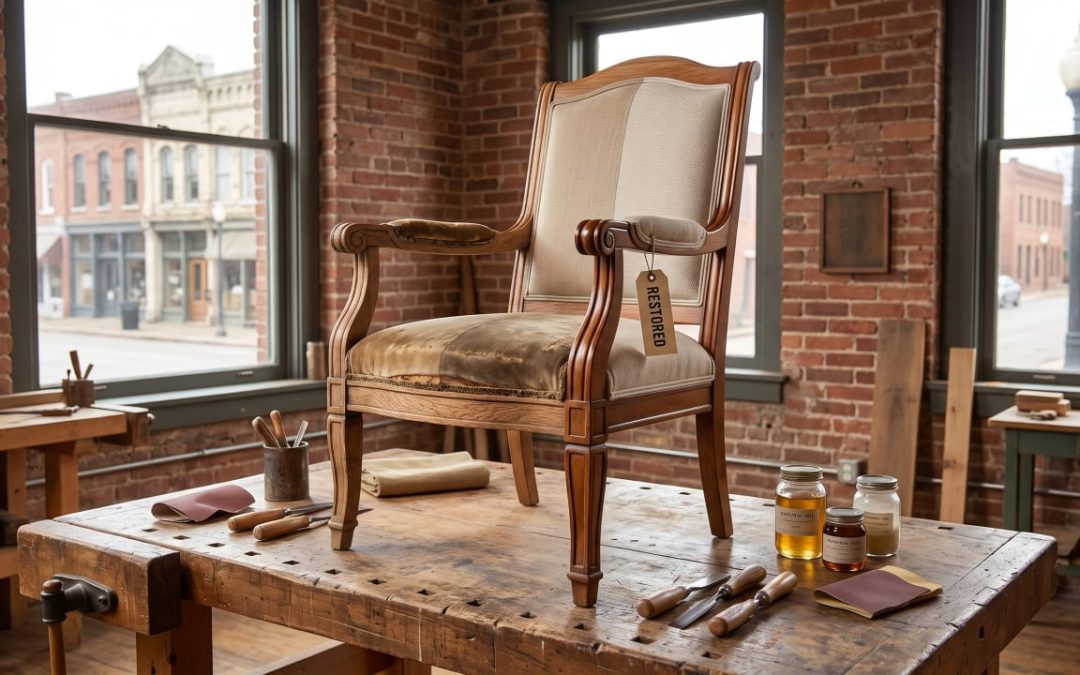
Walk a few blocks off Davis or Melba in Bishop Arts and you will pass one Craftsman bungalow after another, most built between roughly 1910 and the early 1940s. A lot of that housing stock still has its original built-in china cabinets, heart pine floors, and furniture that came with the house or came down through a family. That is the piece we hear about most from this part of North Oak Cliff: a grandmother’s dining table with a wobbly leg, a dresser with drawers that stick in summer humidity, a set of dining chairs with caned seats that gave out years ago. Some of it is genuinely worth restoring. Some of it is not, and a shop that has been doing this since 1980 will tell you which is which before you spend a dollar. We handle the furniture repair Dallas homeowners already trust us for, and this neighborhood is a regular part of that work.
This post covers what is actually worth saving in a part of town full of older homes and inherited furniture, what our shop can and cannot do, and what it costs to get a piece to our workshop and back. According to one recent industry market research report, the furniture repair and restoration market has grown steadily as more homeowners choose restoration over replacement, a trend that shows up clearly in older neighborhoods where the furniture is often better built than what would replace it. If you already know your piece needs full refinishing rather than a structural repair, that page covers our process in more depth.
North Oak Cliff’s Housing Stock: Why So Much Furniture Here Is Worth Saving
This part of Dallas was one of the city’s early streetcar suburbs, and the Winnetka Heights Historic District wrapping around the shopping and restaurant strip still has blocks of restored Craftsman bungalows, Tudor revivals, and Prairie-style homes dating to the 1910s and 1920s. Newer infill has filled in gaps over the last two decades, but the older housing stock is still the character of the area, and it tends to come with older furniture: solid oak and walnut dining sets, mahogany sideboards, maple dressers, the kind of pieces built to be repaired rather than replaced. A publication like Family Handyman’s guide to what old furniture is worth restoring makes the same point we make in our shop every week: construction quality, not age alone, is what tells you whether a piece is a good restoration candidate.
That is a different calculation than in a lot of newer subdivisions, where furniture is more likely to be recently purchased and cheaper to replace outright. In Bishop Arts and North Oak Cliff, we are more often looking at a piece with real joinery and solid wood components, decades of life left in it once the finish gets stripped properly and the joints get re-glued. The trade-off is usually an honest one: restoration costs less than buying a comparable new solid-wood piece, and it keeps furniture with family history intact instead of at the curb.

What We Can Restore for Bishop Arts and North Oak Cliff Homeowners
Between refinishing and repair, most of what shows up from this area falls into a handful of categories. We keep this list specific on purpose, because vague “we do it all” claims are not how a shop stays in business for 45 years. The newer infill homes mixed in among the bungalows bring in some newer furniture too, but even there, the pieces worth calling us about are usually the same: solid wood construction with a repairable structural problem, not laminate furniture that was never built to be refinished in the first place.
- Structural repair: re-gluing loose joints, dowel replacement, leg repair, and reframing on solid-wood chairs and tables
- Full refinishing: laser stripping or our chemical overflow method, sanding, staining, and a sprayed lacquer finish on solid wood or on particleboard and MDF that has a real wood veneer
- Cane and rush seat replacement: a common fix on the older dining chairs that come out of Craftsman-era homes
- Scratch and gouge fill: two-part epoxy for deeper damage, with finish blending on the repaired section
- Color matching: done on the actual piece rather than a sample board, which matters more on older wood that has darkened or faded unevenly over decades
- Kitchen and bath cabinet refinishing: a frequent request in the bungalows and Tudors here, where original cabinet boxes are worth keeping
We recently wrote in more depth about cabinet refinishing for Bishop Arts kitchens if that is closer to what you are dealing with. Structural furniture repair and cabinet work often come up together in these older houses, since both are about keeping original materials rather than tearing them out.
Being Upfront About What We Don’t Fix
A shop that has survived four and a half decades in this business learns to say no clearly. We do not restore leather of any kind. We do not repair wicker, rattan, or vinyl webbing, though cane and rush seating is a different scope and something we do handle regularly. We cannot structurally repair particleboard or MDF cores, and we cannot refinish particleboard that has laminate rather than real wood veneer on top. Bubbling veneer, where the veneer has actually blistered rather than just lifted or gone missing in a section, is not something we can fix. Water-damaged pieces where the substrate has swollen or delaminated are usually past what refinishing can address. Table and dresser tops always get fully refinished, never spot touched-up, because a partial fix on a top almost never blends invisibly.
None of this is a knock on your piece. It is just an honest inventory of what stripping, sanding, re-gluing, and a sprayed finish can and cannot undo. A dresser with a few missing veneer sections on the top can come back looking sharp. The same dresser with bubbling veneer across the whole surface usually cannot, no matter how much time we put into it. If your piece falls into one of the categories above, we will tell you during the estimate, before any work starts, rather than after.
From Here to Our Workshop: How Pickup Actually Works
Our shop sits at 2425 Parker Rd. in Carrollton, roughly 25 miles north of Bishop Arts depending on the route and time of day. We are not going to pretend that is a quick trip across town, so we handle it directly instead of asking you to figure it out. Pickup and delivery is available DFW-wide, with fees starting at $250 round trip depending on distance and the size of the job. For a large dining set or a dresser, that is usually simpler than hauling solid wood furniture yourself, especially if a leg or a drawer is already loose.
If your project is a set of loose cushions or something small enough to fit in a car, dropping it at the shop yourself is often the more practical option, and we will talk through which makes sense for your specific piece when you request an estimate. Either way, the pickup fee gets quoted upfront, not tacked on afterward.
The Restoration Process, Step by Step
Once a piece is at the shop, the process is the same one we have used since 1980, refined over 45 years of working on everything from a single Craftsman-era dining chair to whole hotel case-good sets.
- Assessment: we identify the wood species, check joint integrity, and confirm whether the piece needs repair, refinishing, or both
- Stripping: a laser stripper or our chemical overflow method, where stripper flows over the piece as we brush it rather than submerging it, which protects veneer and glued joints
- Structural repair: re-gluing, doweling, and clamping loose joints before anything gets a new finish
- Sanding and staining: color matched against the actual piece, usually across several test passes to get it right
- Finish application: a sprayed lacquer finish for residential interior pieces, applied in our spray booth and cured before the piece ships back out
On joint and dowel repair specifically, our approach lines up with the general guidance you will find from sources like HowStuffWorks’ overview of wooden furniture joint repair: clean the joint fully, use hardwood dowels sized to the original tenon where the old joint has worn or broken, and clamp until the glue has properly cured rather than rushing a piece back into use.
A recent example: we picked up a mahogany dining table from a bungalow near the Bishop Arts strip with a wobbly apron joint and a finish that had gone cloudy from decades of humidity swings. The old glue had failed at two of the leg joints, so we disassembled those, cleaned out the original animal hide glue, re-doweled where the tenons had worn thin, and clamped the frame square before touching the finish at all. Only after the structure was solid did we strip the top with our chemical overflow method, sand it back to bare wood, match the stain to the surviving apron color, and spray a fresh lacquer topcoat. The owner’s grandmother had bought the table new in the 1950s, and it came back to a table that will outlast the next fifty years of family dinners rather than a piece patched together just well enough to sell.

What Furniture Restoration Costs
Every job gets a free photo estimate before we quote a final number, but these are the ranges homeowners in this part of town typically see.
- Basic repair jobs: $125 shop minimum
- Single dining chair refinish: $275-$375
- Full dining set (six chairs): $2,500-$4,000
- Dresser or hutch: $1,200-$2,200
- Refinishing jobs generally start around $600
Prices shift with the amount of structural work, the wood species, and how much stripping the old finish requires, which is exactly why we quote from photos rather than a flat rate over the phone. A solid oak dining chair with one loose joint and clean finish costs less to bring back than a mahogany sideboard that needs full stripping, veneer attention, and a new stain match, even though both might look similarly worn at first glance. Sending a handful of photos with your estimate request, including any cracks, missing hardware, or water rings, gets you a more accurate number the first time.
How Long Restoration Takes
Standard furniture refinishing runs 5-6 weeks from drop-off to delivery, and a single piece typically falls in the 4-6 week range as well, sometimes longer depending on how busy the shop queue is. Kitchen cabinet refinishing moves faster, usually wrapping up in about two weeks since the boxes stay in place and only the doors and drawers travel to the shop. We give you a realistic date at the time of your estimate rather than an optimistic one, since the last thing anyone wants is a dining table still at the shop the week before hosting guests. Spring and fall tend to be our busiest stretches, so if you already know a piece needs work before a specific date, whether that is a holiday dinner or a move, it helps to request the estimate earlier rather than closer to the deadline.
Serving Bishop Arts, North Oak Cliff, and the Surrounding Dallas Neighborhoods
Bishop Arts and North Oak Cliff are part of the wider Dallas service area we cover from our Carrollton workshop, alongside Highland Park, Downtown Dallas, Preston Hollow, and East Dallas, with pickup and delivery available anywhere in DFW.
Frequently Asked Questions
Do you pick up furniture from Bishop Arts and North Oak Cliff?
Yes. We offer pickup and delivery across the metroplex, with fees starting at $250 round trip depending on distance and job size. Since this neighborhood is roughly 25 miles from our shop, most customers here choose pickup rather than transporting furniture themselves.
Can you match the finish on my antique dining table?
In most cases, yes. Color matching is done directly on the actual piece rather than from a sample board, since older wood in these homes has often darkened or faded unevenly, and it usually takes several test passes to land on an exact match. One caveat worth knowing: we can only stain as light as the natural wood allows, never lighter, so a piece that has darkened significantly over the decades cannot be brought back to its original, lighter tone without a full bleach-and-restain process we do not typically recommend.
Do you repair caned dining chairs common in older bungalows here?
Yes, cane and rush seat replacement is one of our regular repair services and comes up often on the older dining sets we see from this part of Dallas. It is a separate service from wicker or rattan restoration, which we do not offer.
How much does furniture restoration cost in Bishop Arts?
Basic repairs start at a $125 shop minimum, and full refinishing jobs typically start around $600, with a complete dining set running $2,500-$4,000. Every job gets a specific, binding quote from a free online photo estimate before any work begins.
Is my furniture worth restoring or should I replace it?
Solid wood pieces, and particleboard or MDF pieces with a real wood veneer, are usually good restoration candidates, especially the older, well-built furniture common in this area’s Craftsman and Tudor homes. Sentimental value counts too. A free estimate will tell you honestly whether a piece makes sense to restore.
Ready to See What’s Worth Saving?
Sustainability is part of this conversation too. Recent industry data collected by First Chair’s roundup of sustainable furniture demand statistics found that a large majority of consumers now say sustainability matters to their purchasing decisions, and restoring an existing piece instead of buying new is one of the more straightforward ways to act on that. If you have a piece from a Bishop Arts bungalow that has been sitting with a wobbly leg or a tired finish, a good next step is our furniture restoration guide for North Dallas or our wood furniture repair breakdown for Preston Hollow, both covering similar older-home restoration decisions nearby. When you are ready, request a free online estimate or call our shop directly at 214-731-3060. We will tell you honestly what is worth saving.