
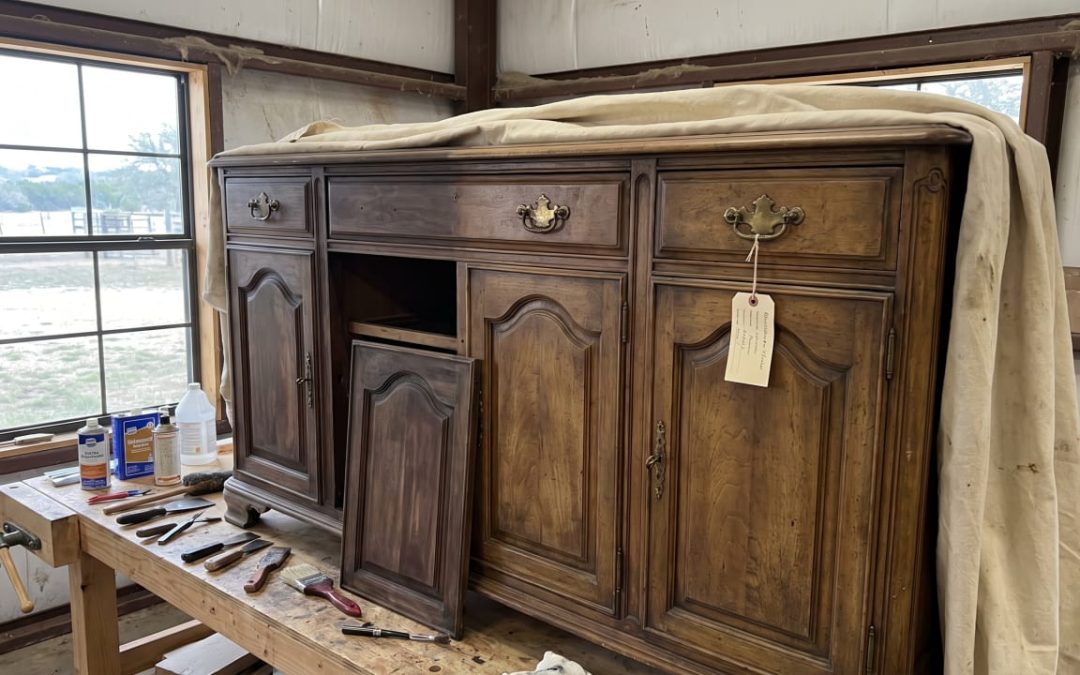
If you collect antiques in Westlake, you already know the problem. The pieces worth owning are the ones that have lived a few lives: a Federal sideboard that came down through a family, a Victorian marble-top table from an estate sale, a set of ladderback chairs with a century of dinners in them. They also tend to arrive with tired finishes, loose joints, and the occasional repair someone made in 1974 with the wrong glue. Antique restoration in Westlake, TX is really a series of judgment calls, and the first one is deciding what the piece actually needs.
Andrew’s Refinishing has been doing that work since 1980, founded by Andrew’s father John and now run by his son Simon, from our family workshop. Our full-service furniture refinishing in Dallas-Fort Worth covers antiques as well as everyday wood pieces. This guide explains how we think about the antique side of the shop, so you can decide with clear eyes before you ever pick up the phone.
What Antique Restoration Actually Means at Our Shop
The word “restoration” gets used loosely. Museums use it one way, auction houses another, and furniture shops a third. Here is how we use it: we repair what is structurally broken, then strip the old finish completely and refinish the piece in a modern lacquer. That straightforward approach suits the great majority of antiques people actually live with.
Conservators who work on museum collections follow a different philosophy. The American Institute for Conservation’s Wooden Artifacts Group works on preserving historic wooden objects, and in that world an early original finish is considered as much a part of the piece as the joinery. Only a genuinely museum-grade piece in documented original condition belongs with a conservator first; the heirlooms most families own are exactly what we restore.
Most antiques in people’s homes sit in a different category. They are good, solid, well-made furniture whose finish has crazed, darkened, or been abused over the decades, and the owner wants to use the piece every day. For those, a full strip and a durable new finish is often the right answer. The key words are well-done and appropriate, and the rest of this article is about how to tell the difference.
Why Westlake Collectors Bring Us Their Pieces
Westlake is a small town with a big furniture footprint. According to the Texas State Historical Association, the town grew from a ranching community into one of the most affluent addresses in the metroplex, with custom homes in neighborhoods like Vaquero, Entrada, and Granada. Those homes are filled by people who buy carefully, inherit generously, and furnish rooms with the kind of pieces that are meant to last.
The result is a steady stream of heirlooms and acquired antiques: English and American case pieces, farmhouse tables, French-style commodes, and mixed estate lots. Many of them have moved across the country at least once, which brings its own damage. If you are sorting through an inherited collection, our notes on when a crackled antique finish is worth saving will help you read what the surface is telling you.
The Damage We See Most Often
- Failing finish: alligatoring, crazing, white rings, and dark patches where old varnish has oxidized.
- Loose or broken joints: rocking chairs, wobbling table legs, and drawers that no longer track true.
- Lifted or missing veneer: chipped corners, lost banding, and sections that have come away from the substrate.
- Worn cane and rush seats: sagging or broken seats on side chairs and dining chairs.
- Color mismatch: a replaced leg or panel from an earlier repair that never matched the rest of the piece.
Almost every antique that comes through the shop has more than one of these going on at once. A tired finish usually hides a loose joint or two, and a lost veneer corner often sits right beside a long-ago color mismatch. That is why we assess the whole piece, not just the part the owner points to.
Our Antique Process, Step by Step
Every antique goes through the same disciplined sequence at our shop. If you want the long version for any piece, we cover it in our Carrollton workshop process walkthrough. Here is the antique-specific summary.
1. Assessment from Photos
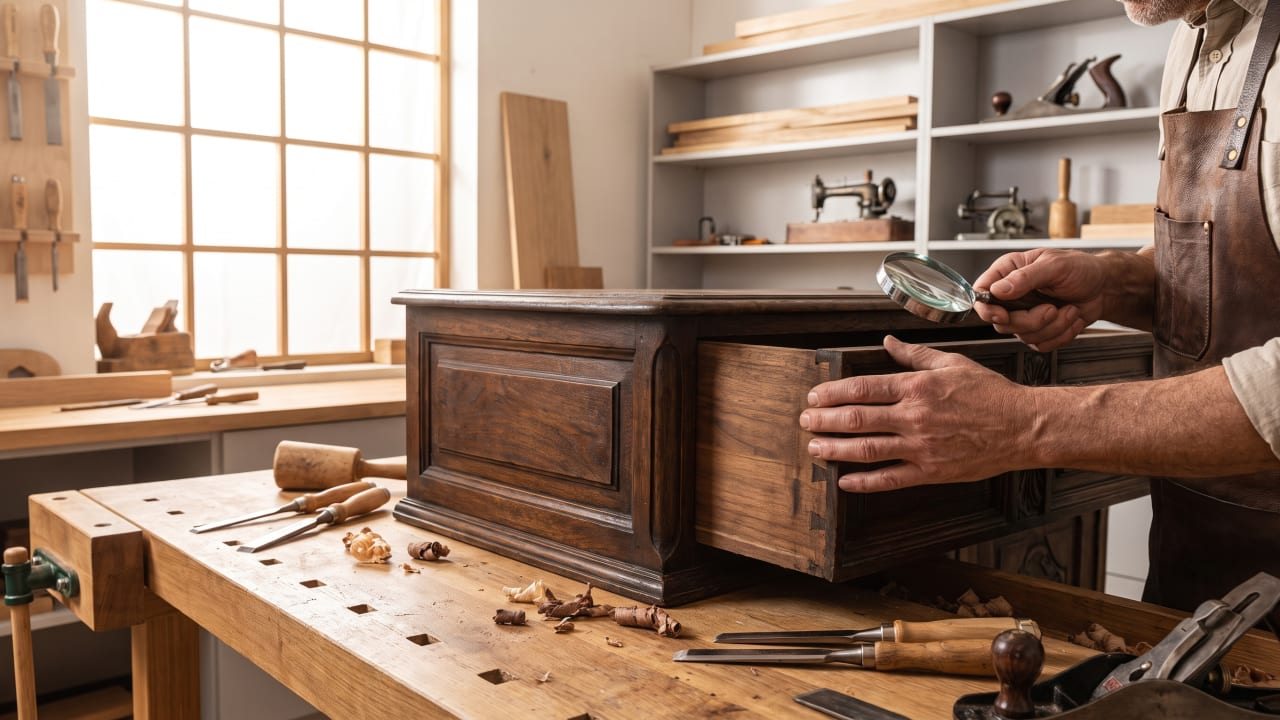
You start with a free online estimate. Send clear photos of the full piece, the joints, the underside, and any damage. We look at the wood species, the construction, how the finish is failing, and whether veneer is involved. We read the piece from the photos and from handling it at the bench, and we tell you what we see before any work begins.
2. Structural Repair First
Finish goes on last, so the bones come first. We re-glue loose joints, replace missing dowels, repair broken legs, and fill deep gouges with two-part epoxy. Lifted veneer and missing veneer sections are repairable. Cane and rush seats can be replaced, so a sagging set of side chairs can get new seats at the same visit as the rest of the work.
3. Stripping Without Harming the Wood
We remove old finish with a laser stripper or a chemical overflow method, where stripper flows over the piece as we brush it. That gentle, controlled approach matters on antiques because old hide-glued joints and thin veneers need the stripper working on the surface rather than soaking into the piece. Where a piece has a flat top that needs refinishing on its own, we can use a gel stripper so nothing runs down the legs.
A note on shellac. Many older antiques wear a shellac finish, sometimes the hand-applied kind collectors call French polish. It is beautiful, but it has almost no resistance to heat, water, or scratches. We do not offer French polish, so a shellac antique is stripped like any other and refinished in lacquer, which gives you a surface that survives a coffee cup and a Texas summer.
4. Color Matching on the Actual Piece
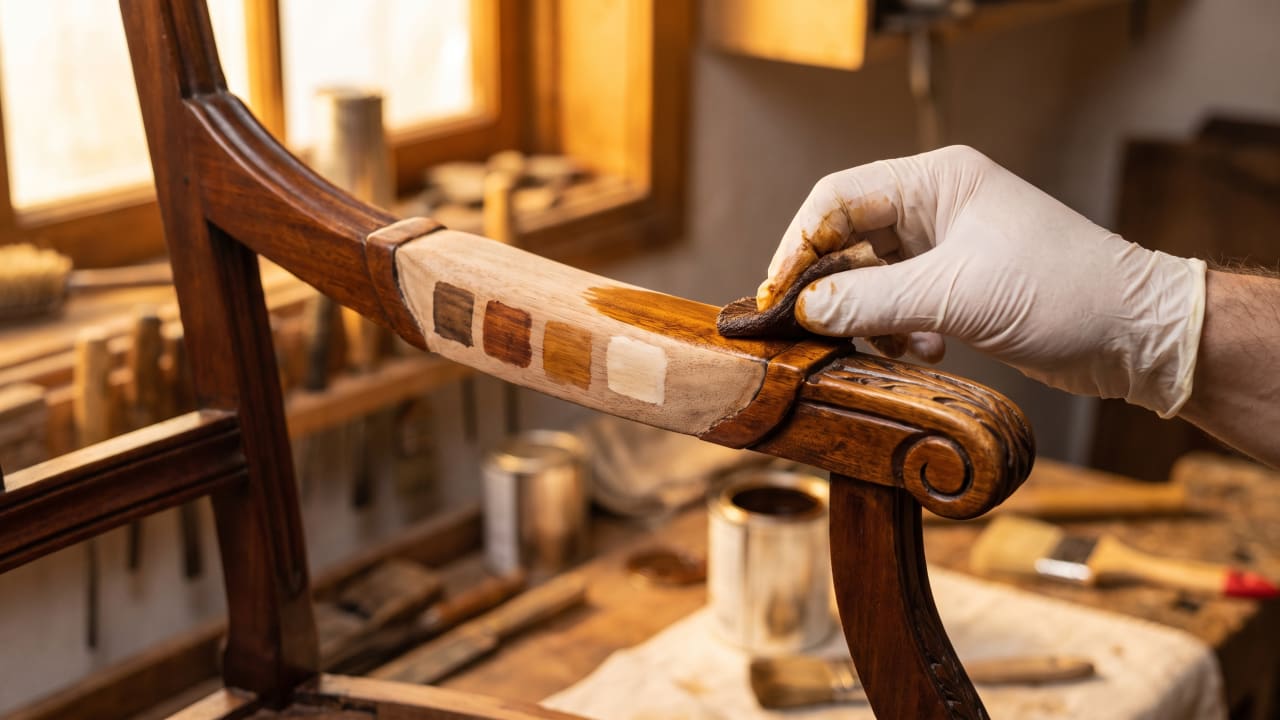
Antique wood has history in it. Old mahogany has darkened, old oak has taken on honey tones, and old walnut has its own depth. We build color with a dye and pigment stain system, working test passes on the actual piece rather than leaning on a sample board. Three to six passes is normal for a careful match. Once the finish is stripped, the bare wood shows the lightest tone available, and we build color from there. Our notes on mahogany restoration show how that plays out on a dark, richly aged species.
5. Lacquer Topcoat and Inspection
Residential antiques get lacquer, sprayed in our booth. It cures to a clear, durable protective surface that lets the wood grain do the talking. When the topcoat has cured, we inspect the piece against your original photos and notes, then schedule your delivery or pickup. Pickup and delivery run across the metroplex and start at $250 round trip depending on location and the size of the job.
Is Your Westlake Antique Worth Restoring?
This is the question we hear most. Money is part of the answer, but not the whole answer. A piece that has been in your family for four generations may not pencil out against a replacement, and still be the thing you would grab first from a fire. We take sentimental value seriously and so should you.
On the value side, the picture is mixed and you should know it. A WorthPoint overview of refinishing and antique value notes the long-running view that careful refinishing and repair can raise the worth of many ordinary old pieces, with exceptions for rare, museum-quality items in good original condition. Common antiques that are simply old are rarely high-dollar either way, so the best reason to restore them is that you will use and love them again.
Good Candidates
- Solid wood case pieces and tables with sound structure and a failing finish.
- Pieces with real wood veneer over a solid or plywood core, including lifted or missing sections.
- Dining and side chairs with loose joints or worn cane and rush seats.
- Anything with family history that you want to keep using.
Mid-Century and Later Pieces
Mid-century and later pieces built on particleboard or MDF with a real wood veneer are a large share of our jobs, and they refinish beautifully. Send photos of the surface and the edges, and we will confirm the veneer is real wood before quoting.
Where Westlake Antiques Live, and What That Means for the Finish
Westlake houses tend to be large, open, and bright. A dining table that spent fifty years in a dim Victorian dining room may now sit under tall windows, and the light shows every flaw the old finish was hiding. That is often the moment owners call us. The piece was fine in the old house and suddenly looks tired in the new one.
Scale matters too. A Westlake great room can swallow a small chest, while a big armoire or breakfront suddenly looks right at home. We see owners refinish a piece mainly to make it feel intentional in a new space, adjusting the tone a shade darker or warmer so it sits well beside newer cabinetry and stone. We can deepen a color or warm it, and we build that tone on the actual piece so you see it before the topcoat goes on.
Working With Designers and Estate Managers
Many of our antique jobs arrive through someone other than the owner. An interior designer is placing an inherited piece in a new room. An estate manager is preparing a collection for division among heirs. A Westlake family is moving furniture between a primary home and a second property. In each case we work from the same photo estimate, and we can quote a group of pieces together so the whole collection gets consistent color work.
If you are coordinating for another owner, send photos of every piece and a short note on how each one will be used. A dining table that will see weekly meals needs a different conversation than a hall console that mostly holds a lamp. Honest information up front lets us recommend the right level of repair and the right color, and it keeps the schedule predictable.
What It Costs and How Long It Takes
Prices depend on size, carving, wood species, and repair needs, and the free photo estimate is where real numbers come from. As a guide, refinishing jobs start around $600. A single dining chair typically runs $275 to $375, and a dresser or hutch commonly falls between $1,200 and $2,200. A full dining set with six chairs typically lands between $2,500 and $4,000. Basic repair jobs start at our $125 shop minimum. For more on how these ranges are built, see our breakdown of what furniture refinishing costs.
Plan on 5 to 6 weeks for standard refinishing. Single pieces typically take 4 to 6 weeks, and large sets or complex repair work can run longer. Spring and fall are our busiest seasons, so plan on the longer end if you need a piece back before the holidays. For a collector working through several pieces, it often makes sense to send them in together so the color work stays consistent across the set.
Protecting a Restored Piece in a Westlake Home
Texas homes swing between cool, dry air conditioning and humid weather, and wood moves with it. The Canadian Conservation Institute’s basic care guidance for wooden furniture stresses stable humidity and keeping pieces away from direct sunlight, heat vents, and damp walls. That advice applies to a restored piece just as much as an untouched one.
Keep large windows in mind in the glass-heavy rooms common to newer custom builds. Direct sun fades color over a few summers, so rotate the room layout or use window film. Use coasters and felt pads under anything that holds a drink. And if a joint starts to loosen again, bring it in early: our guide to re-gluing, doweling, and reframing wobbly chairs explains why a quick fix beats waiting. For repair-focused jobs, our furniture repair service page has the details.
Antique Restoration in Westlake: Common Questions
Can you restore an antique without stripping it?
We restore antiques by repairing the structure, stripping the old finish completely, and refinishing in lacquer. That gives the piece a uniform, durable surface that holds up to daily use in a Westlake home.
What photos should I send for a Westlake antique estimate?
Send the full piece, close-ups of the joints and any damage, the underside, and a note on how you plan to use it. With those, we can quote the repair and refinishing for your Westlake antique, usually without a visit.
How much does antique furniture restoration cost for a Westlake home?
Refinishing jobs start around $600, a single dining chair typically runs $275 to $375, and a dresser or hutch commonly runs $1,200 to $2,200. Send photos for a free online estimate and we will quote your actual piece.
How long will my antique be at the shop?
Standard refinishing takes about 5 to 6 weeks, and single pieces typically take 4 to 6 weeks. Large sets and heavy repair work can take longer, especially in spring and fall.
Do you pick up antiques from Westlake?
Yes. Pickup and delivery are offered across the metroplex and start at $250 round trip, depending on location and job size. The fee is quoted up front in your estimate.
Serving Westlake and the Surrounding DFW Area
We serve Westlake collectors and homeowners, plus neighbors in Southlake, Flower Mound, Grapevine, Coppell, Frisco, and Dallas. Our workshop is at 2425 Parker Rd. Bldg. 5 in Carrollton, and our location and contact page has directions and hours.
Start With a Free Online Estimate
Good antique restoration starts with an honest read of the piece. Westlake homeowners can request a free online estimate by sending a few photos, or call 214-731-3060 to talk it through with the shop. We will tell you what the piece needs, what it will cost, and how we would approach it at our bench.