
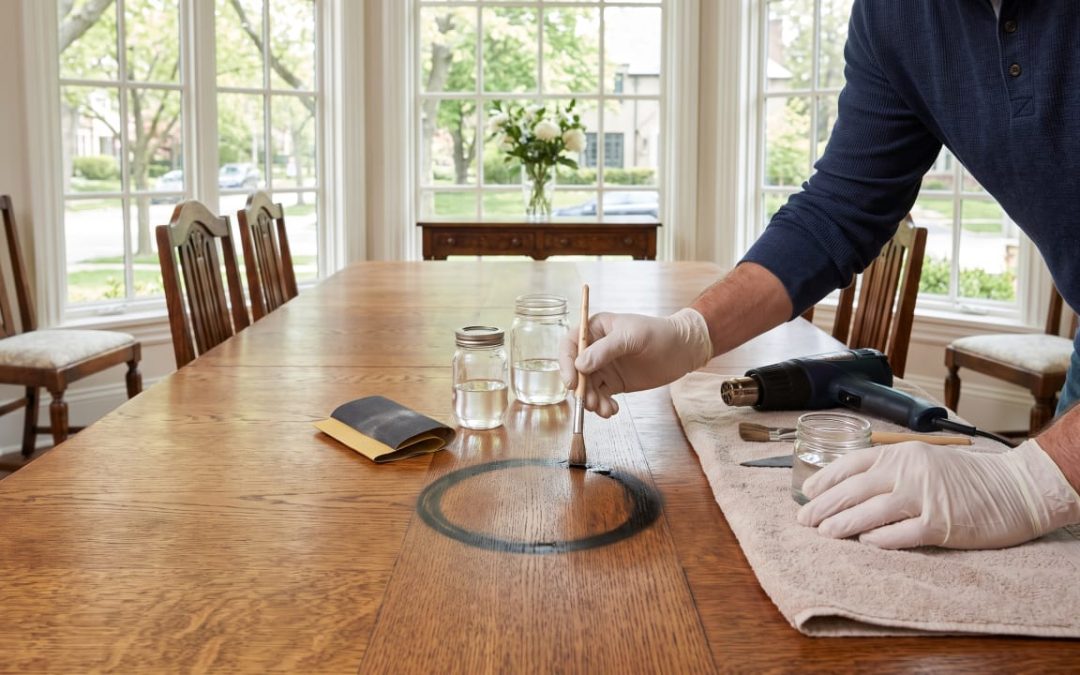
A black stain on an antique dining table or heirloom dresser is a different problem than a white ring left by a sweating glass. If you’ve tried an iron and a dish towel, or dabbed on mayonnaise the way your grandmother swore by, and the dark mark is still staring back at you a week later, you’re not doing anything wrong. You’re dealing with a mark that lives inside the wood itself, not one sitting in the finish on top of it. That’s the situation a lot of Highland Park, Dallas homeowners bring us: a genuinely old, genuinely valuable piece with a black watermark that no amount of surface polishing will touch.
We see this constantly at our Carrollton workshop, and it comes up often enough in Highland Park that we can usually guess which one we’re dealing with before we even see a photo. If your piece needs a full evaluation, our Dallas-Fort Worth furniture repair team can review photos and tell you within a day or two whether you’re looking at a cosmetic stain or something more serious. If the mark on your piece is the paler, cloudy kind instead of true black, we’ve written a companion piece on removing white watermarks from wood furniture that covers that scenario instead.
Why the Color of the Stain Tells You Everything
Wood finishers use color as a rough diagnostic tool, and it holds up well in practice. A white or cloudy ring is trapped moisture sitting inside the topcoat itself. Water vapor gets caught between finish layers, or inside a finish that’s gone slightly porous with age, and it scatters light instead of letting it pass through cleanly, which is why the spot looks pale and milky rather than dark. According to WOCA Woodcare’s guide to black wood stains, that kind of moisture damage stays at the finish level and can sometimes be coaxed out with heat or humidity, because the wood underneath was never actually touched.
A black or dark gray-brown mark is a different problem. That color means water made it all the way through the finish and into the wood fibers, where it reacted with the tannins naturally present in species like oak, walnut, and mahogany. No amount of surface buffing fixes that, because the discoloration isn’t sitting on the wood anymore. It’s part of the wood.
What’s Actually Happening Inside the Wood
The reaction behind most black watermarks has an actual name: ferric tannate. Tannins are natural compounds concentrated in the grain of tannin-rich species, and when water acts as a carrier, it lets those tannins bond with trace iron. That iron can come from an old nail or staple in the frame, mineral content in tap water, or residue from a metal object left on the surface for years. The tannin and the iron form a stable, dark blue-black compound that lives inside the wood fibers rather than on the surface. Wood bleaching references on oxalic acid chemistry describe the same reaction from the restoration side, explaining how the acid can chelate iron and break that bond in a controlled setting. On a finished antique with existing color history and undamaged wood right next to the stain, though, a spot chemical treatment almost always leaves a patch that’s lighter, duller, or a different tone than everything around it, which is why we don’t rely on it for a piece like that.
Is It Definitely a Black Watermark? A Few Look-Alikes
Before you assume the worst, it’s worth ruling out a few other marks that can be mistaken for a true black watermark. Mold or mildew tends to show up as a grayish-green haze with a slightly fuzzy texture and a musty smell, usually on a piece that’s been in storage or a damp space rather than in daily use, and it often wipes away or lightens with cleaning rather than staying fixed in the wood. Ink or dye stains usually have sharper, more defined edges, tracing the shape of whatever caused them (a spilled pen, a piece of colored paper left too long) rather than the soft, rounded shape of a water ring. Candle wax leaves a waxy, slightly raised texture you can feel with a fingernail, and it usually lifts with gentle heat rather than needing a full refinish.
A true black watermark from water and tannin has none of that texture. It’s flat, it’s inside the wood grain rather than sitting on top of it, and it doesn’t respond to cleaning, heat, or time. If you’re not sure what you’re looking at, a photo through our free online estimate is usually enough for us to tell the difference before you spend money on the wrong fix.
Why Highland Park’s Older Homes See More of This
Highland Park has one of the oldest, best-preserved housing stocks in Dallas. Many of the neighborhood’s Tudor Revival and Colonial Revival homes date to the 1920s and 1930s, and the furniture inside them is often original to the house, or close to it: dining tables, sideboards, and dressers that have stayed with the same family for three or four generations. Real estate research on Highland Park’s architecture notes how much of that early-20th-century character has survived intact, and the furniture that came with those houses tends to be just as original.
That’s exactly the kind of furniture most prone to black watermarks. Older oak and walnut pieces were often finished with shellac or a thin varnish that offers far less moisture protection than a modern lacquer topcoat, and decades of holiday dinners, flower arrangements, and the occasional forgotten glass add up over time. We also see it on pieces that survived a slow leak, a humid storage stretch, or a plant stand that sat too long without a saucer underneath. If the piece in question is mahogany specifically, our guide to mahogany restoration in Highland Park goes deeper into how that wood ages and colors over time.

The Honest Fix: Why We Refinish the Whole Top, Not Just the Stain
Here’s the part that surprises some customers: we don’t spot-treat a black watermark, and we don’t spot-treat any tabletop, stain or no stain. When a table, dresser, or sideboard top comes into our Carrollton workshop, the entire surface gets refinished as one piece, not just the damaged section. There are two reasons for that. First, any chemical or sanding attempt to lighten just the stained area changes the color and grain reflection of that one spot relative to the wood around it, and it’s nearly impossible to blend back in once the rest of the surface has decades of patina on it. Second, a full refinish is simply the more durable, better-looking result, and it’s the same finishing standard the shop has held since John, Andrew’s father, founded it in 1980.
The process itself is the same one we use on any wood furniture refinishing job. We strip the old finish using our laser stripper or the chemical overflow method, where the stripper flows over the piece as we brush it, never a submersion tank and never a heat gun. From there we sand the bare wood back to an even surface and work through however many passes of stain it takes to match the surrounding tone. Because we’re matching color on wood that’s likely seen 40, 60, or 80 years of sun and handling, three to six passes on the actual piece is normal, not a sign something’s gone wrong. Once the color is right, we seal it in residential-grade lacquer, the finish we use on interior furniture across the board.
Why Restoring Usually Beats Replacing
A dark stain on an old dining table often makes people wonder if it’s time to just replace the piece instead of fixing it. In most cases we’ve seen, that’s the wrong call. Furniture built in the early-to-mid 20th century, the era a lot of Park Cities heirlooms come from, was typically built from solid hardwood with joinery that a modern mid-tier replacement doesn’t match at any price point. A new dining table with comparable solid-wood construction usually costs more than a full refinish of the one you already have, and that’s before accounting for the sentimental weight of a piece that’s been in the family for generations.
Sentimental value counts for something too, even when the math is close. If a table came from a grandparent’s house, or if it’s the one piece that survived a move or a downsizing, it’s worth restoring on those grounds alone, separate from whatever it might be worth on paper. That’s part of why we always start with a photo estimate rather than a guess: it lets you weigh the actual number against what the piece means to you before deciding anything.

A Stained Top Is Restorable. A Structurally Compromised Piece Isn’t.
It’s worth being precise about scope, because the two problems get confused often. A black watermark, even a dark, ugly one covering most of a tabletop, is a surface and near-surface staining issue. The wood is still solid, the joints are still tight, and the piece is completely restorable through a full strip and refinish.
A structurally water-damaged piece is a different situation. If a dresser sat in standing water, if joints have swollen and separated, or if the substrate underneath a veneer has delaminated and gone soft, that’s damage refinishing alone can’t reliably fix. We see both situations come out of Highland Park, sometimes from an older home’s slow appliance leak or a sunroom that saw more rain than it should have, and the honest answer occasionally disappoints someone hoping for a full restoration. We’d rather tell you upfront that a piece isn’t a good candidate than take on a job we can’t do well.
What a Black Watermark Repair Typically Involves
Beyond the stain itself, we’re usually checking a few related things while a piece is in the shop: whether any joints have loosened over the years, something that comes up often on older furniture, whether there’s lifted or missing veneer near the stained area that needs to be reset before we refinish over it, and whether hardware needs adjustment once the surface work is done. None of that adds much time when it’s bundled into a refinish that’s already planned.
One thing we don’t do is treat hardware or joint work as its own standalone visit. If a piece needs a full top refinish for the watermark, that’s the primary job, and anything else gets folded into it rather than scheduled separately.
What This Typically Costs and How Long It Takes
Basic repair work like a reglue or a hardware adjustment starts at our $125 shop minimum. A full tabletop refinish, which is what a genuine black watermark calls for, is priced by the running foot for a standard finish, typically around $120 per running foot. A full refinish on a dresser, sideboard, or larger case piece generally starts around $600 and moves up from there depending on size and condition. Every quote for Highland Park customers starts with a free online estimate built from photos, and it’s binding, not a number that grows once the job starts.
Standard furniture refinishing takes about 5 to 6 weeks from drop-off to completion. That window covers stripping, sanding, the color-matching passes, and lacquer cure time, not just the visible work. Pickup and delivery is available across the Highland Park area and the rest of DFW, starting around $250 round trip depending on distance and load.
Serving Highland Park and the Surrounding Park Cities Area
Most of the black watermark repairs we handle for Highland Park come from dining tables, sideboards, and dressers that have been in a family for decades, sometimes longer than the house itself. We serve Highland Park directly from our Carrollton workshop, along with University Park, Preston Hollow, Uptown Dallas, North Dallas, and Downtown Dallas. Highland Park’s Preservation Park Cities initiative actively tracks the neighborhood’s most historically significant homes, and it’s not unusual for the furniture inside those homes to be just as original as the architecture around it.
Frequently Asked Questions
Can a black water stain be removed from wood furniture without refinishing the whole piece?
Usually not. A black or dark stain means water reached the wood fibers and reacted with natural tannins, not just the finish sitting on top. Spot treatments can lighten the mark in a controlled setting, but on a finished antique they tend to leave a patch that’s a different color and sheen than the wood around it. We treat black watermarks by refinishing the entire top, the same standard we hold for any table or dresser top regardless of the damage.
How much does it cost to fix a black watermark on furniture in Highland Park?
It depends on the size of the piece and whether other repairs are needed alongside it. A full tabletop refinish is typically priced around $120 per running foot for a standard finish, and a full case piece like a dresser generally starts around $600. Smaller standalone repairs start at our $125 shop minimum. We always start with a free online estimate built from photos so you have a real number before committing to anything.
How do I know if my antique has a repairable stain or actual water damage?
A stain, even a dark one, means the surface and near-surface wood absorbed moisture and discolored while the piece stayed structurally sound. Real water damage means joints have swollen, separated, or a veneer substrate has softened, and that’s usually not something refinishing alone can fix. If you’re not sure which you’re looking at, send us photos through our free online estimate and we’ll tell you honestly which category it falls into.
How long does a full tabletop refinish take?
Standard furniture refinishing runs about 5 to 6 weeks from drop-off to completion, covering stripping, sanding, several passes of color matching, and lacquer cure time. Complex pieces or larger sets can run longer, and we’ll give you a realistic window as part of your estimate.
Ready for a Second Opinion on That Stain?
A black watermark on a piece you care about is disappointing, but it’s rarely the end of the piece. In almost every case we see out of Highland Park, the wood underneath is completely sound, and a full refinish brings it back to a finish that will outlast the one that just failed. Request a free online estimate with a few photos of the stain, and we’ll give you an honest read on scope, cost, and timeline before anything leaves your house. Or call the shop directly at 214-731-3060 and we’ll talk it through.