
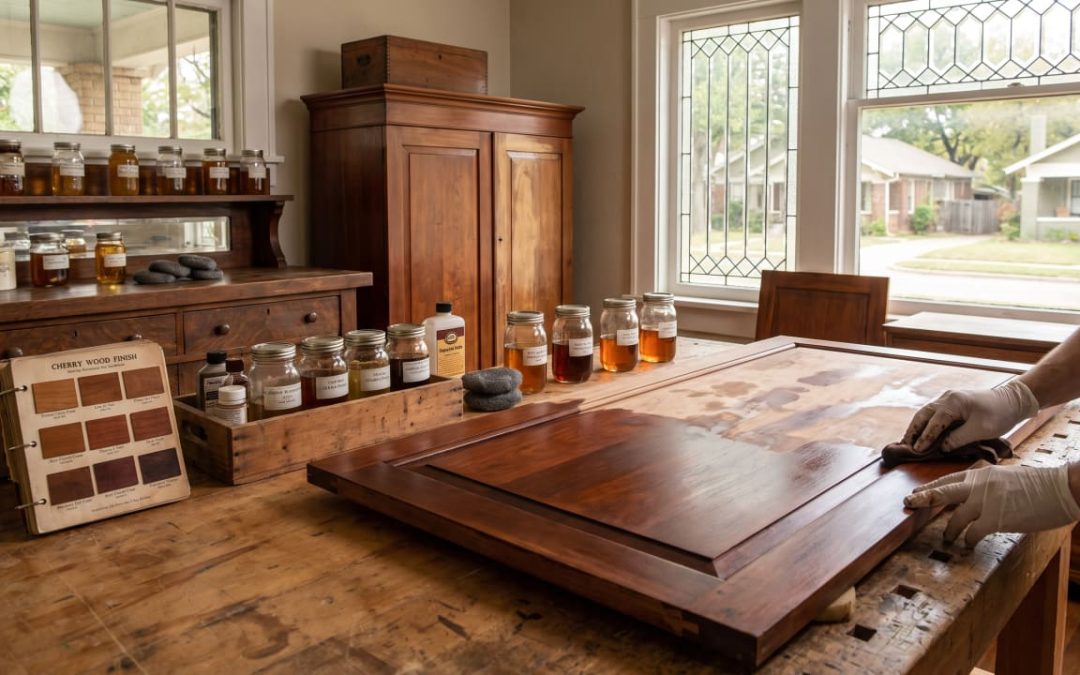
Cherry shows up more than almost any other wood in the dining rooms of the M Streets. Walk into one of the 1920s Tudor cottages near Greenland Hills Park, or along a block off Mercedes or Monticello, and there is a good chance you will find a cherry table, hutch, or dresser that has been in the family for two or three generations. Cherry ages beautifully, but it also does a few things that surprise homeowners the first time they try to refinish one of these pieces. This guide covers what actually happens to cherry over time, how we control the blotching that makes it famously hard to stain evenly, and what our Dallas furniture refinishing process looks like on a piece like this.
If your piece needs structural work rather than, or in addition to, color and finish work, loose joints, a cracked leg, missing veneer, we have covered that ground separately in a companion article on wood furniture repair in the M Streets. This article stays focused on refinishing: how cherry changes color as it ages, and how we approach blotch control and color matching on it.
Why Cherry Behaves So Differently From Other Furniture Woods
Cherry is a closed grain hardwood, which is part of why it takes such a smooth, satiny finish once it is done right. It is also part of the problem. The Wood Database’s black cherry profile describes cherry heartwood as light to dark reddish brown with a fine, straight grain, the same traits that make it prone to blotching under an ordinary stain. The surface absorbs color unevenly along small shifts in grain direction, leaving darker patches next to lighter ones on the same board, sometimes on the same leg.
Cherry also does something most other furniture woods don’t: it keeps changing color for years after it leaves the workshop. Cherry is rich in compounds similar to what makes a cut apple turn brown, and both oxygen and ultraviolet light react with those compounds over time. Furniture maker Thos. Moser has documented that most of that darkening happens quickly, with the bulk of the color shift occurring within the first couple of years and continuing, more slowly, for years after that. Direct sun accelerates it; indirect light slows it down. A cherry piece that spent two decades next to a bay window is going to look noticeably different from a similar piece that lived in a windowless hallway the whole time, and that mismatch is the first thing we work around when a set gets refinished together.
None of this is a reason to avoid cherry. The same grain shifts that cause blotching also produce the depth and chatoyance, the way the surface seems to shift and glow depending on the angle, that make cherry one of the most requested woods for fine furniture in the first place. The trick is managing the wood’s behavior instead of fighting it, which is a process question more than a material one.

Cherry Furniture in the M Streets, Dallas: Tudor Cottages Full of Inherited Case Goods
The M Streets, sometimes called Greenland Hills, is one of the more distinct pockets of East Dallas, tucked between Lower Greenville and Mockingbird Lane. The 1920s Tudor cottages on streets like Mercedes, Monticello, and Melrose were built with real formal dining rooms, small by today’s standards but original to the house, and that layout has kept a lot of solid wood furniture in circulation that would have been swapped out for something open concept somewhere else. We see a steady stream of cherry dining sets, china hutches, and bedroom furniture coming out of these homes, usually inherited from a parent or grandparent, occasionally bought secondhand when the current owner moved in.
What makes cherry pieces from the M Streets interesting is the color history. A cottage this size doesn’t have a lot of places to put a hutch other than against an exterior wall, often near a window, and cherry that has spent decades in that spot has darkened and reddened unevenly compared to a matching piece kept in a closet or a formal room that stayed curtained most of the year. When a full dining set comes in for refinishing, the table, chairs, and hutch frequently no longer match even though they started life as one identical set. Getting them back to a consistent color, without overcorrecting into something that looks fake or plastic, is most of the actual craft in a cherry refinishing job.
Is It Really Solid Cherry? What We Check Before We Quote
Before we quote a cherry refinishing job on a piece coming out of an M Streets home, we look closely at it, because a lot of what got sold as cherry bedroom and dining furniture between the 1970s and 1990s was not solid cherry at all. It was often cherry veneer over particleboard, or a cheaper wood like maple or birch finished with a cherry-toned stain to mimic the real thing. Edge banding that looks slightly too uniform, or grain that appears to wrap unnaturally around a corner, are usually the first clues. We can refinish real wood veneer over particleboard or MDF, in fact it is a large share of the furniture we handle, but we cannot refinish a veneer that has a laminate layer instead of actual wood, and we cannot structurally repair a particleboard core if the piece is also falling apart at the joints. Knowing which one you have changes the plan before any stripper touches the piece.
Even on solid cherry, there is a second wrinkle: sapwood. Cherry trees have a noticeable band of pale sapwood surrounding the darker heartwood, a distinction the USDA Forest Products Laboratory’s technical profile of black cherry lays out in detail, and furniture makers sometimes mixed the two within a single board, or a single piece, to save material. Sapwood does not carry the same pigments as heartwood, so it will not darken and redden the same way no matter how much sun it sees or how much stain we apply. If a table from the M Streets has a lighter streak running through one leg or across the apron, that is almost always sapwood showing through, not a repair mismatch or something we caused. It’s one of the first things we point out during a walkthrough, since it sets realistic expectations for the final color. If you’re not sure whether a piece is solid wood at all, our article on oak furniture refinishing in Dallas walks through a similar identification process for a different species and is worth a look if oak, not cherry, turns out to be what you actually have.
Controlling Blotch: Dye, Pigment, and a Careful Spray Schedule
Blotching is the single biggest reason cherry has a reputation as a difficult wood to finish well. Fine Woodworking has written extensively about the cause: cherry’s grain shifts direction in small, irregular patterns across the board, and an ordinary stain soaks into those areas at different rates, leaving a patchwork of dark and light zones once the excess is wiped away. On a factory cherry veneer piece the effect is usually mild. On solid cherry, especially older, slower-grown boards, it can be dramatic enough to ruin an otherwise good refinishing job if it isn’t managed correctly from the first pass.
We do not use gel stain to control it, even though it’s a common suggestion in DIY circles. Gel stain sits on the surface rather than penetrating, which can even out color on a test board, but it also flattens the depth and chatoyance that make cherry worth restoring in the first place, and it isn’t a system we run in our shop. Instead, we control blotch through the sequence itself: a controlled dye stain lays down a base tone evenly across the whole piece, and where more depth or color correction is needed, we layer pigment stain and toner in the spray booth in measured passes rather than one heavy coat. Building color gradually, checking it between passes, and adjusting the schedule as we go is what keeps a cherry dining set looking like wood instead of looking painted on.

Surface prep matters just as much as the stain itself. We sand progressively up through fine grits before any color goes on, since scratches or swirl marks that would be invisible under a darker stain show up clearly under cherry’s lighter, more transparent color. Rushing this step is one of the most common reasons DIY cherry refinishing jobs come out blotchy even when the stain itself was applied carefully.
Color Matching Cherry: What We Can (and Can’t) Do
Because cherry keeps darkening under UV light for years after it leaves a workshop, color matching an inherited piece to a newer replacement, or matching mismatched pieces within one set, is one of the more common requests we get. There is one hard limit worth knowing up front: we cannot stain a piece lighter than its natural wood. Once cherry has darkened, we can only work with that starting point, or strip it back to bare wood and start over; we can’t bleach a fifty-year-old hutch back down to match a lighter piece without also stripping and refinishing the lighter piece to bring it up instead. We also don’t rely on sample boards alone. Color matching happens on the actual piece, with test passes applied directly to it and adjusted in real time, usually across three to six passes before we call it dialed in. A sample chip can get us close, but cherry’s grain and color history are specific enough to the individual board that the final call always happens on the furniture itself.
Stripping, Sanding, and the Lacquer Finish at Our Workshop
Stripping the old finish off a cherry piece has to be done without damaging the wood underneath, since any gouge or scorch mark shows up clearly once new stain and finish go on. We strip with a laser stripper or the chemical overflow method, where stripper flows over the piece as we brush it rather than the piece sitting submerged in a tank. For a top-only refinish, a table surface that needs new color but has legs and an apron in decent shape, we sometimes use a gel stripper instead so the chemical stays where we want it rather than running down onto parts we aren’t touching. We never submerge a piece, and we never use a heat gun or sandblasting on wood furniture; both are too easy to scorch or gouge cherry’s soft, close grain.
For the finish itself, residential cherry pieces get lacquer, which is what we use across the shop for interior furniture. It builds a smooth, even topcoat over the dye and pigment work without the amber cast or slower cure time of an oil finish, and it holds up to the seasonal humidity swings between summer air conditioning and winter heat. If you’re restoring a mahogany or another dark hardwood piece alongside your cherry set, our mahogany restoration article from Highland Park walks through a similar strip-and-refinish process on a different species, and the workshop steps are largely the same.
What Cherry Refinishing Costs and How Long It Takes
Refinishing jobs at our shop start around $600, though a full cherry dining set with blotch control and color matching across every piece will run well above that starting point once the actual scope is known. Rough ranges we quote most often:
- Dining table top, standard finish: about $120 per running foot
- Full dining set with six chairs: typically $2,500 to $4,000, depending on condition and how much color correction is needed
- Dresser or hutch: typically $1,200 to $2,200
Every job starts with a free online estimate built from photos, and that number holds unless something changes once we actually have the piece in the shop. Standard turnaround for furniture refinishing is 5 to 6 weeks, and a single smaller piece is usually 4 to 6 weeks depending on how much blotch control and color matching it needs. Even when a cherry set doesn’t pencil out purely on resale value, sentimental value is a legitimate reason to restore it, and we factor that into how we talk through options with a family working through an estate or a move.
We offer pickup and delivery across DFW starting at $250 round trip, which is a short, straightforward drive from the M Streets to our workshop. For cushion or fabric-only jobs on a different piece we generally prefer customer drop-off at the shop, but a full cherry case good or dining set is a pickup job by default.
Serving the M Streets and the Surrounding Dallas Neighborhoods
The M Streets sits inside a stretch of East Dallas we work in regularly, and we serve the neighborhoods around it just as often: Lakewood, Lower Greenville, Uptown Dallas, Highland Park, and our home base in Carrollton. If you’re in one of these nearby areas and have a cherry, oak, or walnut piece that needs the same kind of color and finish attention, the process described here applies just as directly to your furniture.
Frequently Asked Questions About Cherry Furniture Refinishing
How do I know if my dining set from the M Streets is real cherry?
Solid cherry has a straight, fine grain and, if you check an unfinished edge or the underside, a color ranging from pale sapwood to deep reddish heartwood. Furniture marketed as cherry between the 1970s and 1990s is frequently cherry veneer over particleboard, or a different wood entirely finished to look like cherry. We check this during our walkthrough before quoting the job, since it changes which refinishing options apply.
Why did my cherry table get so much darker than I remember?
Cherry contains compounds that react with oxygen and UV light, so it keeps darkening and reddening for years after it’s finished, especially near a window. Most of that color change happens within the first couple of years, then continues more slowly after that. It’s a normal property of the wood, not a sign the original finish failed.
Can you match the color if my cherry set has faded unevenly?
Usually, yes. We build color in dye and pigment passes on the actual piece rather than relying only on a sample board, checking the match as we go. The one real limit is that we cannot stain wood lighter than its natural color, so if one piece in a set has darkened much more than the others, the plan usually involves bringing the lighter pieces up to match rather than trying to lighten the darker one.
Do you use gel stain to prevent cherry from blotching?
No. We control blotching through a dye stain base coat plus measured pigment and toner passes in the spray booth, not gel stain. It keeps the wood’s natural depth and grain visible instead of sitting on top of the surface like a coat of paint.
How much does cherry furniture refinishing cost, and how long does it take?
Refinishing starts around $600, with a full dining set typically running $2,500 to $4,000 and a dresser or hutch running $1,200 to $2,200, depending on condition and how much color correction the piece needs. Standard turnaround is 5 to 6 weeks, with single pieces sometimes finishing sooner. Every quote starts with a free online estimate from photos before anything gets scheduled.
Ready to Restore Your Cherry Piece?
Cherry rewards patience more than almost any other wood we work with, and a piece that has spent a generation in an M Streets dining room deserves a refinishing process that respects its color history instead of fighting it. If you have a cherry table, hutch, or bedroom set that needs stripping, blotch-controlled staining, and a proper lacquer finish, request a free online estimate and we’ll walk you through what your specific piece needs. You can also reach our Carrollton workshop directly at 214-731-3060 to talk through a set with mismatched color or a piece you aren’t sure is solid wood.