

If the sofa in your Highland Park living room or the dining chairs at your formal table have been on your list since last winter, early September is the moment to move on it, not October. Reupholstery is a genuinely slow craft process, not a same-week furniture swap, and the math for getting a piece back before Thanksgiving or Christmas guests arrive only works if you start the clock now. At our Carrollton upholstery shop, we’ve reupholstered furniture for DFW families since 1980, and fall is consistently our busiest season for exactly this reason: everyone wants their formal dining room and living room ready at the same time.
This guide walks through the honest timeline: what “6 to 12 weeks” actually means once you count fabric selection and the deposit, which projects can still realistically land before Thanksgiving, and what to do if you’re reading this in October instead of September. If you want the general primer on reupholstery scope and process first, our reupholstery guide for Highland Park homes covers frame quality and fabric basics in more depth.

The Real Reupholstery Timeline for a Highland Park Sofa or Chair
Fabric selection and the deposit happen before we ever pick up your piece, not after. That’s not a stalling tactic. It means the material is already sitting on our shelf when production starts, instead of your chair waiting half-finished on a frame while we wait on a bolt of fabric. If you’re choosing from our swatch books rather than supplying your own material, plan on about a week from the day you pick a fabric to the day it lands at the shop. According to a furniture lead-time guide for interior designers, September and October are peak production months across the upholstery industry nationwide, with realistic turnaround often running two to four weeks longer than a summer quote. Our shop is no exception, and it’s worth planning around rather than hoping around.
A quick way to shave a few days off the front end: have a sense of your fabric direction (color family, pattern versus solid, general budget range) ready before you call, and take a few photos of the piece from different angles. We can often narrow swatch book options down to a short list in one visit instead of two or three, which matters when every day counts toward a specific date on the calendar rather than a general “sometime this fall.”
Once the frame and fabric are both here, production itself runs 6 to 12 weeks depending on how full our queue is at that moment. We’ll be honest about why the range is that wide: fall is our heaviest stretch of the year, and during a genuine surge we occasionally send overflow upholstery work to a trusted subcontractor rather than let every job’s timeline slip. Refinishing and structural repair stay in-house year-round. Upholstery is the one department where extra hands sometimes come in when the queue is this deep, and that’s part of why an honest range beats a rosy promise. We would rather tell a customer their sofa is realistically a nine-week job than promise six weeks and miss it by three, especially when the piece has to be sitting in a dining room on a specific Thursday in November.
Stack the pieces together and the real timeline from “I called today” to “the piece is back in my dining room” looks like this: fabric selection and deposit, roughly a week if you already have a few swatches in mind; about another week for that fabric to arrive; then 6 to 12 weeks of production once your piece is at the shop. A set of dining chairs out of a Highland Park dining room, or a single club chair, started in early September has a real shot at Thanksgiving. A full sofa is a tighter question, and the next section walks through the actual dates rather than a vague “should be fine.”
Working Backward From Thanksgiving and Christmas
Thanksgiving lands in the last week of November this year. If you call this week, in the first days of September, and move quickly on fabric selection, here’s roughly how the calendar plays out:
- Now (early September): consultation, fabric chosen from swatch books, deposit paid.
- About a week later: fabric arrives at the shop, piece is picked up or dropped off, production begins.
- 6 to 12 weeks after that: your piece is finished, landing somewhere between mid-October and mid-December depending on where your job falls in the fall queue.
That range is the honest part. Because fall is peak season, our queue is likely to run closer to the 8 to 12 week mark than the fast end, which means a piece started today is realistic for Thanksgiving only if it lands near the front of that range, not something we can guarantee by counting on the 6-week best case. A dining chair or a small set of them, which typically needs less shop time than a full sofa, is the more dependable Thanksgiving project this year for most Highland Park households. A three-seat sofa or a pair of club chairs started today is a safer bet for a December gathering than for a table set three weeks from now.
If your real target is Christmas or a New Year’s gathering instead of Thanksgiving, starting now gives you genuine breathing room, even at the 12-week end of the range. Wait until October to call for that same December deadline, though, and you’re compressing fabric selection, the order, and a full production run into a window that leaves almost no margin for a backordered bolt of fabric or an especially deep queue. We would rather tell you that plainly now than promise a date in October we can’t actually keep.
Why Highland Park and the Park Cities Are Built for This Kind of Project
Many of the sofas and dining chairs we pick up from Highland Park started life in houses built in the 1920s and 1930s, the era when Tudor Revival, Mediterranean, and Spanish Revival homes first defined the Park Cities streetscape. Furniture bought for those formal dining rooms and living rooms was typically built to match the house: hardwood frames, tight joinery, construction meant to outlast a few fabric cycles rather than one. That’s exactly the kind of frame worth reupholstering instead of replacing, and it’s a big part of why we see so many of these pieces come through our shop every fall.
Highland Park hosting culture leans formal. A sit-down Thanksgiving table, a living room arranged for after-dinner coffee, dining chairs that need to hold up under a full house rather than the two or three people who use them on an ordinary Tuesday. That jump in traffic for one weekend a year is exactly the scenario the fabric guidance further down is built around, because a fabric that looks fine under everyday use can still show wear fast under a once-a-year crowd.
What a Highland Park Reupholstery Project Actually Costs
Cost is usually the second question after timeline, and it varies quite a bit by piece. Here’s roughly where projects land, with labor and fabric broken out separately since fabric choice moves the total more than anything else:
- Three-seat sofa: labor starts around $1,500, plus roughly $1,200 for fabric, so a complete reupholstery typically starts around $2,500.
- Club or wingback chair: labor runs $650–$900, plus roughly $700 in fabric.
- Single dining chair: $275–$375, which is a big part of why a set of dining chairs is the more realistic before-Thanksgiving project than a full sofa.
If you’re supplying your own fabric (what the trade calls COM, or customer’s own material), there’s a $35 per yard handling fee on top of labor. Every quote comes from a photo-based online estimate first, so you know the real number before anything is scheduled.
Yardage is the variable that moves these numbers around the most. A plain woven or solid performance fabric uses less material than a large-repeat pattern, where the mill has to match the design across seams, which can add a fair amount of yardage to a wingback chair or a tufted sofa back. If you already love a specific patterned fabric, ask about repeat size before you commit. It won’t change the labor estimate, but it will change the fabric line item, sometimes by a few hundred dollars on a larger piece.
Formal dining sets in older homes often run eight, ten, or twelve chairs rather than the standard six, since many of these tables were built to seat a full extended family for the holidays in the first place. Booking the whole set as one job, rather than trickling chairs in one or two at a time over several months, tends to be both faster and more consistent, since the same bolt of fabric covers every seat and the shop can batch the frame work instead of resetting for each visit.
Choosing Fabric That Can Handle a Full House of Holiday Guests
Fabric durability is measured with an abrasion test, most commonly the Martindale rub test the Association for Contract Textiles uses to set its high-traffic performance guidelines, run according to the ASTM D4966 standard that mills follow to generate the rating on the fabric label. For a sofa or chair set that sees regular daily use, we recommend fabric rated at 30,000 rubs or higher. For a formal Highland Park dining room or living room that only fills up a few times a year but fills up completely when it does, a full Thanksgiving table, a room packed for after-dinner drinks, we push that up to 50,000 rubs or higher. A once-a-year gathering doesn’t mean once-a-year wear. It means a dozen extra bodies on cushions that normally see two.
We work from swatch books rather than in-store bolts, so you’re choosing from a curated range instead of standing in a warehouse. Our fabric selection page gives a sense of what’s available, and if you’re set on a specific velvet for a formal room, our velvet reupholstery guide covers pile, backing, and cleaning code in more depth. Bringing your own fabric is fine too. There’s the $35 per yard fee mentioned above, but if your material is already in hand and ready to ship to the shop, it skips our week-long ordering step entirely, which can matter if you’re working against a tight date.
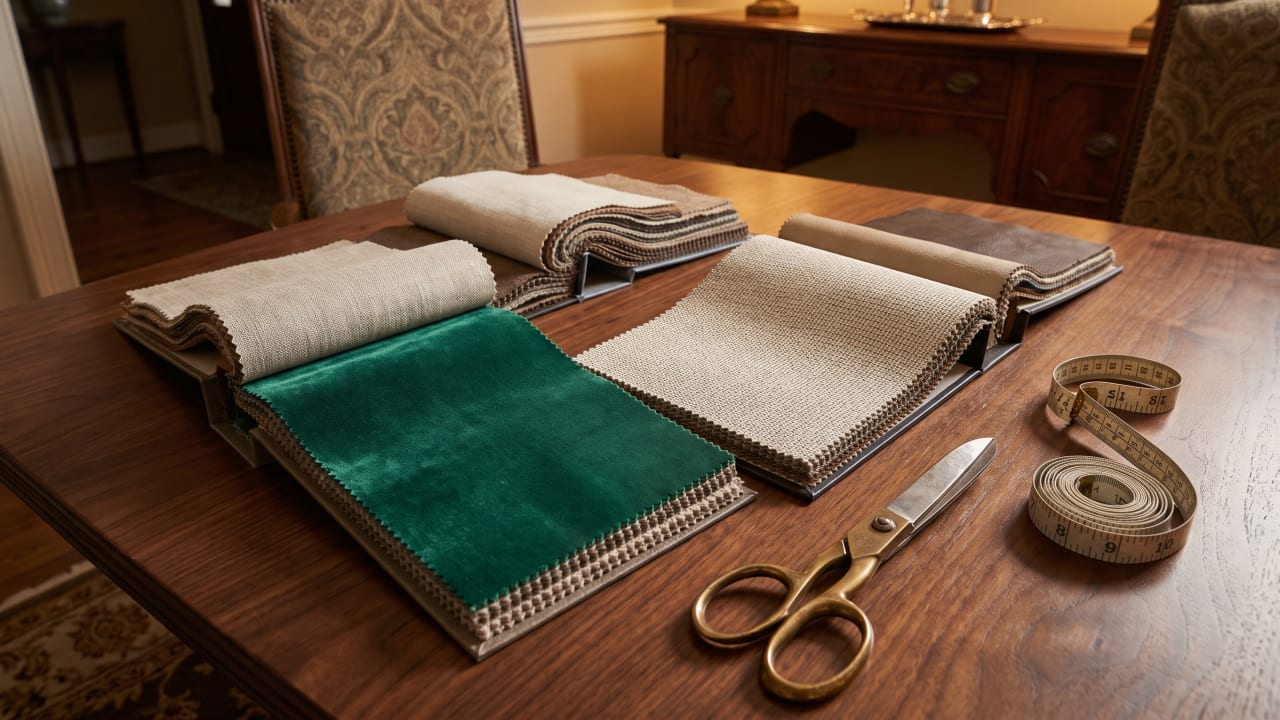
If the piece being reupholstered is one that will see kids or a dog moving through a holiday crowd, a performance fabric line (our Greenhouse swatch books carry a good range of them) is worth a look even for indoor formal furniture. They handle spills and general wear noticeably better than a traditional cotton or linen blend, without looking like the outdoor fabric people picture when they hear “performance.” For a formal room that’s mostly adults and mostly upholstered in something like velvet or a wool blend, standard fabric rated to the durability numbers above is usually the better fit, since performance weaves have a slightly different hand and sheen that doesn’t always suit a traditional room.
Out of Runway? Cushion and Foam Replacement Is a Faster Fix
If today’s date makes a full reupholstery a stretch, and it might if your real target is a specific weekend in November, loose cushion and foam replacement is a genuinely faster alternative for seating that feels flat rather than actually worn through. If the cushion covers zip off or are otherwise removable, we can rebuild the foam inside the existing cover, which is a much shorter job than stripping and rebuilding an entire piece. It isn’t an option for cushions with fabric sewn permanently into the frame; those need full reupholstery because the labor involved ends up being the same either way. On foam itself, we use standard polyurethane as the baseline, with a high-resiliency (HR) grade available as a mid-tier upgrade for anyone who wants firmer, longer-lasting support under heavier daily use. We don’t offer a soy-based foam option, so if that’s specifically what you’re comparing quotes on, standard or HR polyurethane is the choice on our end.
For cushion-only jobs, we’d rather you drop the cushions at our Carrollton workshop than schedule a pickup, since it’s usually faster than coordinating a delivery window for a job this size. Our cushion and foam replacement page has more on foam density options and turnaround, which typically moves much faster than a full reupholstery queue since there’s no fabric ordering or frame work involved.
Serving Highland Park and the Park Cities
We pick up and deliver reupholstery projects throughout Highland Park and the surrounding Park Cities, plus University Park, Preston Hollow, North Dallas, Uptown Dallas, and the rest of Dallas, all a reasonably short drive from our Carrollton workshop. Wherever your piece is coming from, the same fall timeline applies: the sooner fabric is chosen and the deposit is in, the sooner it moves into the production queue.
Frequently Asked Questions
How far in advance should I book fall reupholstery for Thanksgiving?
As early as possible in September. Once fabric selection and the deposit are done, plan on about a week for fabric to arrive, then 6 to 12 weeks of production depending on how full the fall queue is. A dining chair or two has a real shot at making Thanksgiving. A full sofa started this month is a safer bet for December than for late November.
Can I still get reupholstery done before Christmas if I call in October?
It’s possible, especially for a chair or a smaller piece, but the margin shrinks fast. October bookings compress fabric selection, ordering, and production into a window that leaves little room for a backordered fabric or a full production queue. If Christmas is the real deadline, calling now instead of waiting gives you far more room to work with.
Do you keep fabric in stock, or does it need to be ordered?
We work from swatch books rather than in-store inventory. Once you choose a fabric, it typically takes about a week to arrive at the shop. Selecting fabric and paying the deposit happen before we ever pick up your piece, so the material is already on hand when production starts.
What does reupholstering a sofa or chair typically cost?
A full three-seat sofa reupholstery starts around $2,500 total, with labor from $1,500 plus roughly $1,200 in fabric. A club or wingback chair runs $650 to $900 in labor plus roughly $700 in fabric. A single dining chair is $275 to $375, which is why dining sets are often the more realistic before-the-holidays project.
What if my cushions just feel flat instead of actually worn out?
That’s usually a foam problem, not a fabric problem, and it’s a faster fix than full reupholstery. If the cushion covers are removable, we can replace the foam inside the existing cover instead of rebuilding the whole piece. Drop them at the shop rather than scheduling a pickup. It isn’t an option for cushions with fabric sewn permanently into the frame.
Book Your Highland Park Reupholstery Before the Fall Queue Fills
If your dining chairs or living room sofa need to be ready before guests sit down this fall, the honest move is to start now, not after the leaves change. Highland Park homeowners can request a free online estimate today, or call our Carrollton shop directly at 214-731-3060 to talk through fabric and timeline before the fall queue fills further. We’ve reupholstered DFW furniture since 1980, and getting the calendar right the first time beats promising a date we can’t keep.