
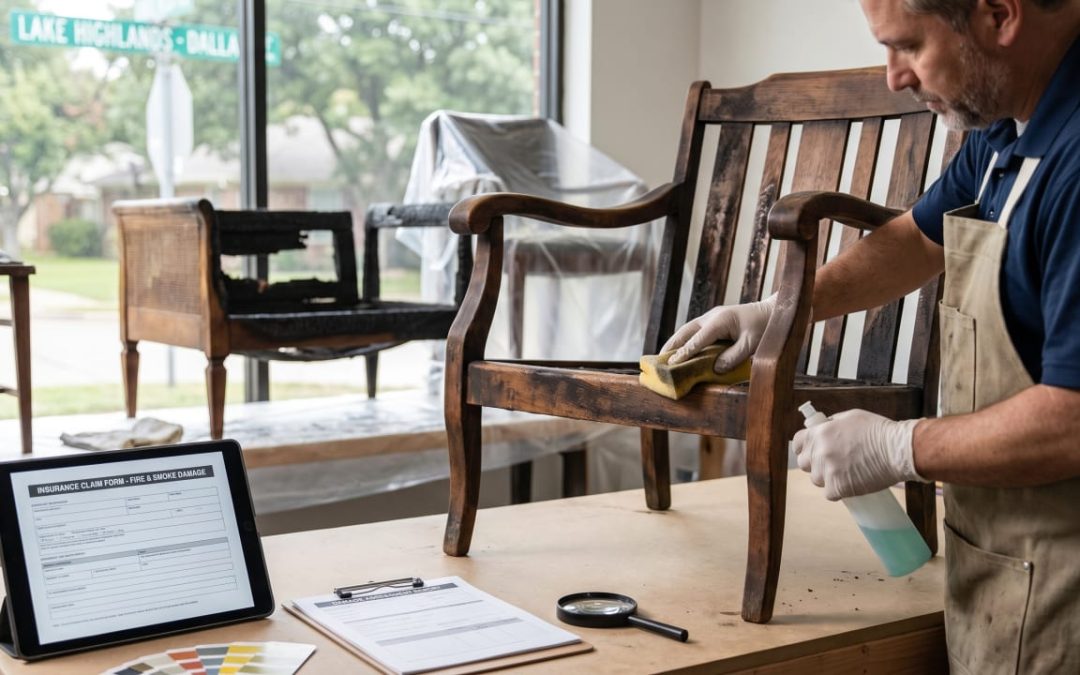
A house fire is disorienting enough without also wondering what happens to the furniture. If you’re in Lake Highlands, the ranch-home neighborhood in northeast Dallas built up mostly in the 1950s and 1960s, there’s a good chance the dining table, bedroom dresser, or hutch that took smoke damage is original to the house or came down from a parent’s estate. That’s exactly the kind of furniture worth restoring rather than replacing, and it’s exactly the furniture where the insurance process, not just the woodworking, decides the outcome.
This guide walks through how that process actually works at our shop: what happens on day one, how we work with your adjuster, and what happens between a binding photo estimate and a finished piece back in your home. For the full scope of what we handle after a fire or water event, see our fire and smoke damage restoration services for Lake Highlands homeowners. If your furniture picked up smoke odor without direct fire exposure, we cover that separately in our guide to smoke odor removal from furniture in Dallas, and if it’s simply worn or dated rather than fire-damaged, our general furniture refinishing guide for the neighborhood covers that instead. Home fires are also more common, and more damaging to furniture throughout a house, than most homeowners expect. According to NFPA fire loss research, U.S. fire departments respond to hundreds of thousands of home fires a year, and even a small, contained kitchen or garage fire routinely leaves soot and smoke residue on furniture well beyond the room where the fire started.
Why Lake Highlands Homes Have So Much Original Wood Furniture to Protect
Lake Highlands is one of the older, more established neighborhoods in northeast Dallas, built out mostly between the 1950s and the 1970s. A lot of the original owners are now the grandparents in the family, and a lot of the dining sets, dressers, and hutches sitting in these houses today are original to the build or came down through an estate. That’s real furniture: often solid wood, sometimes a wood veneer over a plywood or particleboard core, and built to be refinished more than once across its life. It’s exactly the kind of piece worth restoring after a fire instead of replacing with something from a big-box store.
We also see a fair number of mid-century pieces in these homes, teak sideboards, walnut dining sets, oak bedroom suites, that were built solidly enough to survive smoke and soot exposure structurally even when the finish itself is a total loss. Documentation matters here as much as craftsmanship does. Even before a fire happens, the Insurance Information Institute recommends keeping a running home inventory of higher-value furniture, since it speeds up the claims process considerably if something does happen. If you don’t have one, our photo documentation at the time of loss becomes the closest substitute, which is part of why we treat that first round of photos so carefully.

Fires in homes this age often trace back to something ordinary: an aging electrical panel, a space heater running through a cold snap, or a grease fire that starts at the stove and spreads more smoke than flame. None of that changes how we approach the furniture. Whether the fire started in the kitchen and the damage in the dining room is mostly airborne soot, or a bedroom took direct heat exposure, the assessment and restoration process is the same: document first, strip completely, refinish to match.
What Happens When You Call Us After a Fire
The first call is usually the most stressful part, so here’s what to actually expect. We’re not a fire or water mitigation company, and we don’t send a crew out with extraction equipment, air movers, or ozone machines to run on-site the day of a fire. That work belongs to an emergency mitigation company, and it should happen first if your loss involved both fire and water. Once the emergency phase is handled and it’s time to figure out what happens to the furniture itself, that’s where we come in for Lake Highlands homeowners.
- You send photos of the affected pieces through our free online estimate, or call the shop directly at 214-731-3060.
- If the damage is significant or hard to assess from photos, we schedule an on-site smoke inspection at your Lake Highlands home. That inspection carries a $150-$200 fee, due at the time of the visit.
- We photograph and document each piece individually for your insurance file, not just a single photo of “the dining room.”
- We put together a written, itemized restoration estimate for you and, if you’d like, send it directly to your adjuster.
Good documentation means more than a single wide shot of the room. We photograph each piece from multiple angles: the overall form, close-ups of the worst soot or heat damage, any existing wear or damage that predates the fire, and, where visible, maker’s marks or manufacturer labels that speak to the piece’s age and value. That level of detail gives your adjuster what they need to approve a fair number the first time, rather than sending someone back out for a second look.
Most customers receive a written estimate within two to three business days of sending complete photos, faster if the damage is limited to a handful of pieces. That estimate is what moves your claim forward, so getting clear photos to us quickly is the single biggest thing you can do to keep the process on schedule.
Nothing about that first visit involves cleanup. We’re there to assess and document, not to remediate. That distinction matters for your claim, since mitigation and restoration are typically billed and covered as separate line items by most carriers.
Working With Your Insurance Adjuster: Why the Photo Estimate Is Binding
Texas gives insurers a defined timeline to respond to a claim, and it helps to know your rights as a policyholder before your adjuster’s first call. The Texas Department of Insurance’s guidance on recovering after a fire or storm is a good independent resource, and it covers the same basics we walk clients through: notify your carrier promptly, don’t dispose of damaged items before the adjuster has seen them, and keep records of every conversation.
Most policies also ask you to complete a proof of loss form listing each damaged item and its value. This is where our itemized estimate helps directly: instead of guessing at replacement cost for a fifty-year-old dresser, you can attach our restoration estimate, which reflects what it actually costs to bring the piece back rather than a generic depreciation table. For older or inherited furniture, that distinction often matters more than it does for newer pieces, since a solid-wood dresser from the 1960s can be well worth restoring even when its resale value on paper looks modest.
Once we’ve photographed and priced the restoration, we send that estimate directly to you and, if it’s useful, directly to your adjuster as well. That number is binding on our end. It doesn’t change once your adjuster signs off, unless something new turns up once the piece is actually in the shop and we can see it up close, which we’ll flag before doing any additional work. Because insurance-billable restoration is a regular part of what we do, we itemize by individual piece rather than giving one lump figure for an entire room, which tends to move claims along faster. Every fire-damaged piece we take on also goes through our complete furniture refinishing process, since a fire-damaged finish can’t be spot-cleaned back to something usable.
From Approval to Finished Piece: What Fire-Damaged Restoration Actually Involves
Smoke doesn’t sit on top of a wood finish, it gets pulled into it. Soot residue is acidic, and smoke odor molecules bond to whatever finish is already on the piece, so wiping down a smoke-damaged dresser or spraying an odor sealer over the existing finish just traps the smell under a new layer. It comes back, usually within a season, once humidity rises. That’s why we don’t offer surface cleaning as a fix for fire-damaged furniture, and why every piece we take on gets a complete strip, all the way to bare wood.
We strip using our laser stripper or the chemical overflow method, where stripper flows over the piece as we brush it in. We never submerge a piece in stripper, and we never use a heat gun. Once the piece is stripped and sanded, we refinish it in lacquer, the same finish we use on any residential piece, matching color across the rest of your set through a series of test passes directly on the wood rather than relying on a sample board alone.
Color matching after a fire is its own small craft. We don’t rely on a sample board alone. We run test passes of stain and topcoat directly on the piece, adjusting through several rounds until the restored section blends into the rest of the set under normal room light. That process looks about the same whether the piece is a decades-old family dresser or something newer, though older pieces with a lot of hand-applied finish history sometimes take an extra pass or two to get right.
On the rare piece where stripping and refinishing doesn’t fully clear the odor (most often something with a lot of end grain or an old glue line that trapped smoke deep inside), we’ll run it through an ozone treatment chamber. We treat ozone as a last resort, not a routine step, because it’s a stronger intervention than most pieces actually need and we’d rather solve the problem with the finish process first. This approach lines up with the ANSI/IICRC S700 standard for professional fire and smoke damage restoration, the restoration industry’s own benchmark for the difference between a real restoration and a surface cleaning. Plan on 4-6 weeks from approval to a finished piece back in your Lake Highlands home, the same window we quote on standard refinishing work.

What We Can (and Can’t) Restore After a Fire
If the same event also caused water damage, from firefighting efforts, a burst pipe, or roof exposure, we should be upfront about it: we don’t repair water-damaged furniture. The wood substrate underneath a water-swollen finish is often too compromised to bring back reliably, and taking on that work would set the wrong expectation for what we can actually deliver. If your loss includes both fire and water damage, your adjuster can route the water-affected pieces to a water-damage restoration specialist while we handle anything smoke- or fire-affected.
Upholstered furniture that was in the room during a fire almost always needs full reupholstery rather than cleaning. Foam and fabric hold smoke odor in a way wood doesn’t, and steam-cleaning a smoke-saturated cushion rarely clears the smell for good. We also don’t restore leather of any kind, or wicker, rattan, or vinyl webbing, so if your loss includes those materials we’ll say so upfront rather than take on a job we can’t finish well. What we’re built for is exactly the case that’s common in Lake Highlands: solid wood or wood-veneer case goods, dining sets, and bedroom furniture that picked up soot and smoke but is structurally sound underneath it.
The scope of a claim can range from a single end table with heat scarring near a fireplace to an entire dining and living room’s worth of case goods after a larger fire. Our process scales either way. Small claims usually move through our shop as a normal repair job, priced and scheduled through the same channel as any other estimate, once your adjuster has approved it. Larger claims, especially ones involving inherited or antique furniture across multiple rooms, sometimes benefit from a short call between us and your adjuster to walk through the piece count before the paperwork moves forward.
When reupholstery is the right call for a smoke-affected sofa or chair, that becomes its own line item inside the same claim: new foam, new fabric, and a frame that’s been aired out and, if needed, sealed before the new cover goes on. We’ll flag that scope difference clearly in the estimate so there’s no confusion between what counts as furniture refinishing and what counts as reupholstery on your adjuster’s side.
Our Service Area: Northeast Dallas and the DFW Metroplex
We work with Lake Highlands homeowners on fire and smoke insurance claims, along with the surrounding northeast Dallas neighborhoods of Lakewood, White Rock Lake and Forest Hills, Preston Hollow, North Dallas, and Richardson, plus the rest of the Dallas-Fort Worth metroplex from our Carrollton workshop. Pickup and delivery is available DFW-wide, starting around $250 round trip depending on distance and job size.
Frequently Asked Questions About Fire and Smoke Furniture Restoration
Does homeowners insurance cover fire and smoke damaged furniture in Lake Highlands?
In almost every case, yes. A standard homeowners policy covers furniture damaged by fire, including smoke and soot damage to items outside the room where the fire started. Coverage details vary by carrier, so your adjuster will confirm what’s included in your specific policy, but fire and smoke damage to personal property is standard coverage, not an add-on.
How long does fire and smoke damage furniture restoration take?
Once your adjuster approves our estimate, plan on 4-6 weeks from pickup or drop-off to a finished piece. That covers the full strip, sanding, staining, and lacquer finish every fire-damaged piece goes through. Larger or more complex pieces can run slightly longer.
Do you come to my Lake Highlands home to clean up fire damage on-site?
No. We don’t perform on-site fire or water damage cleanup, extraction, or air scrubbing. Our role is to photograph and document your furniture for the insurance file and provide a restoration estimate. On-site smoke inspections, when needed, carry a $150-$200 fee due at the time of the visit, and emergency mitigation is handled by a separate specialist before furniture restoration begins.
Will my furniture still smell like smoke after it’s refinished?
Not if it goes through our full process. Every fire-damaged piece gets stripped down to bare wood rather than cleaned on the surface, because smoke odor gets absorbed into the old finish rather than just sitting on top of it. On the rare piece where a trace of odor lingers after stripping and refinishing, we use ozone treatment as a final step, not a routine one.
What if my furniture has water damage as well as fire damage?
We only take on the fire- and smoke-damaged pieces. We don’t repair water-damaged furniture, since the wood underneath a water-swollen finish is usually too compromised to restore reliably. If your loss involves both, we’re glad to handle the fire-affected pieces while your adjuster arranges water-damage restoration separately for the rest.
Request Your Free Online Estimate
If you’re dealing with fire or smoke damaged furniture in Lake Highlands, start with a free online estimate. Send a few photos of each piece and we’ll put together a written estimate you can hand straight to your adjuster, the same number we work from once the piece reaches our workshop. Request your free online estimate today, or call 214-731-3060 to talk through your specific situation before you file.