
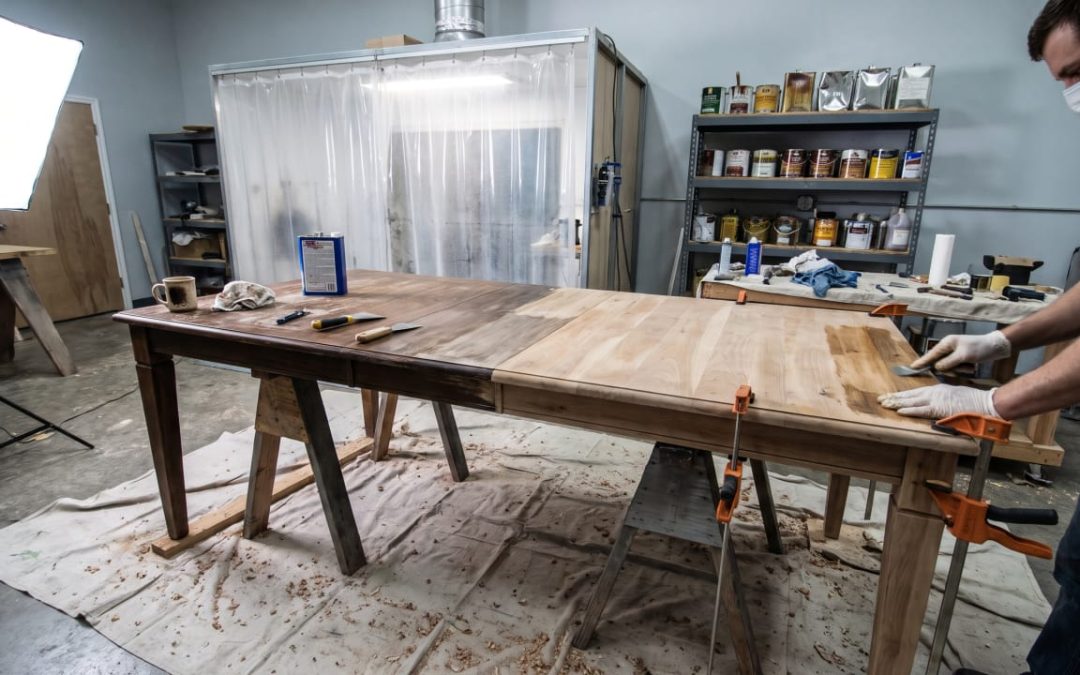
A dining table that has hosted twenty Thanksgivings, a dresser that came from a grandparent’s bedroom, a set of chairs with a finish gone cloudy from years of afternoon sun: these are the pieces that land in our Carrollton shop from across Denton County. If you are weighing furniture refinishing in Flower Mound, TX, this guide walks through seven things worth knowing before you hand a piece over, from stripping and stain color to timelines and what a fair price looks like.
We have refinished furniture for DFW families since 1980, first under founder John and now under his son Simon. The short version of everything below is also what our Dallas furniture refinishing service does every day: strip the old finish completely, correct the wood, match color on the actual piece, and spray a durable lacquer. For the full bench-by-bench sequence, our step-by-step refinishing process goes deeper than we can here.
Why Flower Mound Homeowners Refinish Rather Than Replace
Flower Mound is a Denton County town of established neighborhoods and larger family homes, and larger homes tend to hold larger furniture: sideboards, hutches, full dining suites, solid wood bedroom sets. Those pieces were often bought once, with the intention of keeping them. When the finish wears out, the sensible question is whether to replace or restore.
Solid wood and good veneer furniture almost always wins that comparison. Modern replacements in the same weight class cost far more than a refinish, and the frame you already own is usually better built than what is on showroom floors today. Sentimental value counts too. A table your family has gathered around for decades is worth keeping even when the math is close. If you want a price picture before deciding, our Dallas-Fort Worth refinishing cost guide breaks down what drives the number.
There is also the practical side. A refinished piece gets a fresh, hard protective surface, so a dining table that was starting to show rings and dull spots can go back to daily use, including the kids’ homework and the holiday spread, without anyone flinching every time a hot dish comes out. And because the work is done on your existing furniture, size and proportions already fit your room, something that is hard to guarantee with a new purchase ordered from a photo.
1. A Real Refinish Starts With Complete Stripping
The most important step is the one you never see in the finished piece. Every layer of old finish, including the sealer and the sticky buildup from decades of polish, has to come off before new color goes on. Stain laid over old finish looks muddy and peels at the edges. We remove finish with a laser stripper, or with a chemical overflow method where the stripper flows over the piece while we brush it clean. Both are controlled, and both protect joints and veneer better than aggressive shortcuts.
Once the surface is bare, the wood tells its own story. Water rings, dark glue lines, old repairs and sun-faded patches all show up now, which is why a quality shop evaluates the piece at this stage rather than only at drop-off. Wood is also a living material. The USDA Forest Products Laboratory’s Wood Handbook explains how moisture swings make boards expand and contract across the grain, which is exactly why we let stripped pieces settle before we sand and stain.
For a homeowner, the takeaway is simple. Ask any shop how they remove the old finish, because the answer predicts the result. A piece that is only scuffed and re-coated will look fine for a season and then show every old flaw underneath. A piece that is stripped to bare wood gives the new finish nothing to hide behind, and that is what gives a refinish its depth and clarity.
2. Sanding Decides How the Stain Looks
Stain does not cover the wood, it reveals it. Scratches left from coarse sandpaper glow dark once color is applied, and uneven sanding makes a table top look blotchy no matter how good the stain is. We work through progressively finer grits, with the grain, and take extra care on veneer, where there is only a paper-thin layer of wood to work with.
Veneer deserves a note of its own. Plenty of furniture built from the 1960s onward is real wood veneer over a particleboard or MDF core, and that is a large share of what we refinish. It can be refinished beautifully when handled with care. Veneer with a plastic laminate surface is a different material entirely and not something we can restain.
3. Color Is Matched on Your Actual Piece
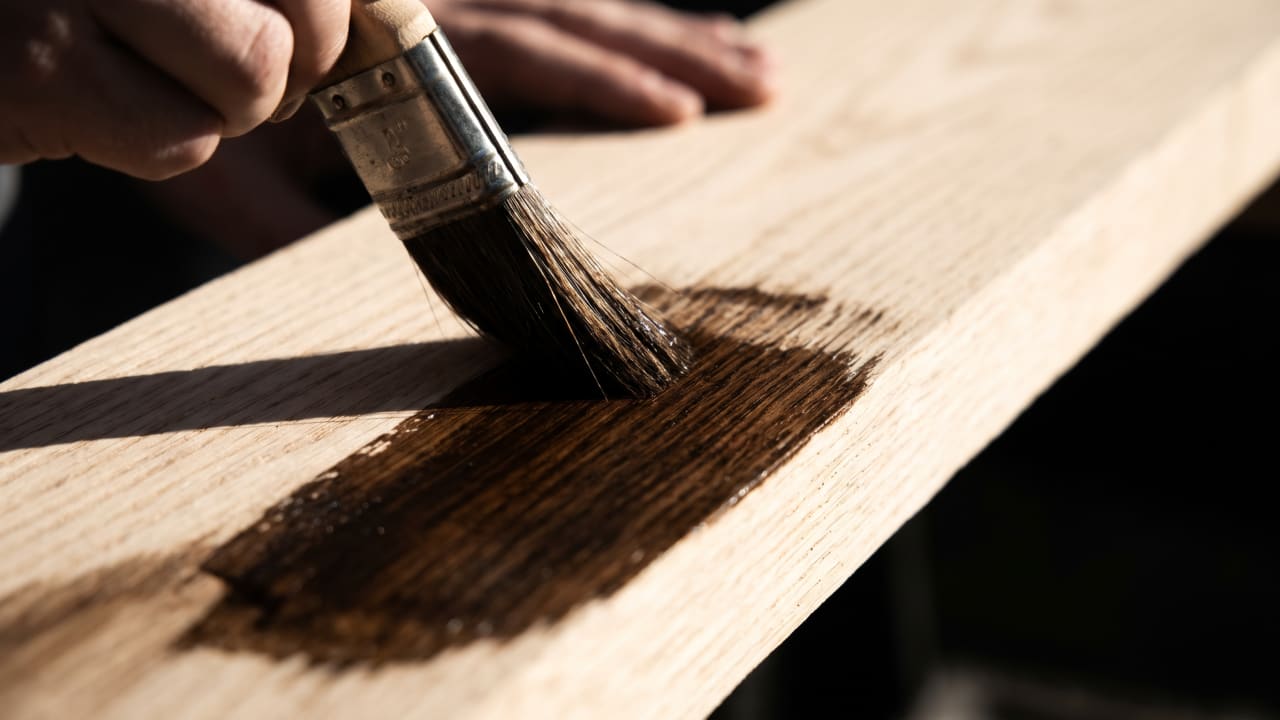
A sample board in a showroom light tells you very little. Wood species, age, and the way the grain takes color all change the result, and two boards of “oak” in the same room can drink stain differently. So we dial in color directly on your furniture, making test passes and adjusting. Three to six passes is normal before a match feels right, and it is the reason a refinished piece looks like it belongs in your room rather than like a stock color.
One honest limit: stain can only take wood darker or richer, not lighter than its natural tone. If your cherry bedroom set has darkened over the years and you want it pale and blonde, the raw wood sets that floor. We will tell you early, and show you what is achievable. Species matters a great deal here. Our guides to oak furniture refinishing and walnut color-matching on heirloom sets show how differently each wood behaves.
Most homeowners choose from three directions: restore the original tone, go a shade richer for a more current look, or shift toward a deeper espresso or walnut. All three are easier to judge with a few phone photos of the piece next to your flooring and walls, which is why our online estimate asks for them. We use a dye and pigment stain approach, so color goes in evenly and the grain still reads clearly through the finish.
4. Lacquer Is the Finish That Fits Interior Furniture
For residential furniture we spray lacquer, nitrocellulose or pre-catalyzed depending on the piece. Lacquer builds in thin, clear coats that cure hard, show off the grain, and feel smooth under the hand. It also dries quickly, which means less dust settling into the surface while it cures, and it can be blended cleanly if a mark shows up years later. It holds up well on dining tables, dressers, nightstands, and bedroom suites.
Sheen is your choice. Many clients ask for a natural satin so the wood looks like wood, while others prefer a touch more sheen on formal pieces. We talk through it during the color stage so the final look is something you picked, not something you discovered at pickup.
Fresh finishes also release odor as they cure, so give the piece good ventilation when it comes home. The EPA’s indoor air quality guidance is a useful reference for airing out a room after any new finish or furnishing arrives. Set felt pads under lamps and décor, use coasters for the first few weeks, and the finish will reach its full hardness without a mark.
5. Table Tops Are Refinished as a Whole
Customers often ask whether we can just fix the one burn mark or the ring from a hot dish. On a table or dresser top the answer is that the entire top gets refinished. A patch of new finish next to old finish always shows, in sheen and in color, and the eye finds it every time the light hits at an angle. Doing the whole top is what makes the result look like one continuous surface.
If the legs and base are still in good shape, a top-only refinish is a cost-conscious option. We price a dining table top-only at a standard finish at about $120 per running foot, and the base stays as it is. Pieces where the old finish is failing everywhere, such as chairs, aprons, and pedestals, are best done as a complete refinish so the color matches throughout.
6. What Refinishing Costs and How Long It Takes
Refinishing jobs start at $600, and the final number depends on size, species, condition, and how much detail the piece has. As rough ranges from our 2026 pricing: a single dining chair runs $275 to $375, a dresser or hutch $1,200 to $2,200, a nightstand starts around $650, and a full dining set with six chairs lands between $2,500 and $4,000. Every quote comes from your photos, so there are no surprises at the door.
Timing is the part most people underestimate. A standard furniture refinish takes 5 to 6 weeks, and fall is one of our busiest seasons, so lean toward the longer end if you are planning around the holidays. If you want a table back for a December gathering, send photos early. Pickup and delivery is available across DFW, starting around $250 round trip, and the fee is quoted up front with your estimate.
Where does the time go? Stripping, sanding and color testing take most of the first weeks. Then the finish goes on in several thin coats with drying time between them, and the piece gets a final inspection under good light before it is wrapped and ready. Rushing any of those stages is how finishes end up cloudy or soft, so we protect the schedule rather than promise a speedy turnaround we cannot keep.
7. How to Start From Flower Mound
The path is simple. Send three or four clear photos through our free online estimate form, including one wide shot, one close-up of the worst wear, and any maker’s marks or labels. We review the photos, ask a question or two, and come back with a price and a timeline. If the number works, you drop the piece at our shop at 2425 Parker Rd. in Carrollton or schedule pickup.
Before you commit, clear out the drawers and take photos of any hardware you want kept. Tell us about the room it will live in, how often the piece is used, and whether kids or pets are part of the picture. Those details shape the sheen and finish decisions more than people expect, and they are the difference between a refinish that looks good on pickup day and one that still looks good five years later.
Not sure the piece is worth the investment? Send it anyway. We will give you a straight answer about condition, expected result and whether refinishing makes sense, and we would rather tell you honestly than take a job that will disappoint you. Sometimes the answer is a simple full refinish, sometimes it is a smaller scope, and occasionally it is a piece that you should keep exactly as it is.
Our Service Area Around Flower Mound
We serve Flower Mound homeowners with pickup and delivery, plus neighbors in Lewisville, Grapevine, Southlake, Coppell, Plano, and Frisco, all within reach of our workshop. Wherever you live in the metroplex, the process is the same: photos first, a clear quote, and a finish built to last.
Frequently Asked Questions About Refinishing in Flower Mound
How much does furniture refinishing cost in Flower Mound?
Refinishing jobs start at $600. A single dining chair is typically $275 to $375, a dresser or hutch $1,200 to $2,200, and a full six-chair dining set $2,500 to $4,000. We quote from photos, so you know the price before anything is picked up.
How long does refinishing take for a Flower Mound homeowner?
Plan on 5 to 6 weeks for standard furniture, and a little longer during our busy fall and spring seasons. Starting your online estimate early is the best way to hit a holiday or event deadline.
Do you pick up furniture in Flower Mound?
Yes. Pickup and delivery is available across DFW, starting at roughly $250 round trip, with the exact fee quoted in your estimate. You are also welcome to bring pieces to our shop yourself.
Can you refinish furniture that has a veneer top?
Yes, real wood veneer, including veneer over particleboard or MDF, refinishes well when sanded with care. A top with plastic laminate is the exception, since laminate cannot be stained.
Can I choose any stain color I want?
Almost any color that is the same shade as your wood or darker. We match on your actual piece with test passes, so you see the result before we finish the full surface.
Ready to Bring a Favorite Piece Back?
A good refinish is part chemistry, part patience, and part knowing when to leave well enough alone. If you have a table, dresser, or chair set that deserves another few decades, Flower Mound homeowners can request a free online estimate or call 214-731-3060 to talk it through with our team.