

You have a dining table that was a good buy twenty years ago, a dresser from a grandparent, or a hutch that came with the house. The finish is cloudy, the top is ringed with water marks, and every few months someone says, “Should we just replace it?” If you live in Lewisville, that question usually has a better answer than a trip to the furniture store. Solid wood and well-built veneer pieces can be stripped and refinished for a fraction of what a comparable new piece costs, and they come back looking like they belong in your home. Our furniture refinishing service for Dallas-Fort Worth homeowners covers exactly this kind of work, and it is the foundation for everything below.
Andrew’s Refinishing has been family-owned and operated since 1980. John founded the shop, and it passed to his son Simon. We work from a Carrollton workshop right next door to Lewisville, so furniture refinishing in Lewisville, TX is not a distant, once-in-a-while job for us. It is a regular part of the week. This guide explains how to decide whether a piece is worth refinishing, what actually happens in the shop, what it costs, and how long you should plan to be without the piece.
Is Refinishing Worth It for Lewisville Homes?
The honest answer depends on three things: how the piece is built, what condition the structure is in, and what it means to you. A solid oak or maple dining table with a failing finish is one of the best candidates there is. The wood is thick, the joinery is usually sound, and a new finish resets the clock for another few decades. A flat-pack bookcase with a photo-printed surface is the opposite: there is no wood to refinish, and the money is better spent elsewhere.
The city’s housing mix explains the range of furniture we see. Lewisville grew from a rail-era settlement, and as the Handbook of Texas entry on Lewisville notes, the town grew rapidly after the railroad arrived in 1881 and then boomed from the 1950s onward as the dam, I-35E, and DFW Airport drew new residents. That means older homes near Old Town with inherited furniture, plus newer communities like Castle Hills and Timber Creek where families bought solid wood sets in the 2000s and 2010s and now want them updated rather than landfilled.
Three questions help most people decide quickly:
- Is it real wood or real wood veneer? Both can be refinished. Particleboard or MDF with a genuine wood veneer is a large share of our work. Laminate or plastic over particleboard is the one construction that does not take a refinish, so check an edge before you decide.
- Is the frame sound? Loose joints, wobbly legs, and loose chair rungs are very repairable. We re-glue, re-dowel, and reinforce as part of a refinishing job.
- Does it matter to you? Sentimental value counts. Plenty of pieces do not pencil out as a pure dollars comparison, and the owners are still glad they did it.
If you are weighing cost against replacement, our breakdown of what furniture refinishing costs across Dallas-Fort Worth goes through the numbers in more detail.
What Happens to Your Piece in Our Carrollton Workshop
Every job follows the same sequence, and it is slower than most people expect, because the quality of the finish is decided by the preparation. For a longer walk-through, see our step-by-step furniture refinishing process. The short version looks like this.
1. Photo estimate and assessment
You send photos through our free online estimate form. We look at the species, the construction, the type of damage, and the condition of the existing finish, then give you a price range and a lead time. The photo estimate is free, and you do not have to carry a heavy piece anywhere to get a number.
2. Stripping the old finish
We strip with a laser stripper or the chemical overflow method, where stripper flows over the piece as we brush it. Because the stripper is brushed on and worked by hand, the glue joints, grain, and veneer stay protected. For a tabletop-only job where we do not want stripper running down the legs, we use a gel stripper on the top alone.
3. Structural repair and fills
Once the old finish is off, hidden problems show themselves. This is when we re-glue loose joints, replace worn dowels, repair lifted or missing veneer, and fill deep gouges with a two-part epoxy. If a chair has a cane seat that has given out, cane and rush replacement is part of what we do too.
4. Sanding and color
Sanding sets the surface the finish will sit on. Then comes color. We use dye and pigment stain systems to build tone and let the grain show properly, and we test on the actual piece rather than relying only on a sample board. Expect several test passes (three to six is normal) before we land on the match you want. Because stain works with the wood’s natural tone, the color you choose can go darker than the raw wood.
5. Lacquer topcoat
Residential furniture gets a lacquer finish, which is durable, repairable later, and gives the wood a clean, natural look. After the coats cure, the piece is inspected before it goes back to you. Tabletops and dresser tops are always refinished in full. Full refinishing on tops gives an even sheen that holds up in raking light, where a patch would show.
If you like the technical side, the USDA Forest Products Laboratory’s chapter on finishing wood explains why surface preparation and coating build matter so much to how long a finish lasts. It matches what we see at the bench: the finish you notice is only as good as the work underneath it.
Lake Weather, Central Air, and Why Finishes Fail Here
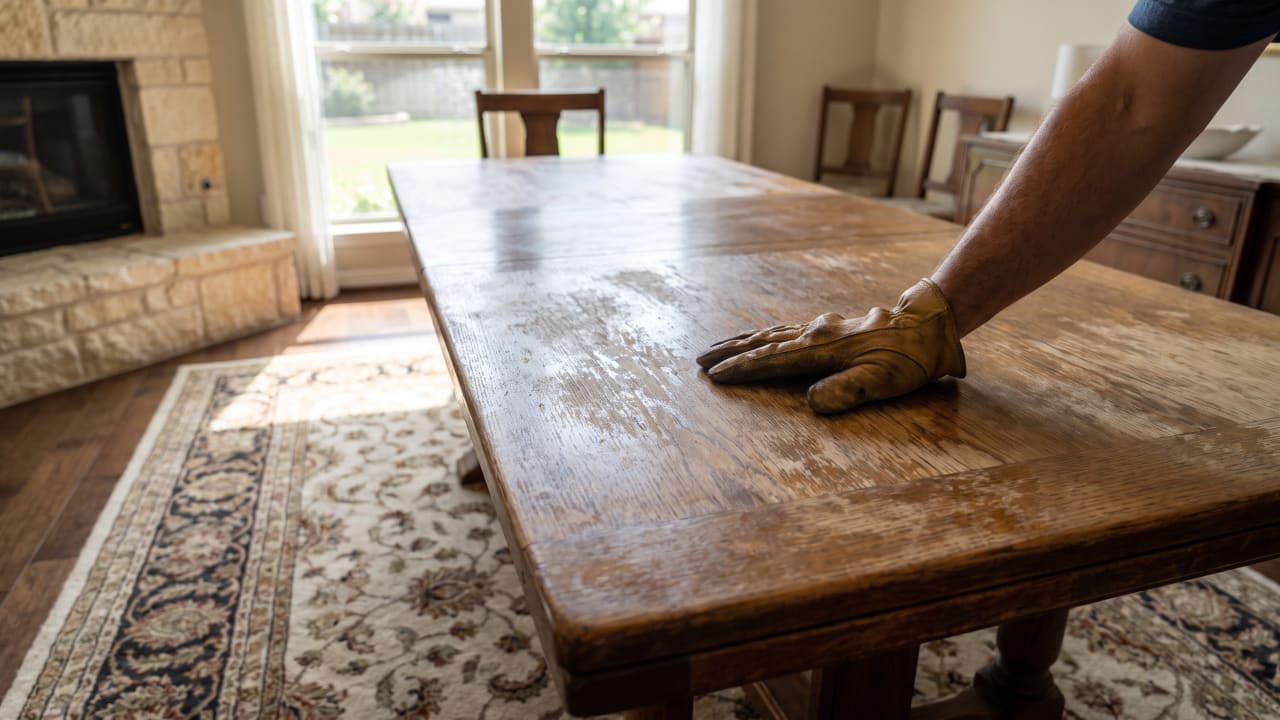
Finishes in this part of Texas live a hard life. Summer heat, strong sun through west-facing windows, and the swing between humid weather and dry air conditioning all stress wood and the coating on it. According to Purdue Extension’s guide on the shrinking and swelling of wood, wood continually trades moisture with the surrounding air, and that movement is what stresses glue lines and finishes over time. A table beside a patio door or a sideboard under an air vent will often fail sooner than the same piece in an interior room.
The common failure patterns we see:
- Sun fading and clouding on tabletops and dresser tops near windows.
- White rings and heat marks from hot dishes, cups, and plates.
- Cracked or peeling finish along edges, where seasonal movement hits hardest.
- Loose joints in chairs and tables that have been shifted, dragged, and sat on for years.
Most of these are cosmetic damage on top of sound wood, which is exactly the case where full refinishing makes sense. If you are not sure what you are looking at, send us photos and we will tell you plainly what we see.
What We Commonly See from Lewisville Households
No two homes bring in the same furniture, but a few categories come up again and again.
Oak dining sets and entertainment pieces
Oak is everywhere in homes built from the 1980s through the 2000s, and it is a fine candidate for refinishing. It has an open, prominent grain that responds well to dye and pigment stain. Our post on why oak takes stain differently explains how we handle it, and why a dated orange-toned oak set can come back looking current in a softer, more neutral color.
Inherited dressers, hutches, and bedroom sets
These are often mahogany, walnut, cherry, or maple, sometimes with veneer panels. We evaluate the veneer carefully. Lifted veneer and missing sections are repairable, and we will tell you up front what we see. Old pieces also tend to have the best joinery, which is why they are usually worth the investment.
Veneered pieces over particleboard or MDF
Many mid-priced pieces use a real wood veneer over a particleboard or MDF core. If the veneer is real wood, we can refinish it. A close look at an edge or an underside photo helps us identify what you have and confirm the veneer is real wood.
Painted and older finished pieces

Furniture from before 1978 may carry lead-containing paint. The EPA’s lead-safe renovation guidance advises against dry sanding and scraping painted surfaces in older homes, because that creates lead dust. If you have an older painted piece and you were thinking of sanding it in the garage, hold off and let a shop with proper stripping methods handle it.
Repairs That Belong in the Same Job
A refinishing job is the best time to fix structural problems, because the piece is bare and everything is visible. Wobbly chairs, sagging drawers, and split panels are all easier to correct before the new finish goes on. If your main issue is the structure and not the finish, take a look at our page on furniture repair services. We handle drawer slides, stops, and hardware alignment alongside refinishing and repair work, so sticking drawers get fixed in the same visit.
Getting Ready for Your Estimate
A good set of photos shortens the estimate and sharpens the price. You do not need a photographer, just a phone and ten minutes. Here is what helps most:
- A wide shot of the whole piece, so we can judge the style and size.
- Close-ups of the worst damage: water rings, scratches, peeling, or cracks.
- A shot of the underside or the inside of a drawer, which often shows the construction and whether the wood is solid or veneered.
- Any chip along an edge, where we can see whether there is real wood veneer under the finish.
- Rough dimensions, especially for tables, hutches, and sets of chairs.
Tell us what you want the piece to look like when it is done. If you want to keep the original color, say so. If you want a different tone, bring a photo of something you like. Remember that stain goes darker than the natural wood, so a deep espresso on a pale oak is very doable, while a light, bleached look on a dark mahogany is not.
Finally, think about the schedule. Standard refinishing takes several weeks, so a table needed for a holiday gathering should be requested early. If you cannot move a heavy piece, mention that when you request your estimate, because pickup and delivery are part of what we arrange.
Cost and Timeline: What to Plan For
Every piece is quoted individually, but these typical 2026 ranges give you a realistic frame. Refinishing jobs start at $600, and a free photo estimate gives you the exact number.
- Single dining chair: $275-$375
- Full dining set (table plus six chairs): $2,500-$4,000
- Dresser or hutch: $1,200-$2,200
- Nightstand: starts at $650
- Dining table top only, standard finish: $120 per running foot
- Basic repair jobs: $125 shop minimum
Plan on 5-6 weeks for standard furniture refinishing, and 4-6 weeks or more for large sets. Fall, before the holidays, is one of our busiest seasons, so if you want a dining table back for Thanksgiving, request your estimate early. Pickup and delivery are available across DFW starting at $250 round trip, with the fee quoted up front in your estimate.
Compare that against replacement. A new solid wood table of similar quality can easily cost more than refinishing the one you own, and particleboard replacements will not last as long. A refinished piece also keeps its original construction, which is often better than what is on showroom floors today.
There is also a practical side to keeping a piece you already own. Old furniture has already survived years of use, which tells you something about the quality of the wood and the joinery. A refinished piece can last another generation, and the money you save over buying new can go toward the fabric, rug, or lighting that completes the room. For many households the result is not just a cheaper option but a better one, with furniture that has history and still fits the space.
How to Choose a Refinishing Shop
A few practical checks keep you out of trouble:
- Ask who will handle your piece at each stage and how long the shop has been refinishing furniture in DFW.
- Ask what finish is applied and why. A shop should be able to explain it in plain terms.
- Ask whether color is tested on your actual piece.
- Ask for a written estimate and lead time before you commit.
- Look at reviews and finished work from real customers.
You can read what other customers say on our reviews page.
Serving Lewisville and the Surrounding Area
We serve Lewisville homeowners and businesses, plus nearby Carrollton, Flower Mound, Coppell, Frisco, Plano, and Allen, along with the rest of the Dallas-Fort Worth metroplex. You are welcome to drop pieces off at our Carrollton shop at 2425 Parker Rd. Bldg. 5, and pickup and delivery can be arranged for larger items.
Furniture Refinishing in Lewisville: Frequently Asked Questions
How much does furniture refinishing cost in Lewisville?
Refinishing jobs start at $600. A single dining chair typically runs $275-$375, a dresser or hutch $1,200-$2,200, and a full dining set $2,500-$4,000. A free online estimate with photos gives you a firm range for your piece.
How long does furniture refinishing take?
Standard furniture refinishing takes about 5-6 weeks, and larger sets can run longer. Fall and spring are busier, so ask for your estimate early if you have a deadline.
Can you pick up furniture from Lewisville?
Yes. Pickup and delivery are available across DFW, starting at $250 round trip depending on location and job size. You are also welcome to bring pieces to our Carrollton workshop yourself.
Can you refinish furniture with a veneer top?
Yes, as long as it is real wood veneer, which is a large share of the pieces we refinish. We can also repair lifted or missing sections of veneer, and photos of an edge or underside help us confirm what you have.
What finish do you use on dining tables?
Residential furniture, including dining tables, gets a lacquer topcoat. It is durable for daily use and can be repaired or refreshed later if needed.
Ready to Bring Your Furniture Back?
If you have a piece you are not ready to give up on, refinishing is usually the better path than replacement. Lewisville homeowners can send photos and request a free online estimate to get a price range and lead time, or call 214-731-3060 to talk it through with the shop. You can also see the full range of our furniture refinishing services before you decide.