

In the Craftsman bungalows and Tudor cottages lining the streets around White Rock Lake, you will find furniture that was built to outlast the house it sits in. A lot of Lakewood living rooms still hold a sofa, a wingback chair, or a set of dining chairs that came from a parent or grandparent: solid hardwood underneath, springs that still have some life in them, joints that were cut and glued the old way. The fabric is usually the part that has given out. That is the case for reupholstery rather than replacement, and it is one we make often through our reupholstery work across Dallas.
Reupholstery is a different job than the general restoration we cover in our piece on furniture restoration in Lakewood. Structural work fixes what is broken. Reupholstery replaces what is worn out, the fabric, the padding, sometimes the webbing underneath, while keeping the frame that made the piece worth having in the first place. If you have got a piece with real bones and tired upholstery in your East Dallas home, here is what the process actually looks like, what it costs, and what to expect from a shop that has been doing this work in the DFW metroplex since 1980.
Why Lakewood’s Older Sofas and Chairs Are Worth Saving
Most of the reupholstery work we do in Lakewood starts with a frame that is better built than what you would find on a big-box sofa today. Furniture from the 1950s through the 1980s, and plenty of the antique and early-twentieth-century pieces passed down through local families, used kiln-dried hardwood, doweled and glued joints, and coil or hand-tied springs rather than the stapled softwood and sinuous wire construction common in lower-cost furniture now. A well-built upholstery frame is the part of a sofa or chair that determines whether reupholstery makes sense in the first place. If the frame is solid, new fabric and padding can extend its life by decades. If the frame itself is failing, MDF, particleboard, or split hardwood, reupholstery will not fix the underlying problem.
The neighborhood’s housing stock plays a role here too. Lakewood Heights and the blocks around it developed mostly in the 1920s and 1930s: brick Tudor cottages, Spanish-influenced bungalows, and Craftsman houses, many protected today by a local conservation district. Furniture bought for those homes when they were new, or inherited since, tends to match the quality of the house: real wood, real joinery, upholstery built to be redone rather than thrown out. That tracks with what the preservation community has documented about the neighborhood’s architectural history.
Not every piece worth reupholstering is decades old. Plenty of the sofas and chairs we see are mid-century pieces bought new by a previous generation, and just as many are antiques with joinery from well before that. Both categories tend to share the same advantage over most furniture sold today: real wood frames built by someone who expected the upholstery to be redone more than once over the piece’s life.
Signs Your Piece Is a Good Reupholstery Candidate
Not every worn piece in a Lakewood home is worth the investment, but a few signs point toward yes.
- The frame does not wobble or creak when you sit down, and there is no visible cracking at the joints.
- The springs still have tension. If you sink straight through to the frame, that is a bigger repair than fabric alone can fix.
- It is solid wood or a real wood veneer over a sound substrate, not particleboard wrapped in plastic laminate.
- The silhouette is one you actually like. Reupholstery changes the fabric, not the shape, so the bones need to be right.
- It carries enough history or quality that replacing it with something new would not really be a replacement at all.

What to Expect from Our Reupholstery Process
Reupholstery starts with a look at the piece, either in person or through photos for a free online estimate. We are checking frame condition, the spring system, and how much of the original padding is still usable. From there, fabric selection happens before the piece ever leaves your house. We keep swatch books rather than a full showroom of bolts on hand, so once you have picked a fabric and put down a deposit, we place the order. It typically takes about a week to arrive at the shop, and pickup gets scheduled once the material is in hand.
Once the piece is at the shop, we strip it down to the frame: old fabric, old padding, and any degraded webbing or springs come off so we can see exactly what we are working with. Loose joints get reglued while the frame is exposed, since that is the easiest time to do that work. Then it is new webbing or springs as needed, fresh padding (standard polyurethane foam, with a higher-density option available as an upcharge for seating that gets heavy daily use), and the new fabric, cut and sewn to the original pattern or a close variation if you are adjusting the silhouette slightly. A single Lakewood sofa typically sits behind several other reupholstery jobs already in progress, which is part of why we quote 6 to 12 weeks depending on shop workload rather than a fixed date.
Frame Repair While It’s Apart
Taking a piece down to bare wood is also the best chance to deal with problems fabric has been hiding. A loose corner block, a cracked leg, a joint that has started to separate, all of that gets addressed before new webbing, springs, or padding go back on. It does not make sense to put fresh fabric over a frame that is still structurally compromised, so structural repair is treated as part of the reupholstery job rather than a separate line item you have to catch on your own. If a frame turns out to need more extensive structural work than expected, we will flag it and adjust the estimate before continuing rather than after the fact.
If you already own the fabric you want, customer-supplied material (COM) works fine, and we build that into the estimate with a $35 per yard handling fee. Either way, the deposit and fabric decision happen up front, not after your Lakewood sofa is already sitting half-finished in our Carrollton workshop. Reupholstery is largely done in-house, though during peak season some upholstery work is occasionally sent to a trusted subcontractor to keep queues moving.
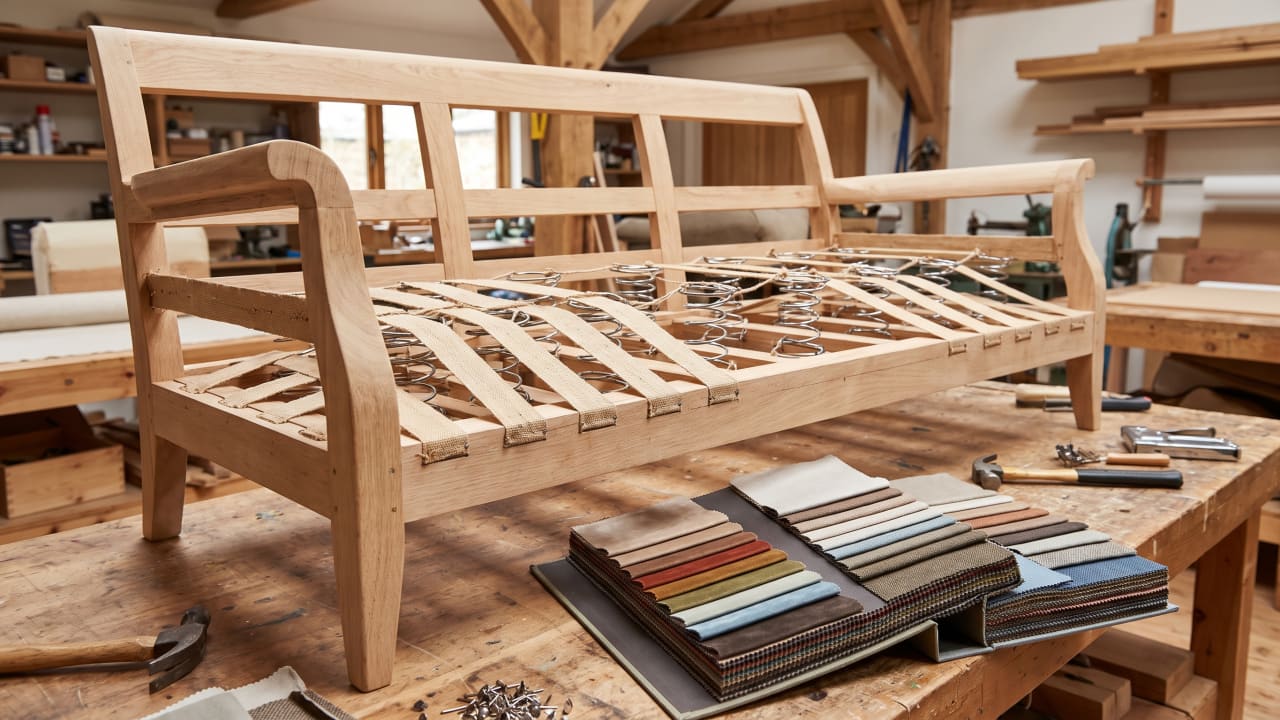
Fabric Durability: Choosing What Actually Holds Up
Fabric choice matters almost as much as frame quality for how long a reupholstery job lasts. The textile industry measures wear resistance in Martindale rub counts, the number of abrasion cycles a fabric can withstand before it starts to show wear. The published industry guidelines for high-traffic upholstery fabric set a baseline that most commercial furniture is built to clear. We set our own recommendations higher than that published baseline for the pieces that come through our shop.
For a sofa or chair in regular household use, we recommend fabric rated at 30,000 double rubs or higher. For a piece in a high-traffic room, a family room sofa with kids and pets, a dining chair used every night, we push that to 50,000 or higher. On commercial jobs, restaurant booths, hotel lobby seating, we do not use anything rated under 100,000 rubs. Performance fabrics like Sunbrella or Crypton tend to clear these numbers comfortably and clean up easier than natural fiber blends, which is worth considering for a piece that sees daily use.
Rub count is not the only variable. Tightly woven performance weaves in Sunbrella or Crypton resist spills and pet claws well, which makes them a common pick for family rooms and window-facing furniture that takes direct sun. Velvet reads more formal and holds up fine in a lower-traffic living or dining room, but it is not the fabric we would put on a daily-use sectional with kids and a dog. Linen and cotton blends sit in between: comfortable and breathable, better suited to rooms that see moderate rather than constant use. Part of the fabric selection conversation before we place your order is matching the weave to how the piece actually gets used, not just how it looks in the swatch book.
Reupholster or Replace? What It Actually Costs
Reupholstery pricing depends on the piece and the fabric. A full three-seat sofa typically runs from about $1,500 in labor, plus roughly $1,200 in fabric for most mid-range options, so a complete job usually starts around $2,500. A club or wingback chair runs $650 to $900 in labor plus around $700 in fabric. A single dining chair seat costs considerably less, typically in the $275 to $375 range. Treat these as planning numbers rather than a quote; the free online estimate is where we confirm the real one against your actual piece and fabric choice.
What’s Included in a Reupholstery Estimate
- Labor to strip the piece, repair the frame, and rebuild the seating structure.
- Fabric cost, whether it is customer-supplied (plus the COM handling fee) or ordered through our swatch books.
- Padding and foam, with standard polyurethane included and higher-density foam offered as an upcharge.
- Any webbing, spring, or minor hardware replacement the frame needs once it is opened up.
- Pickup and delivery, if you choose that option instead of dropping the piece off yourself.
None of these line items are add-ons that show up after the fact. The free online estimate is built to reflect the finished job, not a starting bid that grows once the piece is already in our shop.
Against those numbers, a comparable new sofa built with a kiln-dried hardwood frame and hand-tied springs, the kind of construction actually worth keeping for another twenty years, usually costs more than reupholstering the one you already own, and a good deal more if you are trying to match a vintage silhouette a Lakewood home calls for. There is a waste argument too: most discarded furniture in the United States ends up in a landfill rather than getting reused or recycled. A frame that is still sound is usually worth keeping in service instead of adding to that pile.
One distinction worth knowing before you call: if only your seat or back cushions have gone flat and the covers unzip, that is a smaller job. Our cushion and foam replacement service can handle it without touching the rest of the piece. If the fabric is sewn directly to the frame with no zipper access, the labor involved is close enough to a full reupholstery that we will usually recommend doing the whole piece at once instead of a partial fix.
Reupholstery covers more than sofas. We regularly rebuild club and wingback chairs, dining chair sets, ottomans, headboards, and banquette seating for both homes and small commercial spaces. The common thread across all of it is a frame worth keeping. An estate-sale find, a set of dining chairs inherited from a grandparent, or a sofa that has simply earned its keep over twenty years of use, all of them are candidates as long as the bones check out. Sentimental value counts here too. A piece does not have to pencil out purely on resale math to be worth restoring if it means something to the family that owns it.
Serving Lakewood and the Surrounding Dallas Neighborhoods
Our shop is based in Carrollton, about a 25-minute drive away depending on traffic, and we offer DFW-wide pickup and delivery so distance is not a reason to put off reupholstery on a piece worth keeping. Beyond Lakewood, we regularly take on reupholstery projects throughout Highland Park, Lake Highlands, the M Streets and Greenland Hills, University Park, Uptown Dallas, and the neighborhoods around White Rock Lake.
Frequently Asked Questions About Reupholstery in Lakewood, Dallas
How much does reupholstery cost in Lakewood, Dallas?
A full three-seat sofa typically starts around $1,500 in labor plus roughly $1,200 in fabric, so complete jobs usually begin near $2,500. A club or wingback chair runs about $650 to $900 in labor plus roughly $700 in fabric, and a single dining chair seat costs considerably less, usually in the $275 to $375 range. The exact number depends on the piece and fabric choice, which is why we confirm it with a free online estimate before any work starts.
How long does a reupholstery project take?
Most reupholstery jobs take 6 to 12 weeks from drop-off to finished piece, depending on how busy the shop is at the time. Fabric is ordered and paid for before your furniture leaves your house, so once the piece arrives at the shop the material is already on hand and ready to go.
Can I supply my own fabric?
Yes. Customer-supplied fabric (COM) is common, and we add a $35 per yard handling fee to the estimate. If you would rather choose from what we carry, we work from swatch books rather than in-store bolts, and ordered fabric typically arrives at the shop within about a week.
Do you offer pickup and delivery for furniture in Lakewood?
Yes. We offer DFW-wide pickup and delivery starting at around $250 round trip, priced by distance and job size. Our workshop is in Carrollton, roughly a 25-minute drive from Lakewood, and the fee is quoted up front as part of your estimate.
Do you reupholster leather furniture?
No. We do not restore, repair, or reupholster leather in any form. Our reupholstery work is fabric-based: sofas, club and wingback chairs, dining seats, ottomans, and banquettes, using customer-supplied material or fabric from our swatch books.
Ready to Give Your Furniture New Life?
If you have got a sofa, a wingback chair, or a set of dining chairs in your Lakewood home that still has good bones under tired fabric, reupholstery is usually the better call than replacement, both for what you will spend and for what you will end up with. Request a free online estimate and send us a few photos, or call the shop directly at 214-731-3060. We have been doing this work out of our Carrollton workshop since 1980, and a good frame is exactly the kind of piece we like to see come through the door.