
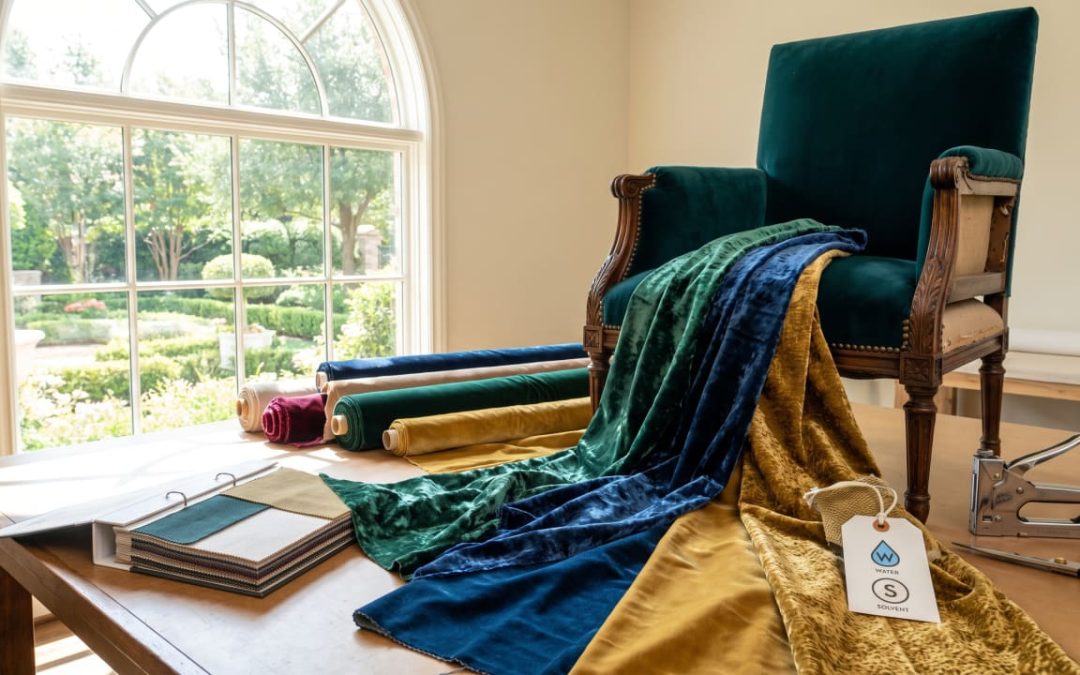
Velvet keeps showing up in the formal living rooms and library corners of Highland Park, Dallas, and it is not just a color story. The pile catches light in a way flat fabrics never will, and it reads as substantial the moment you sit down. But velvet is also the fabric people misunderstand most when they are shopping for velvet reupholstery: which fiber to choose, how the backing holds up under a tufted or channel-back frame, and what those little cleaning-code tags on the swatch actually mean once the sofa is in daily use. That is the deep-dive this guide is for. If you want the broader picture of how a full reupholstery job runs from pickup to delivery, our Dallas-Fort Worth upholstery shop covers that ground; here, we are staying narrowly focused on velvet.
We have reupholstered a lot of velvet in Highland Park over the years, from Georgian Revival wingbacks to mid-century club chairs that just needed the fabric to catch up to the frame. The short version: velvet is a wonderful choice for formal, low-abrasion seating, and a poor choice for the sectional the kids use as a trampoline. The long version follows below, along with the pile, backing, and cleaning-code details that actually determine whether you will love the fabric in five years or regret it in five months.
Why Velvet Is Back in Highland Park, Dallas Living Rooms
Part of it is architecture. The neighborhood’s older housing stock, the Georgian Revival estates, the Tudor cottages near the village, the traditional two-stories closer to the creek, was built with formal living rooms and libraries that flat performance fabrics tend to underserve. Velvet has the visual weight to hold its own against crown molding, wood paneling, and the kind of furniture that was bought to last a generation. For a deeper look at how we approach reupholstery projects across the neighborhood more broadly, our guide to reupholstery in Highland Park, Dallas is a good companion read to this one.
The other part is practical. A well-made velvet, on the right frame, in a room that does not see daily foot traffic from kids or large dogs, will outlast most trend fabrics by a decade. It is a fabric that rewards being used the way it was designed to be used: as the anchor piece in a room people sit in on purpose, not the couch that absorbs every spill in the house.

Cotton, Mohair, and Performance Velvet: Picking the Right Pile
“Velvet” is a weave structure, not a fiber, so the first real decision is what the pile is made of. Cotton velvet has the softest hand and the deepest, most matte color depth of the three, which is why it still shows up on the pieces people fall in love with in a showroom. It is also the least forgiving option: cotton pile crushes and shows shading in high-traffic spots faster than the other two, and it is not a fabric we recommend for a piece that gets sat on every evening.
Mohair velvet, woven from Angora goat hair, is the durability benchmark. According to a specifier’s comparison of velvet fiber types, mohair velvet resists crushing and dirt well enough to reach Martindale rub counts in the 80,000 to 100,000 range depending on construction, which puts it in genuinely commercial-grade territory. It costs more per yard, and it is the fabric we point clients toward when a piece is going to see real daily use and still needs to look and feel like velvet.
Performance or polyester velvet sits in the middle on price and durability, and it has closed a lot of the gap with mohair on stain resistance thanks to fiber-level treatments that repel liquids before they reach the backing. It will not have quite the same depth of color as cotton or mohair, but for a family room that still wants the velvet look, it is often the more sensible call. Our fabric selection for any of these three routes runs through swatch books rather than an in-store bolt inventory, since that lets us bring in a much wider range of mills than we could ever stock on shelves.
Pile Direction, Crushing, and Why Velvet Looks Different From Every Angle
Velvet’s most distinctive trait, the way it looks like two different colors depending on where you stand, is not a manufacturing flaw. It is the nap, the direction the pile fibers lean, catching or scattering light. Run a hand down the fabric one way and it looks rich and dark; run it the other way and it lightens noticeably. Every cushion, arm panel, and back panel on a piece has to be cut with the nap running the same direction, or the seams will visibly mismatch in color under normal room light.
This is also why velvet shows crushing at the arms and seat front before anywhere else on the piece, which is simply where hands and legs make the most repeated contact. A textile industry guide to handling and caring for velvet notes that light crushing can often be lifted with steam held just above the pile and a soft brush worked in the nap direction, which is worth knowing before you assume a slightly flattened cushion means the fabric has failed.
Backing Quality: What’s Actually Holding the Pile in Place
The backing is the woven cloth the pile fibers are anchored into, and it matters more than most shoppers realize. A loosely woven or thin backing lets pile fibers shed and pull loose at the seams over time, and it will not hold up to the tension a tufted button or a tightly channeled back panel puts on the fabric during construction. This is a real concern on the deep-buttoned chesterfields and channel-back chairs that are common in the neighborhood’s more traditional rooms.
When we walk a client through a swatch book, backing weight is one of the things we check by hand before recommending a velvet for a heavily tufted frame. A denser backing costs more per yard, but it is the difference between buttons that stay crisp for years and buttons that pull loose within a season of regular use.

Cleaning Codes: W, S, WS, and X Explained
Every upholstery fabric ships with a cleaning code, usually printed as a single letter or letter pair on the sample tag, and it tells you exactly what you can safely use on a spill. Per a widely used reference on upholstery fabric cleaning codes, a W code means the fabric can be spot cleaned with a water-based foam or shampoo cleaner. An S code means solvent-only, no water, which describes a fair number of natural-fiber velvets. WS (sometimes written W/S) means either a water-based or solvent cleaner can be used with caution and a small test spot first. An X code means vacuum or light brushing only, no liquid cleaner of any kind.
Cotton velvet is frequently coded S or WS, since water can leave rings or flatten the pile unevenly if it is not handled correctly. Performance velvets are increasingly coded W, which is part of why they have become the practical choice for households that actually use their furniture rather than reserving it for company. Knowing the code before you commit to a fabric, not after the first red wine incident, is the whole point of asking about it during the swatch-book stage.
Martindale Rub Counts: How Much Durability Does Your Room Need?
The Martindale test is the industry’s standard abrasion benchmark: a fabric sample gets rubbed in a controlled circular motion under a fixed load until pilling, fraying, or fiber breakage first appears, and the number of rubs it survives becomes its rating. A detailed explainer on the Martindale rub test is a good primer if you want to understand how the number is actually generated rather than just trusting the tag.
Our own rule of thumb, based on what we actually see hold up in DFW homes, is to look for at least 30,000 rubs on a sofa that gets regular use, and 50,000 rubs or higher for a family room or any seating that sees heavy daily traffic. Commercial jobs, restaurant booths and hotel lobby seating, do not go out of this shop rated under 100,000 rubs. Cotton velvet often lands south of 30,000, mohair and most performance velvets clear it comfortably, which is the practical reason we steer high-use pieces toward the latter two.
Where Velvet Makes Sense, and Where a Performance Fabric Serves Better
Velvet is the right call for a formal living room sofa, a library wingback, a dining chair that gets used a few times a month rather than three meals a day, or any piece where the seating is occasional rather than constant. It is also a strong choice in the neighborhood’s more traditional rooms specifically because the fabric’s color depth suits the architecture, and low-abrasion use means durability is less of a concern than it would be on daily-use furniture.
Where it falls short is anywhere the furniture takes real daily abuse: a family room sectional, a breakfast-nook bench, a piece shared with a large dog. For those rooms we typically point clients toward Sunbrella or Crypton-style performance fabrics from the same swatch books, since they combine a comparable Martindale rating with stain resistance velvet simply cannot match. Our fabric swatch book selection includes both velvet and performance options side by side, which makes this an easy comparison to make in person before you commit.
Velvet Reupholstery in Highland Park, Dallas: Our Process From Swatch Book to Delivery
Fabric selection happens before your piece ever leaves the house. We work through swatch books with you, talk through pile type, backing, and cleaning code for the specific room the piece lives in, and collect a deposit at that stage so the fabric is already on order when we pick up or you drop off the frame. Ordered fabric typically takes about a week to arrive at the Carrollton workshop, which keeps the schedule moving instead of stalling out while material is in transit.
From there, a full velvet reupholstery job typically runs 6 to 12 weeks depending on shop workload at the time, which covers stripping the old fabric, inspecting and repairing the frame and springs where needed, and the actual upholstery work itself. We have also restored the wood components of pieces sitting alongside velvet upholstery in the same house, including a recent mahogany restoration project nearby, so a formal room’s wood and fabric pieces can be handled by the same shop on a coordinated timeline. Andrew’s Refinishing has been doing this kind of work out of the same Carrollton workshop as a family-owned business since 1980, which means the awkward cases, matching an old frame’s proportions or steaming crushed pile back into shape, are routine rather than first-time problems.
What Velvet Reupholstery Costs
A full three-seat sofa reupholstery typically starts with labor around $1,500, with fabric adding roughly another $1,200 depending on yardage and the velvet grade you choose, putting most complete velvet sofa jobs at around $2,500 and up. A club chair or wingback runs less: labor usually starts between $650 and $900, with fabric adding roughly $700 more on a standard skirted, rolled-arm chair.
If you already own the velvet you want to use, customer-supplied material (COM) carries a $35 per yard handling fee on top of labor. Every quote starts as a free photo-based estimate, and the number you are quoted is the number you pay, since the whole point of the online estimate is avoiding surprise add-ons once the piece is already in the shop.
Serving Highland Park and the Park Cities Area
Our Carrollton workshop handles velvet reupholstery, wood refinishing, and repair work for homes throughout Highland Park, plus the surrounding University Park, Preston Hollow, Uptown Dallas, Downtown Dallas, and North Dallas communities. If you are outside the immediate area, DFW-wide pickup and delivery is available for a flat fee based on distance and job size, quoted upfront as part of your estimate.
Frequently Asked Questions About Velvet Reupholstery in Highland Park, Dallas
Why is velvet such a popular reupholstery choice in Highland Park, Dallas?
Highland Park’s older, more formal housing stock (Georgian Revival estates, Tudor cottages, traditional two-stories) tends to have living rooms and libraries built for furniture with real visual weight. Velvet’s color depth and light-catching pile suit that architecture, and because these rooms typically see occasional rather than constant use, velvet’s durability limits are less of a concern than they would be in a high-traffic family room.
Can velvet upholstery actually be cleaned, or does every spill become permanent?
It depends on the cleaning code printed on the fabric tag. Cotton velvets are often coded S (solvent only) or WS (water or solvent with caution), while many performance velvets are coded W and can be spot cleaned with a water-based foam cleaner. Checking the code before you choose the fabric, not after a spill, is the smart approach, and we walk through it with you at the swatch-book stage.
How much does velvet reupholstery cost for a sofa in Highland Park, Dallas?
A complete three-seat sofa in velvet typically starts around $2,500, combining labor starting at $1,500 with fabric costs of roughly $1,200 depending on the grade and yardage. A club or wingback chair runs less, with labor starting between $650 and $900 plus roughly $700 in fabric. Every job starts with a free, no-surprise photo estimate.
Does Andrew’s Refinishing keep velvet fabric in stock to browse?
We work from swatch books rather than an in-store bolt inventory, which lets us offer a much wider range of cotton, mohair, and performance velvets than we could ever keep on shelves. Once you select a fabric, it typically takes about a week to arrive at our Carrollton workshop, and we order it as soon as your deposit is placed so material is ready when your piece arrives.
How long does a velvet reupholstery project take from start to finish?
Most velvet reupholstery jobs run 6 to 12 weeks from drop-off or pickup to delivery, depending on shop workload at the time. That window includes fabric arrival (about a week after your deposit), frame and spring inspection, and the upholstery work itself. We will give you a realistic timeline specific to your piece as part of your estimate.
Velvet rewards the rooms it is actually suited for, and it is one of the more satisfying fabrics to see finished on a frame that deserved better than its old cover. If you are weighing a velvet reupholstery project for a sofa, wingback, or dining chair in Highland Park, our team can walk you through pile, backing, and cleaning code in person with the swatch books in front of you. Request a free online estimate and we will follow up with a straightforward quote, no pressure and no surprise add-ons once the work begins.