
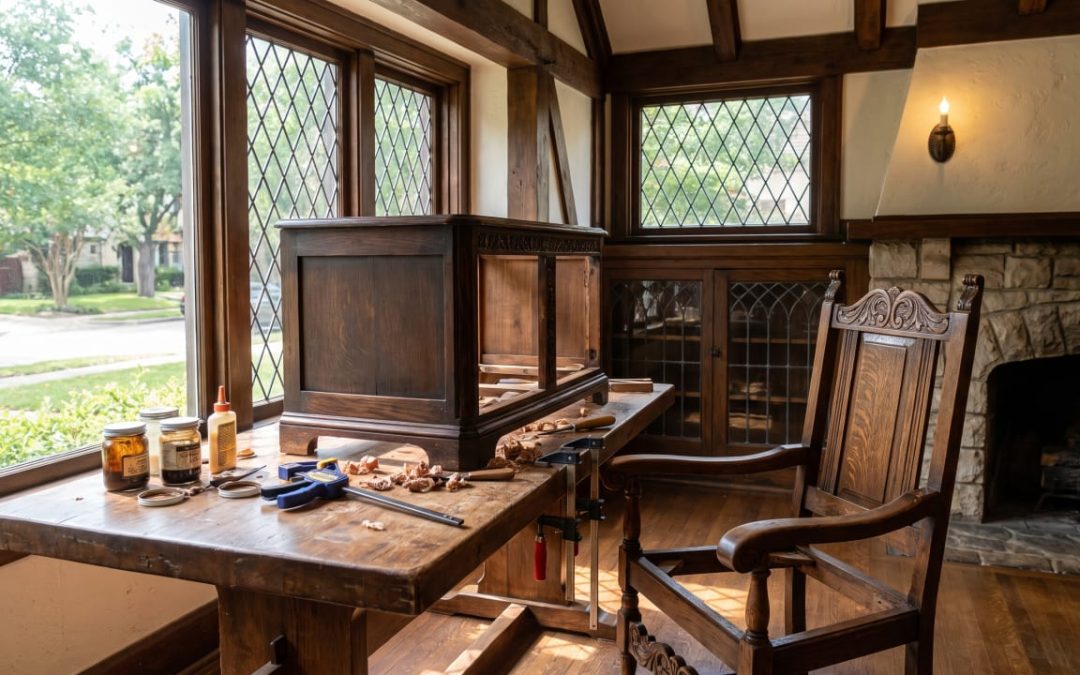
Walk the tree-lined blocks of McCommas, Mercedes, Morningside, Monticello, and Merrimac in the M Streets and you are standing in one of the largest collections of Tudor-style homes in the country. These 1920s houses, built after Fletcher and Frank McNeny carved the old Bennett dairy farm into a streetcar suburb near Mockingbird, came furnished with solid oak, walnut, and mahogany pieces meant to last generations. Many of those original pieces, or the ones passed down since, are still doing daily work in M Streets dining rooms and bedrooms today. After a century of humidity swings, moves, and everyday use, most of them need some kind of wood furniture repair.
That is where we come in. Andrew’s Refinishing has handled wood furniture repair across Dallas from our Carrollton workshop since 1980, and this stretch of East Dallas sends us a steady stream of loose joints, worn finishes, and gouged tabletops from its Tudor-era homes. If you are closer to Preston Hollow, our companion wood furniture repair guide for that neighborhood covers a different housing stock and a different set of repair patterns. This one is about what actually shows up on our bench from M Streets homes, and what we can, and cannot, do about it.
Why the M Streets Has So Much Solid Wood Furniture to Repair
In November 2002, Greenland Hills became the ninth conservation district in Dallas, a designation that protects the original Tudor details on these homes from being torn out or replaced without review. According to D Magazine’s history of the M Streets, the neighborhood’s builders leaned hard into English Tudor styling, complete with stained glass, steep gables, and the kind of solid millwork that simply does not get built anymore. The same instinct that keeps a homeowner from ripping out original leaded glass windows tends to extend to the furniture inside the house. Preservation Dallas’s overview of the M Streets East Conservation District describes the same conservation ethic that governs the exteriors, and we see it reflected inside these houses too. Dining tables and dressers that came with the house, or that a grandparent left behind, tend to get repaired rather than hauled to the curb.
The practical upshot is that furniture repair calls from this part of the neighborhood skew toward genuinely old, genuinely solid pieces. We are not usually dealing with laminate-over-particleboard furniture that cannot be repaired in the first place, because that kind of furniture was not what these houses were built to hold. We are dealing with real oak library tables, walnut buffets, and maple dining chairs built to be fixed, which is good news, because it means almost everything that comes off an M Streets moving truck is a candidate for repair rather than replacement. The same pattern shows up elsewhere in the city’s older housing stock too, something we get into in our piece on furniture restoration in North Dallas, but the M Streets’ Tudor-specific housing and conservation-district status give it its own repair patterns.

The Repair Work We Actually Do on Wood Furniture
Furniture repair covers a specific, bounded set of fixes, and it is worth being precise about what is included so you know what to expect when you call the shop. On solid wood pieces, we handle:
- Re-gluing loose joints in chairs, tables, and case pieces where the original glue has failed after decades of use
- Dowel replacement where a leg or stretcher has worked itself loose over the years
- Leg repair, including cracked or broken legs on dining chairs and side tables
- Two-part epoxy fill for deep gouges and scratches that a simple touch-up will not hide
- Cane and rush seat replacement on dining and side chairs, a different scope entirely from wicker, which we do not restore
- Veneer repair for lifted or missing sections, common on the 1920s-era case pieces found throughout the neighborhood
- Color matching and finish blending on parts of a piece, done on the actual wood rather than a sample board
The gouge fill work deserves a quick explanation, because it is one of the more misunderstood repairs we do. A deep gouge in a table leg or chair apron is not something you can sand out without removing an unreasonable amount of surrounding wood, so instead we fill it with a two-part epoxy that cures hard enough to sand, shape, and finish over. General guidance on epoxy wood repair backs up why this approach holds up better over time than a soft wood filler: epoxy bridges the gap and reinforces the surrounding fibers instead of just sitting in the hole. Done well, a color-blended epoxy repair on a table leg or chair rail from an old dining set is genuinely difficult to spot once it is finished and cured.

Veneer repair is the other one worth flagging, since the 1920s case pieces common in the neighborhood often have veneer that has lifted at a corner or edge, or a small section that has gone missing entirely. Both of those are repairable. What we do not take on is bubbling veneer, where the substrate underneath has swelled and separated across a broad area rather than just lifting at an edge. At that point the wood movement has usually outpaced what a spot repair can fix, and the honest answer is that it is not a job we can take. If you are not sure which one you are looking at on an old buffet or dresser, our guide to loose joints and wobbly chair repair covers the structural side of the same houses, and we are glad to look at a few photos before you commit either way.
One more scope note, since it comes up often with older case pieces: we do not take hardware-only jobs, meaning a drawer that only needs new slides or stops without any other repair work attached. Drawer and hardware alignment gets handled as part of a broader repair or refinishing job, not on its own, which keeps our shop focused on the structural and cosmetic work that actually needs a craftsman’s hand.
Cane and rush seats deserve their own mention, since they show up constantly on the ladder-back and Craftsman-influenced dining chairs that furnished these Tudor bungalows and cottages in the 1920s. Original cane webbing dries out and snaps over decades of use, and rush seating, the twisted-fiber weave common on simpler side chairs, wears through at the front edge where feet rest. Both are a full re-weave rather than a patch: we strip out what remains of the old material and hand-weave new cane or rush to the original pattern. It is slower work than most people expect, often a full day per chair for hand-caning, which is part of why it is priced separately from a basic frame repair.
If you are trying to decide which category your own piece falls into before you call, a simple visual check gets you most of the way there. If the finish itself still looks intact, glossy or satin in the right places with no widespread clouding or crazing, and the problem is a wobble, a gouge, a torn seat, or a lifted veneer edge, that is almost always a repair. If the finish has failed broadly (alligatored, cloudy, or worn through to bare wood across large areas) or the color has faded unevenly from sun exposure through a window, that points toward a full refinish instead, even if the joints themselves are solid. We are happy to make that call from photos before you commit to either path.
When a Full Refinish Makes More Sense Than a Repair
One rule we do not bend: table and dresser tops always get fully refinished, never spot-touched. A tabletop takes the most wear of any surface in the house, and a color-blended patch on a top tends to age differently than the surrounding finish within a year or two, which ends up looking worse than the original scratch did. If the damage is confined to a top, that is a refinishing job, not a repair, even when the rest of the piece is structurally sound and everything else could be handled with a simple regluing.
When a piece does need a full refinish, we strip it using a laser stripper or a chemical overflow method, where stripper flows over the piece as we brush it rather than submerging it in a tank, and refinish in lacquer for residential work. Color matching happens on the actual piece rather than a sample board, usually across three to six test passes until it reads correctly next to the rest of a set. It is worth knowing upfront that we can only go as light as the bare wood allows; we cannot stain a piece lighter than its natural color once the old finish is stripped away. For a mahogany buffet or a walnut dining set that has lost its original color over decades of sun exposure, our mahogany restoration case study walks through how we approach color-matching an heirloom set from start to finish.
What Wood Furniture Repair Costs and How Long It Takes
Basic repair work, things like re-gluing a joint, replacing a dowel, or filling a small gouge, starts around the shop’s $125 minimum for straightforward jobs, and scales up from there depending on how many joints are involved or how much veneer work a piece needs. A single dining chair regluing and finish blend typically lands well under the price of a full refinish. If a piece needs a complete strip and refinish instead of, or in addition to, a repair, single pieces generally start at $600 and up, a full six-chair dining set runs $2,500 to $4,000, and a dresser or hutch typically lands in the $1,200 to $2,200 range. Every number here is a starting point; your exact quote comes from a free photo-based estimate, so you are not guessing before you commit to anything.
A few things move a repair quote up or down in practice. The number of joints involved matters more than almost anything else: a single loose stretcher is a much smaller job than a dining chair with four failing joints and a cracked seat rail. Wood species plays a role too, since dense hardwoods like oak and maple take longer to prep for an epoxy fill or a color blend than softer woods do. Veneer work adds time in proportion to how much of it needs re-gluing or patching, and a full cane or rush re-weave is priced closer to a small refinish than a basic structural fix, simply because of the labor involved in hand-weaving new material to match the original pattern.
Repair-only work is often faster than a full refinish, since there is no stripping or spray-booth time involved. But a piece that needs both structural repair and a refinish, say a regluing plus a full strip and lacquer, typically falls into our standard 4 to 6 week window for single pieces. We will give you a specific timeline once we have seen photos of what is actually wrong, since a loose stretcher and a case piece with lifted veneer across three drawer fronts are very different jobs on the shop calendar.
Restoration vs. Replacement: The Case for Fixing What You Have
There is a practical argument for repair that goes beyond sentimental value. Americans throw away roughly 12 million tons of furniture a year, and reporting on furniture waste from Earth911 puts the share that ends up straight in a landfill at close to 80 percent, with less than one percent actually recycled. Solid wood furniture built from the 1920s through the 1970s was generally overbuilt compared to a lot of what is sold new today, which is exactly why repair makes sense: the bones are better than much of what you would buy to replace them, and a repair or refinish job priced in the hundreds to low thousands is almost always cheaper than a comparable-quality new piece built from solid hardwood.
We also do not discount sentimental value in that math. A dresser that has been in the same house since it was built in the 1920s does not have to pencil out purely on dollars to be worth saving, and we treat those jobs with the same care we would give a piece headed to resale or an estate sale. Plenty of the furniture we repair falls into exactly that category: not the most valuable piece in the house, but the one nobody wants to lose.
Serving the M Streets and Nearby Neighborhoods
We handle wood furniture repair throughout the M Streets and the rest of East Dallas, plus nearby Lakewood, Highland Park, Downtown Dallas, and North Dallas, all dispatched from our Carrollton workshop. Pickup and delivery starts around $250 round trip depending on distance and job size, and it is quoted upfront as part of your estimate, so there are no surprises once the truck shows up.
Frequently Asked Questions
Is my solid wood furniture from an M Streets home worth repairing?
In most cases, yes. The Tudor-era houses in the M Streets tend to hold genuinely solid oak, walnut, and mahogany pieces rather than particleboard furniture, and solid wood is exactly what our repair process is built for. Sentimental value counts too. If a piece has been in the family for decades, it is often worth fixing even when the numbers alone would not justify it.
What does a typical wood furniture repair cost?
Basic repairs like re-gluing a joint or filling a gouge start around our $125 shop minimum. A full strip and refinish, if that is what a piece actually needs instead of a repair, starts at $600 for a single piece and scales up based on size and condition. We will give you an exact number from a free online photo estimate before any work starts on your piece.
How long does a typical furniture repair take?
Straightforward structural repairs without a full refinish are usually quicker than our standard refinishing window. If a piece needs both repair and a complete refinish, plan on 4 to 6 weeks for a single item, and longer for a full set or a more involved antique with multiple issues.
Do you offer pickup and delivery for M Streets furniture repair?
Yes. We offer pickup and delivery DFW-wide, starting around $250 round trip depending on distance and job size, quoted upfront as part of your estimate so the number never changes after the fact.
Can you fix peeling or missing veneer on a 1920s dresser from Greenland Hills?
Yes, lifted veneer and missing veneer sections are both repairable, which covers most of what shows up on furniture from these Tudor-era homes. Bubbling veneer, where the substrate has swelled broadly rather than lifted at an edge, is the one veneer condition we cannot repair.
Get a Free Online Estimate for Your Wood Furniture Repair
If you have a wobbly chair, a gouged table leg, or a dresser with lifting veneer sitting in an M Streets Tudor, you do not have to live with it or replace it. Request a free online estimate with a few photos, or call the shop directly at 214-731-3060, and we will tell you honestly whether your piece needs a repair, a full refinish, or something in between.