
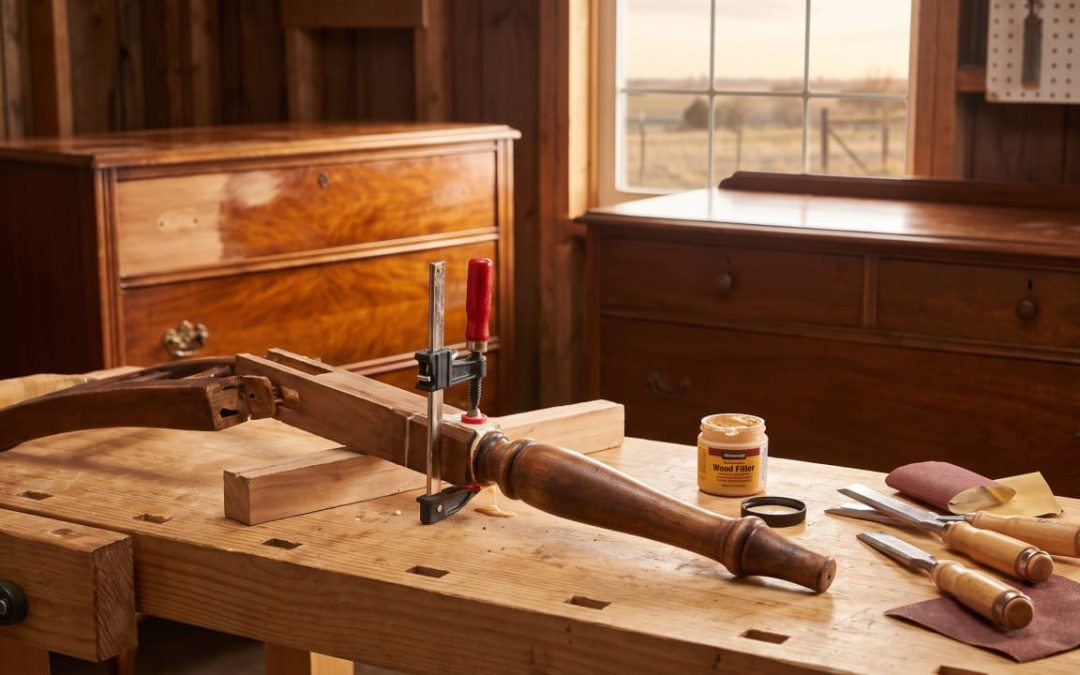
A chair that rocks when you sit down, a dining table with a gouge from a moving box, a dresser drawer that no longer closes square. Most furniture problems announce themselves long before the piece fails, and the owners who act early almost always spend less. If you are searching for wood furniture repair in McKinney, TX, this guide covers the five problems we see most often, what each repair really involves, and how to tell a quick fix from a job that needs a full refinish.
Andrew’s Refinishing has been a family-owned shop since 1980, founded by John and now run by his son Simon, working out of our Carrollton workshop at 2425 Parker Rd. The same craftsmen who handle our furniture repair in Dallas work also take in pieces from McKinney homes, and McKinney is a short drive up US-75 from the shop. Before the five problems, a quick look at why this part of Collin County keeps good furniture in circulation.
Why McKinney Homeowners Repair Instead of Replace
McKinney has a mix of housing that makes repair worth considering. Around the historic downtown square you find homes from the early 1900s with furniture that came with them or was bought to match. In the newer neighborhoods off Eldorado Parkway and Stonebridge Ranch, families are often living with solid wood dining sets and bedroom suites bought a decade ago that still have sound frames. The city’s own official website describes a downtown core built around preservation, and that instinct carries into living rooms too.
Solid wood is the reason repair makes sense. A well-made oak or walnut frame can outlast three or four generations of upholstery and two or three finishes. New furniture at the same weight and joinery costs far more than most people expect, and a lot of what is sold today is built from thin, mass-produced materials with little to restore. When your piece is real wood or a real wood veneer, a repair is usually the better dollar.
There is also the sentimental side. A table that hosted fifteen Thanksgivings is not interchangeable with one from a showroom. We tell customers plainly that the numbers sometimes do not pencil out on paper, and that a piece can still be worth saving because of who sat at it.
Five Wood Furniture Problems Worth Fixing Now
1. Loose joints and wobbly chairs
The most common call we get is a chair that has started to rack. Furniture joints are glued, and over time seasonal movement in the wood breaks that glue line. Once a joint is loose, every time someone sits down the loose tenon grinds against its mortise and the hole gets bigger. Caught early, the fix is clean: we disassemble the joint, remove the old glue, and re-glue it with fresh adhesive and clamps. Caught late, we may need to add a dowel or build up the tenon before it will hold.
Do not squirt glue into a loose joint and call it done. Glue does not bond well to old glue, and a joint that has been glued over several times is much harder to repair properly. We cover the full process in our guide to loose joints and wobbly chair repair. The short version: stop using the chair and bring it to us before the damage spreads to the rails and legs.
2. Deep scratches and gouges
Light surface scratches are one thing. A gouge deep enough to catch a fingernail is another. For deep gouges we fill with a two-part epoxy, shape it to the surrounding surface, and then the repaired area is color matched and blended into the finish. Color matching is done on the actual piece, not from a sample board, because the same stain reads differently on every board in the same table, and it usually takes several test passes to dial in.
A top is the most visible, most-used surface on the piece, and a patch there tends to show in raking light. When the damage is on a table or dresser top, we refinish the whole top so it reads as one surface, with sheen and color consistent end to end. Damage on legs, aprons, doors, and drawer fronts can often be blended without redoing the whole piece.
3. Lifted or missing veneer
Veneer gets a bad reputation it does not deserve. A thin layer of real mahogany, walnut, or burl over a stable core is how a lot of beautiful mid-century and earlier furniture was made, and a large share of the jobs that come through our shop are real wood veneer over particleboard or MDF. When a corner lifts or a section chips away, we can re-adhere it or replace the missing piece and match it to the surrounding grain.
One honest limit: veneer that is bubbling across a whole surface is not something we repair. A photo estimate tells us quickly what kind of surface you have and which repair fits it, so you know where your piece stands before anything is scheduled.
4. Drawers that stick, rack, or fall apart
A drawer that sticks in July and loosens in January is usually telling you about wood movement. Humidity swings in North Texas are real: air conditioning dries a house out in summer, and a wet spring swells wood back up. According to the USDA Forest Products Laboratory, wood continually gains and loses moisture with its environment, and it shrinks and swells as it does. That movement is why drawer fronts separate from sides and glue joints open up.
We repair drawer boxes by re-gluing the dovetails or rabbets, reinforcing corners, and truing the runners so the drawer travels square again. Slides, stops, and alignment are handled as part of the larger repair or refinishing job on the same piece. If a drawer is your only visible issue, send photos anyway, because there is often more going on than the one drawer and we can address it all in one visit to the shop.
5. A finish that has worn through, cracked, or clouded
Heat rings, cloudy patches, dull traffic paths on a dining table, and checking across an older finish all point to a finish that has reached the end of its life. Here a repair turns into a refinish. We remove the old finish with our laser stripper or the chemical overflow method, where stripper flows over the piece as we brush it. For a top-only job we may use a gel stripper so nothing runs down the legs.
After stripping and sanding, we color the wood with a dye and pigment stain system and finish in lacquer for residential furniture. Refinishing jobs start at $600, with a single dining chair typically $275-$375 and a full dining set generally $2,500-$4,000. Our step-by-step refinishing process walks through what happens in each stage of the work.

How to Tell a Repair from a Refinish
People tend to assume the finish is the problem when the structure is, and vice versa. A simple test: if the piece moves, wobbles, or comes apart, it needs structural repair first. If it holds together but looks tired, it needs refinishing. Many pieces need both, and the order matters. Structural work always comes first, because a joint that is repaired after refinishing can crack the new finish.
- Wobble, rocking, or separation: structural repair (re-gluing, dowels, leg or joint repair).
- Gouges and dents on legs or sides: epoxy fill and finish blending.
- Damaged top: a full top refinish so the surface reads as one.
- Cane seat with a broken or sagging weave: cane or rush replacement.
- Worn or cloudy finish overall: strip and refinish in lacquer.
Pieces where water has soaked through the wood are outside what we repair, so tell us about any moisture history when you send photos. If you are unsure which category yours falls into, send photos. It takes a couple of minutes and costs nothing.
What to Expect When You Send a Piece to the Carrollton Workshop
Start with our free online estimate. You upload a few photos, tell us what is wrong, and we respond with a written quote. Basic repairs start at a $125 shop minimum, and anything larger is priced to the specific piece. There is no obligation, and you will know what the job costs before anything leaves your house.
Single pieces typically take 4-6 weeks, sometimes longer when the shop is busy, and the busiest stretches tend to be spring and the weeks before the holidays. Refinishing and repair are done in our own shop by our own craftsmen. If you are on a deadline for a family event, tell us up front and we will give you a realistic answer rather than a hopeful one.
We offer pickup and delivery across DFW, starting around $250 round trip depending on location and job size. That fee is disclosed in the estimate, so there are no surprises. Many customers drop pieces off themselves, and a pickup tends to make more sense for a large dining table or a heavy hutch that is hard to move safely.

Keeping Repaired Furniture Solid After It Goes Home
A good repair is only as good as the environment it returns to. A few habits protect the work, whether it is a re-glued chair or a newly finished table.
- Keep pieces out of direct afternoon sun, which fades stain and dries out glue lines. A sheer shade or a different spot in the room goes a long way.
- Avoid parking a piece directly against a vent or a hot exterior wall. Constant blasts of air accelerate wood movement.
- Use felt pads under lamps and decor, and trivets under anything hot. Lacquer is durable but not heat proof.
- Slide chairs by the seat, not the back rail, when pulling them in and out. Pulling on a rail is how joints get loosened again.
- Wipe up spills promptly and skip silicone sprays, which can complicate any future finish work.
If you own an older home or antique and have any concern about old paint, the EPA’s lead renovation guidance explains why pre-1978 painted surfaces should be handled with care. Painted antiques can carry old lead-based coatings, so ask us before you or a family member sand a painted piece at home.
Antiques, Heirlooms, and the Historic McKinney Home
Antiques deserve a slower approach. The National Park Service’s Preservation Briefs are written for buildings, but the underlying philosophy applies to furniture too: repair what you can before replacing, and respect the original material. We apply the same thinking to an antique chest or a Victorian side table. We keep the original wood, the original joinery, and the original proportions, and repair whatever has failed.
When an antique needs a new finish, we strip it and refinish it in modern lacquer. Lacquer protects far better against heat, water, and everyday scratches, which is why we use it. If a piece has hand-carved details, tell us when you send photos so we can plan the stripping around them.
The Texas Historical Commission works to preserve historic places across the state, and plenty of families in Collin County have a few pieces that deserve the same respect. Our job is to stabilize and refresh them so they can be used for another generation, not to make them look brand new.
Serving McKinney and the Surrounding Collin County Area
We take in work from McKinney homeowners, plus neighboring Allen, Frisco, Plano, Richardson, and Lewisville, as well as the rest of the metroplex. For a full overview of how we handle structural repair, color matching, and finishing, see our page on Dallas furniture repair. For finishing jobs, our furniture refinishing service page covers pricing and scope.
Wood Furniture Repair in McKinney: Frequently Asked Questions
How much does wood furniture repair cost in McKinney, TX?
Basic repairs start at a $125 shop minimum. A single dining chair re-glue usually lands near that range, while larger jobs such as reframing a piece or repairing veneer are priced individually. A free online estimate gives you a written number before you commit.
Can you repair a wobbly dining chair for a McKinney home?
Yes. Loose and racked chairs are some of the most common repairs we do. We take the joints apart, clean out the old glue, and re-glue them, adding dowels or building up tenons when the holes have worn too large.
How long does wood furniture repair take?
Single pieces typically take 4-6 weeks, and sometimes longer during our busiest seasons. Pieces that need only re-gluing may come back sooner, but we quote on the longer end so you can plan.
Do you offer pickup for McKinney customers?
Yes. Pickup and delivery are offered across DFW, starting around $250 round trip depending on location and job size. Many customers also choose to drop their pieces off at our Carrollton workshop.
How do you fix a scratch on my McKinney dining table top?
We refinish the whole top so the color and sheen read as one surface, which is how a scratched or gouged tabletop blends best. Damage on legs, aprons, and sides can be filled with epoxy and the finish blended in place.
Get Your Furniture Looked At Before the Problem Grows
Furniture does not get cheaper to repair the longer you wait. A loose joint becomes a broken rail, a lifted corner becomes a lost section, and a worn finish lets moisture reach bare wood. If something in your home is wobbling, scratched, or sticking, a few photos is all it takes to find out what the repair involves.
McKinney homeowners can request a free online estimate at any time, or call the Carrollton workshop at 214-731-3060. We will tell you honestly what is worth fixing and what is not.