
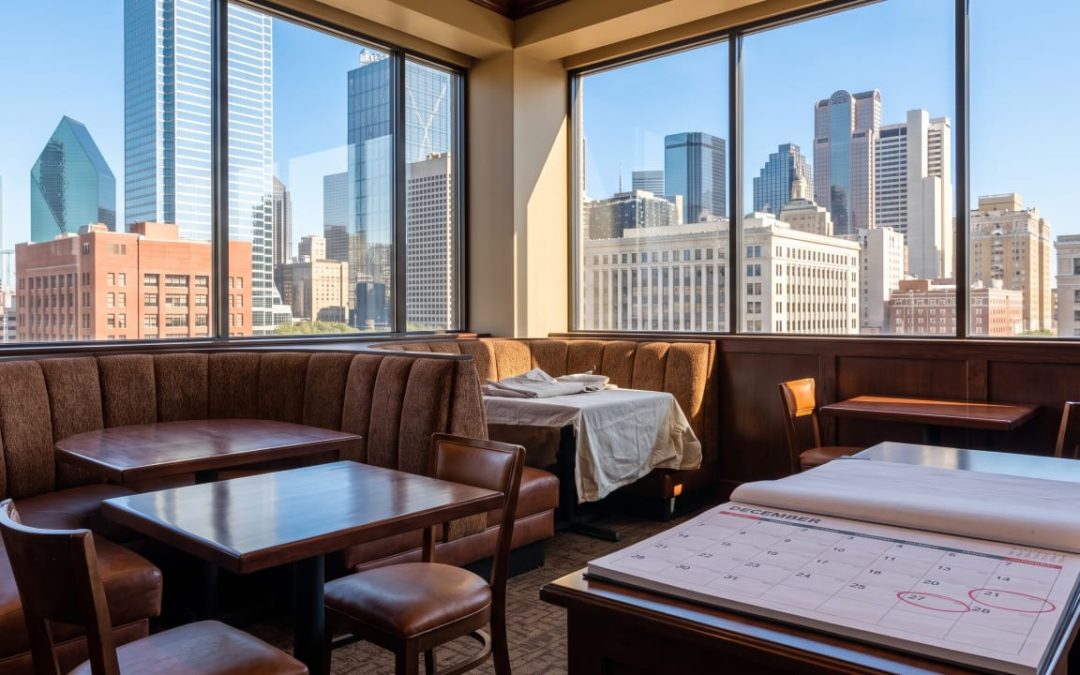
If you run a restaurant, hotel, office, or church, you already know which pieces are tired. The booth by the kitchen door has a split seam. The conference chairs wobble. The lobby console has a ring where a hundred coffee cups sat. The question is not whether to fix them. The question is when, and in what order, so the work does not collide with your busiest weeks.
That is what a year end commercial furniture refresh DFW businesses can actually finish looks like: a plan that starts in the fall, uses your slow stretch, and gets pieces back before the doors need to be fully open again. Our Carrollton shop has handled commercial furniture refinishing and reupholstery across DFW since 1980, and the single biggest thing we see go wrong is not the work. It is the calendar.
A quick, honest note on timing before we go further. Standard refinishing runs about 5-6 weeks, and reupholstery runs 6-12 weeks depending on what is in the shop at the time. Fall is one of our two busiest seasons. If you are reading this in October and want pieces back before the new year, the time to request an estimate is now, not mid-November. We will tell you plainly if a date is not realistic, and we would rather do that than promise a date we cannot keep.
Why Year End Is a Smart Time to Refresh Commercial Furniture
Most hospitality and office operations have a soft spot somewhere between Thanksgiving and mid-January. Restaurants that cater see a dip after the holiday party season (the National Restaurant Association tracks these seasonal swings for the industry). Offices run lighter the last two weeks of December. Churches often have a gap between Advent services and the first Sunday of the new year. Hotels have corporate-travel lulls. Those soft weeks are when a phased furniture rotation causes the least disruption.
There is also a simple psychological reason. A refreshed space opening in January reads as a fresh start to staff and guests. New booth upholstery or restored lobby chairs signal that the place is cared for, and customers notice that more than owners expect.
Then there is the budget calendar. Many owners and facilities managers want spending decisions made before the fiscal year closes. Whether a furniture project counts as a deductible repair or a capitalized improvement is a question for your accountant, and the rules around that are specific. If you want a starting point for the conversation, the IRS explains how depreciation and expensing of business property work in IRS Publication 946. We can provide an itemized estimate and invoice that your bookkeeper can work from, but how any of it applies to your business is a question to take to your accountant.
Restoring Often Beats Replacing for Commercial Pieces
Quality commercial case goods and frames are frequently better built than the replacements available at a similar price. A solid hardwood dining chair with a failing finish and a tired seat can be refinished and reupholstered for a fraction of what a comparable new chair costs, and you keep the construction. That said, we will be straight with you when a frame is truly finished. If a joint has been re-glued three times or a particleboard core has crumbled, we will tell you it is not worth the money.
Who Refreshes at Year End Across DFW, and What They Actually Need
Different businesses have very different year-end problems. Here is what we see most often from the shop floor.
Restaurants and Bars
Booths and banquettes take the worst of it. Foam compresses, seams split, and the upholstery wears along the front edge where people slide in and out. Dining chairs loosen at the joints and the finish wears off the arms and top rail. The usual fix is foam replacement and reupholstery on the seating, with refinishing on the wood chairs and table bases. We walked through how to keep a dining room operating during this work in our guide to phased restaurant booth reupholstery, and the same logic applies anywhere in the metroplex.
Hotels and Extended-Stay Properties
Hotel case goods (headboards, dressers, desks, nightstands) tend to show wear from luggage, cleaning carts, and years of glasses and room-service trays. Refinishing in a durable commercial topcoat brings them back without a full furniture purchase. Property managers typically take a block of rooms out of service at a time. Our write-up on how property managers phase a hotel furniture refresh explains the approach in detail.
Offices and Professional Suites
Executive desks, credenza tops, conference tables, and reception seating are the pieces people see first. Tops show ring marks, heat damage, and scratches. Because we always fully refinish a top rather than spot-treating it, the result is an even surface instead of a patchy one. Upholstered guest and conference chairs can be recovered in a high-wear fabric at a fraction of the replacement cost.
Churches and Institutions
Pews, sanctuary chairs, altar-area furniture, and fellowship hall tables all see steady use and then sit still for long stretches, which is why many congregations plan work around a quiet week. Pew cushions, kneelers, and padded chairs can be rebuilt with new foam and fabric, and wood surfaces can be stripped and refinished. Because these projects often involve dozens of pieces, committee approval and a clear schedule matter as much as the craft.

A Realistic Timeline for a Year End Refresh in DFW
Here is the schedule we would actually put on the wall. The numbers below come from how the shop runs today, and they get longer, not shorter, in the fall.
- Week 1: photos and estimate. Send photos of the pieces through our online form and we respond with a written estimate. You will want a count, rough dimensions, and a note on which pieces are the priority.
- Weeks 1-2: approve, choose fabric, pay the deposit. For upholstery, fabric selection and the deposit happen before pickup, so the material is already on hand when we are ready to start. Fabric is selected from our swatch books (our books come from Greenhouse Fabrics) and ordered, which takes about a week to arrive.
- Weeks 2-3: pickup or drop-off. We offer pickup and delivery across DFW, starting around $250 round trip depending on location and job size. For larger commercial loads, we plan the truck with you in advance.
- Weeks 3-9 and beyond: the work. Standard furniture refinishing is typically 5-6 weeks. Reupholstery is 6-12 weeks depending on workload. Large sets can run longer. We usually stage a project in batches so the first pieces come back while later ones are still in progress.
- Return and install. Pieces come back in the order they were finished, so you can rotate them into service without a long gap.
Do the math from today. A project started with an estimate request in early October can plausibly return the first batch by mid-to-late November and finish before the end of the year, depending on size and fabric. A request made in mid-November is more likely to land in January. That is not a problem if you plan for it, and it is a real problem if you assume a December 20 finish and find out on December 1.
How to Phase the Work So You Stay Open
The most useful thing a commercial customer can do is stop thinking of a refresh as one event. A phased rotation almost always beats a single big drop.
Work in Batches of Pieces, Not Rooms
Pick the group of pieces that hurts the most, send those first, and leave the rest in service. A restaurant might send half its booths first. A hotel might send one floor of case goods. An office might start with the conference room and reception. When the first batch returns, the next goes out. This keeps seating capacity and room inventory above the line that matters to your revenue.
Use Spare or Rotating Inventory
If you have storage chairs, spare tables, or a banquet-room stockpile, rotate them into service while the main pieces are away. It sounds obvious, but we have seen owners skip it and then scramble.
Rank by Visibility and Wear
Start with what guests see and touch most: front-of-house seating, reception furniture, and lobby pieces. Back-of-house and low-traffic pieces can wait for the next slow window.
We have written separately about how a similar plan works for a business near our shop in phased commercial furniture restoration in Addison, if you want to see the sequencing from another angle.

Materials and Finishes That Hold Up in Commercial Settings
Commercial furniture lives a harder life than residential, and the specs reflect it.
Finishes for Commercial Wood
On commercial interior wood we use either polyurethane or pre-catalyzed lacquer, chosen for the piece and how it will be used. Both stand up to cleaning products, spills, and constant contact far better than a decorative residential finish. Before any finish goes on, the old one has to come off. We strip with our laser stripper or a chemical overflow method, where the stripper flows across the piece as we brush. That controlled approach protects the wood and its joints, which matters on commercial pieces that have been refinished before and carry several old coats.
Color Matching Across a Set
When you are refreshing twenty chairs that were not all stained identically to begin with, matching matters. We build color on the actual piece through test passes rather than relying on a sample board, and three to six passes is not unusual to get it right. One real limit: we cannot stain lighter than the natural wood. If you want a lighter color than what the wood allows, we will say so up front.
Fabric: Do Not Shortcut the Rub Count
Fabric durability is usually measured in Martindale rubs, a standard abrasion test explained in more detail in this overview of the Martindale method. For a home sofa in regular use we suggest 30,000 rubs or more, and 50,000 or more for high-traffic rooms. For commercial jobs, we choose fabrics rated at 100,000 rubs or higher. A booth fabric rated for lighter use can look fine at installation and look tired within a season. Choosing the right fabric for a high-traffic Dallas dining room or Plano office lobby costs a little more on the front end and saves a full re-do later.
Flammability is another real consideration for public spaces. Federal rules and local fire codes cover upholstered furniture in different ways, and the U.S. Consumer Product Safety Commission publishes guidance on upholstered furniture flammability. If your venue has specific code requirements, such as for assembly occupancy, tell us when you request your estimate so fabric selection fits them.
Foam is the other half of the booth story. Compressed foam makes a seat look and feel old no matter how new the fabric is. We replace it with standard polyurethane HR foam on loose cushions and on booth and banquette seating. If you are mostly dealing with cushions that can be removed, see our cushion and foam replacement page, and note that for cushion-only work we prefer you drop them off at the shop.
Budgeting a Commercial Refresh: What to Expect
Every commercial job gets its own estimate, because piece counts, sizes, and condition vary so much. Still, a few figures help with early planning.
- Basic repairs start at our $125 shop minimum, and refinishing jobs start at $600.
- A single dining chair refinish typically runs $275-$375, which is a useful reference for restaurant and boardroom chairs before volume pricing.
- Commercial volume pricing applies on jobs of 10 or more pieces.
- If you supply your own fabric, the COM fee is $35 per yard.
- Pickup and delivery starts around $250 round trip and is quoted up front in the estimate.
Treat those as starting points, not quotes. The only way to get a real number is to send photos. One thing worth planning for is that restoring part of a set rarely saves as much as you would expect, because matching a restored piece beside a worn one makes the gap obvious. If budget forces a choice, we usually suggest restoring the most visible group completely rather than spreading the money thin across everything.
How to Start Your Refresh This Month
- Walk the space and list every piece that needs work, with a priority rank.
- Photograph each piece, including close-ups of damage, labels, and any seams or joints that are failing.
- Decide your hard deadline and tell us. We will say honestly whether it is workable and how to batch the work to meet it.
- Identify who approves the estimate and fabric, since delays in sign-off are the most common reason a year-end timeline slips.
- Confirm the fabric and finish early. Fabric orders take about a week to arrive, and the deposit has to be in place before pickup.
Facilities teams who also handle residential-style pieces, such as executive-office sofas, may find our upholstery services page helpful. And if your timeline feels tight, our post on starting fall reupholstery before the holidays covers why early scheduling matters.
Serving Businesses Across the DFW Metroplex
Our workshop is at 2425 Parker Rd., Bldg. 5 in Carrollton, and we work with commercial customers across DFW, including Dallas, Plano, Frisco, Irving, Lewisville, and Fort Worth. Founded by John in 1980 and passed to his son Simon, the shop is still family-owned. Whether your space is a downtown restaurant, a suburban office, or a neighborhood church, the process is the same: photos, estimate, a clear schedule, and honest lead times.
Year End Commercial Furniture Refresh in DFW: Common Questions
How far ahead should I start a year end commercial furniture refresh in DFW?
Ideally eight to twelve weeks before your deadline. Refinishing typically takes 5-6 weeks and reupholstery 6-12 weeks, and fall is one of our busiest seasons. Sending photos in early October gives you the best chance of finishing before the new year.
Can I keep my restaurant open while the furniture is being refreshed?
Yes, if you phase it. Send a batch of booths or chairs first, rotate spare seating in, and bring the next batch when the first returns. We help you plan the batches so seating capacity stays where you need it.
What fabric rating do you use for commercial seating?
On commercial jobs we choose fabrics rated at 100,000 Martindale rubs or higher. That keeps booths and lobby seating looking good through heavy daily use.
Do you offer volume pricing for commercial furniture in the Dallas-Fort Worth area?
Yes. Commercial volume pricing applies on jobs of 10 or more pieces, and every commercial project is quoted individually from photos. Pickup and delivery across DFW starts around $250 round trip.
Can hotels, churches, and offices use you, or only restaurants?
All of them. We refinish and reupholster furniture for restaurants, hotels, offices, churches, and other institutions. Request an estimate with photos and a piece count.
Ready to Plan Your Refresh?
A year end refresh does not have to be a scramble. Pick your priority pieces, send photos, and work backward from your real deadline. DFW business owners can request a free online estimate or call 214-731-3060 and we will tell you, honestly, what can be done and when.